
Google’s Search Generative Experience (SGE) – now largely known as AI Overviews and AI Mode – is Google’s shift from “10 blue links” to AI-generated answers directly in the search results. It changes how users search, how information appears on Google, and how businesses need to think about SEO and visibility in 2026.
Today we take a deep dive on how Google SGE has developed, how good it is, and how this impacts businesses in their endeavour to get discovered online to generate sales and enquiries.
What is Google SGE and why was it created?
Google SGE stands for Search Generative Experience and was created to integrate generative AI directly into Google Search so users get AI-written answers instead of just a list of links. Announced at Google I/O in May 2023 and now rebranded as AI Overviews, it was Google’s response to competition from tools like ChatGPT, Bing Chat and Perplexity AI. The core aim is to reduce user effort by synthesising information from multiple sources into one overview, especially for complex or multi-step queries. It is powered by customised Gemini models that combine advanced reasoning, multimodality (text, images, etc.) and real-time grounding in search results. Google reports that this AI-led format has already been used billions of times and has increased search frequency and user satisfaction.
What are the key features of Google SGE / AI Overviews?
Google SGE / AI Overviews provides an AI-generated summary box at the top of search results that answers the query in natural language with bullet points and citations to sources. It can handle text, images, voice and even documents, particularly in AI Mode, which became more widely available in 2025. Users can continue the conversation with follow-up questions, making search feel more like chatting with an assistant than typing isolated queries. Behind the scenes, Google’s systems can fan out a query into up to 16 sub-queries to build a richer, multi-layered response. A separate AI Mode tab removes traditional blue links entirely and focuses on deep, conversational exploration of a topic.
How does Google SGE differ from traditional Google Search?
Google SGE differs from traditional search because it leads with a generated answer instead of a ranked list of blue links. Rather than extracting snippets, it synthesises and rewrites information from multiple sources using Gemini-based models. The interface shifts organic results further down the page and, in AI Mode, removes them altogether in favour of a purely AI-driven conversation. It is built for longer, more complex, “ask anything” queries, while classic search was optimised for short, keyword-based searches. This helps users get faster answers but also reduces click-through to publishers’ sites, which many critics see as harmful to the open web.
What impact does Google SGE have on SEO and businesses?
Google SGE and AI Overviews have significantly reduced organic click-through rates and traffic for many sites, even when they still rank highly. Some studies report organic CTR drops of around 61% when AI Overviews appear, with top pages losing roughly a third of their clicks. Overall, sites in affected niches have seen Google traffic declines in the 20–60% range, and publishers report notable revenue impacts. Only about 1% of users click the links cited inside AI Overviews and 8% click the results below, compared to 15% when AI Overviews are absent. As AI Mode grows, many businesses are being forced to pivot towards AI-focused optimisation, diversification beyond Google, and stronger E‑E‑A‑T (Experience, Expertise, Authoritativeness, Trustworthiness).
How often do AI Overviews give wrong or misleading answers?
AI Overviews do not have a published, global error rate, but independent tests show accuracy varies from low error rates in benchmarks to much higher issues in the real world. Google claims most AI Overviews are as accurate as existing features like featured snippets and that serious policy violations are extremely rare (less than 1 in 7 million queries). Benchmark tests on Gemini variants show very low hallucination rates in controlled conditions, such as around 0.7% on some factual consistency benchmarks. However, external studies have found much higher hallucination rates in news and citation tasks, with some evaluations reporting error rates above 70% for certain Gemini use cases. Journalistic and anecdotal testing often finds that roughly 1 in 5 AI Overviews can be inaccurate or misleading in practice, especially on complex or ambiguous topics.
Why is Google’s AI Overview sometimes confidently incorrect on basic facts?
AI Overviews can be confidently wrong because the underlying large language models are designed to produce fluent, plausible text, not to “know” truth in a human sense. These models predict the next token based on patterns in training data and can fabricate details when information is sparse, out-of-date or conflicting. They are also fine-tuned to sound helpful and authoritative, which reduces hedging language and makes errors feel more convincing. Errors often occur on time-sensitive questions, current events or unusual fact queries, where the model may rely on outdated or niche sources. Google has tried to reduce this by grounding answers more tightly in search results and improving recency filters, but critics note that hallucinations remain an ongoing issue.
Are AI Overviews dangerous for YMYL topics like health, finance or safety?
Yes, AI Overviews can be risky for YMYL (Your Money or Your Life) topics because incorrect answers may lead to harmful decisions. Investigations have found examples of AI Overviews giving poor or misleading medical advice, such as recommending dietary restrictions that contradict expert guidance for cancer patients. In some cases, health information has been presented without critical context about age, sex or geography, potentially downplaying serious conditions. Mental health queries have also surfaced advice described by experts as “very dangerous” and capable of discouraging people from seeking professional help. Although Google has removed AI Overviews for certain sensitive queries and emphasises clinician input, YMYL topics still show high AI Overview trigger rates – over 44% for medical queries in some studies.
How much traffic loss are sites seeing from AI Overviews in 2026?
By early 2026, many publishers and informational sites are reporting substantial traffic losses attributed to AI Overviews and AI Mode. Global publisher traffic from Google dropped around 33% between November 2024 and November 2025, with US publishers seeing falls closer to 38%. Surveys suggest news publishers expect an average 43% drop in search referrals by 2029, with some anticipating losses above 75%. Organic CTR for queries with AI Overviews has fallen from roughly 1.76 to 0.61 over 15 months, with no signs of recovery. These declines are especially severe for high-funnel informational content, where AI summaries satisfy most user needs on the results page.
Why is my organic CTR dropping even when I rank #1?
Organic CTR is dropping even at #1 because AI Overviews and other SERP features now sit above traditional organic results and absorb user attention. When AI Overviews appear, clicks on top organic listings can fall by roughly 32–46%, and users end sessions on Google more often instead of visiting sites. Even queries without AI Overviews have seen CTR declines, likely because users increasingly rely on AI assistants or social platforms rather than clicking search results. Only a tiny fraction of users click AI Overview citations and fewer click the organic results below, further depressing traffic. Long-term tracking shows CTRs at multi-year lows, with top-ranked pages losing 25–35 clicks per affected query on average.
How can brands or sites get cited in AI Overviews – and why aren’t we showing up?
Brands can increase their chances of being cited through AI SEO services. This includes building strong E‑E‑A‑T signals and publishing clear, structured, evidence-backed content that is easy for AI to extract. AI Overviews tend to favour authoritative, fresh pages with expert authorship, transparent sourcing, and well-marked structures like headings, lists and tables. Adding schema markup (FAQPage, HowTo, Article, Product, Organisation) and ensuring technical crawlability and up-to-date content also helps. However, competition is intense: high-authority domains such as Reddit, YouTube and Wikipedia capture a large share of citations. Studies suggest citations can boost organic clicks by around 35% when achieved, so focusing on niche expertise and distinct insights is often more effective than chasing broad, generic topics.
Is zero-click search the new normal because of AI Overviews?
Yes, zero-click search has effectively become the norm and AI Overviews are a major driver of this shift. Around 58–60% of Google searches now end without a click, and for AI Overview queries, zero-click rates are typically in the 38–45% range. In AI Mode, which is purely conversational, up to 93% of sessions end without any website visit at all. When AI Overviews appear, users end sessions more often and click fewer traditional results than when those AI boxes are absent. Forecasts suggest zero-click behaviour could exceed 70% in some verticals by late 2026, particularly for quick, informational queries.
What happens to SEO if users never click through anymore?
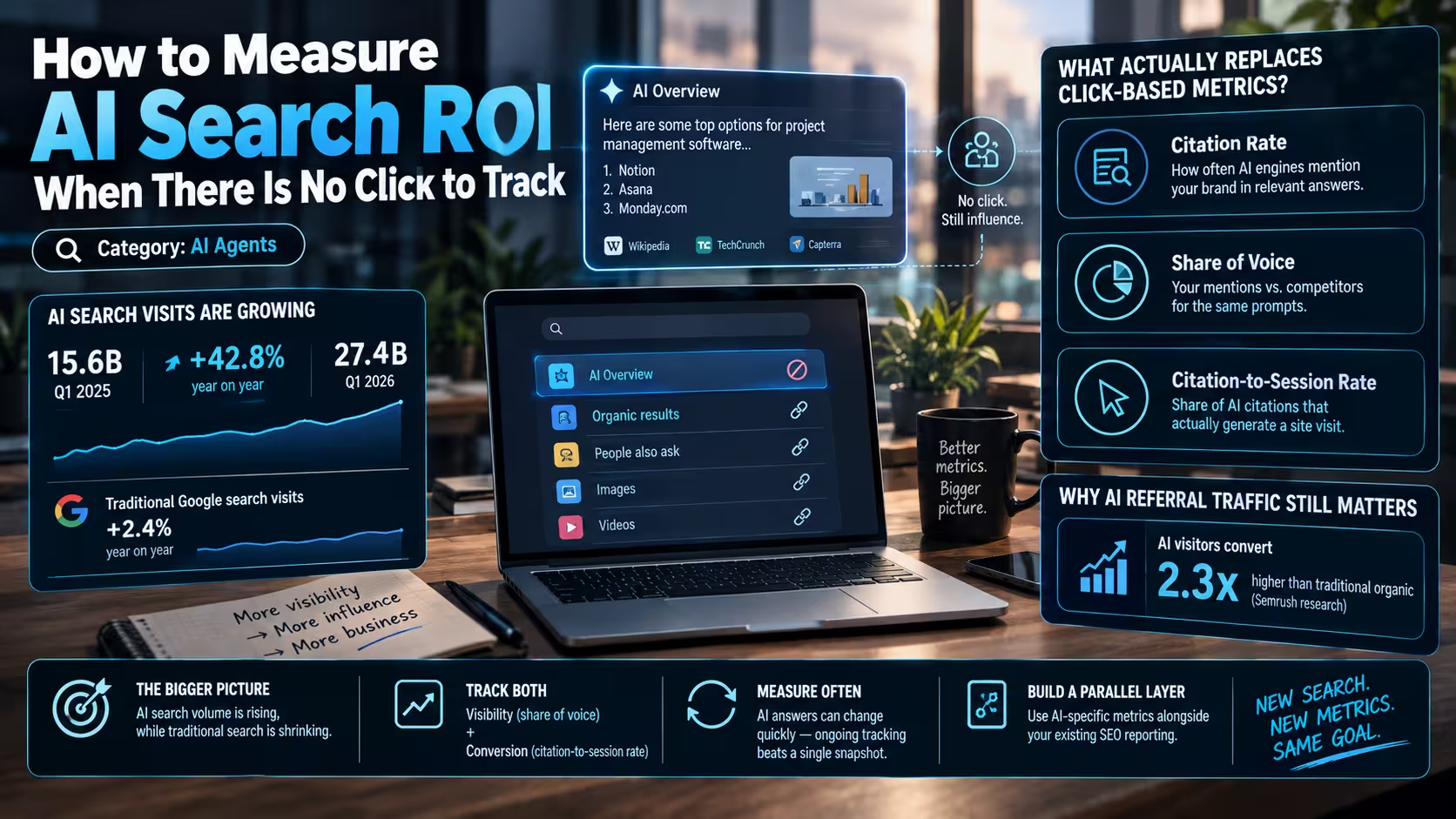
If users rarely click through, SEO becomes less about driving sheer traffic volume and more about visibility, brand authority and influence within AI answers. Success metrics shift from CTR and sessions towards impressions in AI Overviews, citation frequency, share of voice and branded search uplift. Being cited in AI answers can still drive high-intent visits and conversions, even if overall clicks fall. At the same time, publishers face serious business risks: projected traffic drops of 33–43% threaten ad-funded and affiliate-based models. SEO is evolving into “Search Everywhere Optimisation” across Google, AI assistants, social platforms and vertical search, with a premium on human-centred, original content.
How do you optimise content for AI Overviews and AI Mode in 2026?
Optimising for AI Overviews and AI Mode means practising Generative Engine Optimisation (GEO), making your content citable, trustworthy and easy to summarise. Prioritise E‑E‑A‑T by using clear authorship, expert credentials, primary sources, and transparent about/contact information. Structure content with question-based headings, concise paragraphs, bullet points, numbered steps and tables, and give direct answers early in each section. Add specific data, statistics, case studies and concrete examples, all properly sourced, as AI favours content with measurable details. Use appropriate schema, maintain technical health, update content regularly and test queries in AI Mode to see which competitors are being cited.
Does traditional keyword ranking still matter, or should we focus on AI citations?
Traditional keyword rankings still matter as a foundation, but AI citations are becoming just as important – and sometimes more valuable. Most AI Overview citations still come from pages that rank in the top 10, so strong organic SEO supports AI visibility. However, in many SERPs, being cited in the AI box delivers more exposure than being the #1 organic link below it. Zero-click trends mean rankings alone no longer guarantee traffic or ROI, especially for informational queries. A hybrid strategy works best: maintain keyword and technical SEO while optimising content formats and authority signals to maximise AI citations.
What page types and formats get cited most in AI Overviews?
AI Overviews favour clear, structured formats such as how-to guides, lists, FAQs and comparison tables. Step-by-step tutorials with numbered instructions and HowTo schema are frequently pulled into AI responses. Pages rich in bullet points, short definitions and concise explanations are easily extractable and therefore more likely to be used. FAQ sections with direct, standalone answers – particularly when marked up with FAQPage schema – are strong citation candidates. Data-heavy pages with tables, statistics and well-attributed figures also perform well, especially as most AI Overview responses average around 157 words.
Should we block or allow Google-Extended for AI training and grounding?
In most cases, allowing Google-Extended is advisable if you want maximum visibility in AI experiences beyond core search. Google-Extended is a robots.txt directive that controls whether content can be used to train and ground Gemini-powered products outside standard search. Blocking it does not stop indexing, ranking or inclusion in AI Overviews, because those use Googlebot and the regular search index. Allowing Google-Extended can improve your odds of being surfaced in Gemini chats and other AI products, but it also means accepting broader AI use of your content. Blocking may suit sites with strict IP or privacy concerns, but there is no SEO penalty either way.
How can we track and report AI Overview visibility and citations for clients?
Tracking AI visibility now requires tools that monitor brand mentions and citations inside AI search results and chatbots. Platforms like Semrush’s AI Visibility Toolkit and Ahrefs’ Brand Radar provide metrics on citations, sentiment and share of voice across AI Overviews and conversational AI tools. Other tools such as Profound, Otterly and Promptmonitor offer URL-level tracking, brand indices and GEO-focused reporting. Agencies also use manual checks – querying key terms in AI Mode, taking screenshots and correlating with Google Search Console data – to spot trends. Reporting typically combines citation counts, AI share of voice, sentiment and conversion performance from AI-driven traffic.
What’s the difference between AI Overviews and AI Mode?
AI Overviews are short, automatically triggered summaries that appear within the standard search results page, while AI Mode is a separate, conversational tab with no traditional blue links. AI Overviews aim to give quick at-a-glance answers with bullet points and citations, keeping organic results visible beneath. AI Mode behaves more like ChatGPT, offering longer responses, follow-up questions, multimodal input and advanced features like fan-out querying. Use cases differ: AI Overviews suit quick information needs, while AI Mode supports deeper research, planning and multi-step tasks. For publishers, AI Mode is more disruptive because it keeps users in a closed AI environment and further reduces click opportunities.
How has SGE / AI Overviews evolved from 2024–2025 to now in 2026?
SGE began as an opt-in experiment in 2023 and has since become a default, global feature of Google Search. In May 2024 it was rebranded as AI Overviews and rolled out widely in the US, later expanding to around 100 countries with growing ad integration. AI Mode was introduced in 2025 as a dedicated conversational tab and expanded globally, adding features like planning, reservations and multimodal search. Trigger rates for AI Overviews have grown significantly, reaching about 60% of US searches by late 2025 in some datasets. Model upgrades – including newer Gemini generations – have improved reasoning and multimodality, but concerns about traffic loss and errors persist.
Why does Google use different Gemini models for simple vs complex queries?
Google uses different Gemini variants to balance speed, cost and capability across the huge range of queries it serves. Lighter models such as Gemini Flash handle simple, high-volume queries where latency and efficiency are critical. More powerful models like Gemini Pro or Ultra (and newer 3.x versions) are reserved for complex, multi-step or high-stakes queries that need deeper reasoning. Query understanding systems route each search to an appropriate model based on difficulty and intent. This layered approach keeps everyday search fast while allowing AI Mode and advanced features to use frontier models for richer, more accurate responses.
Will AI Overviews kill traditional SEO or create new opportunities?
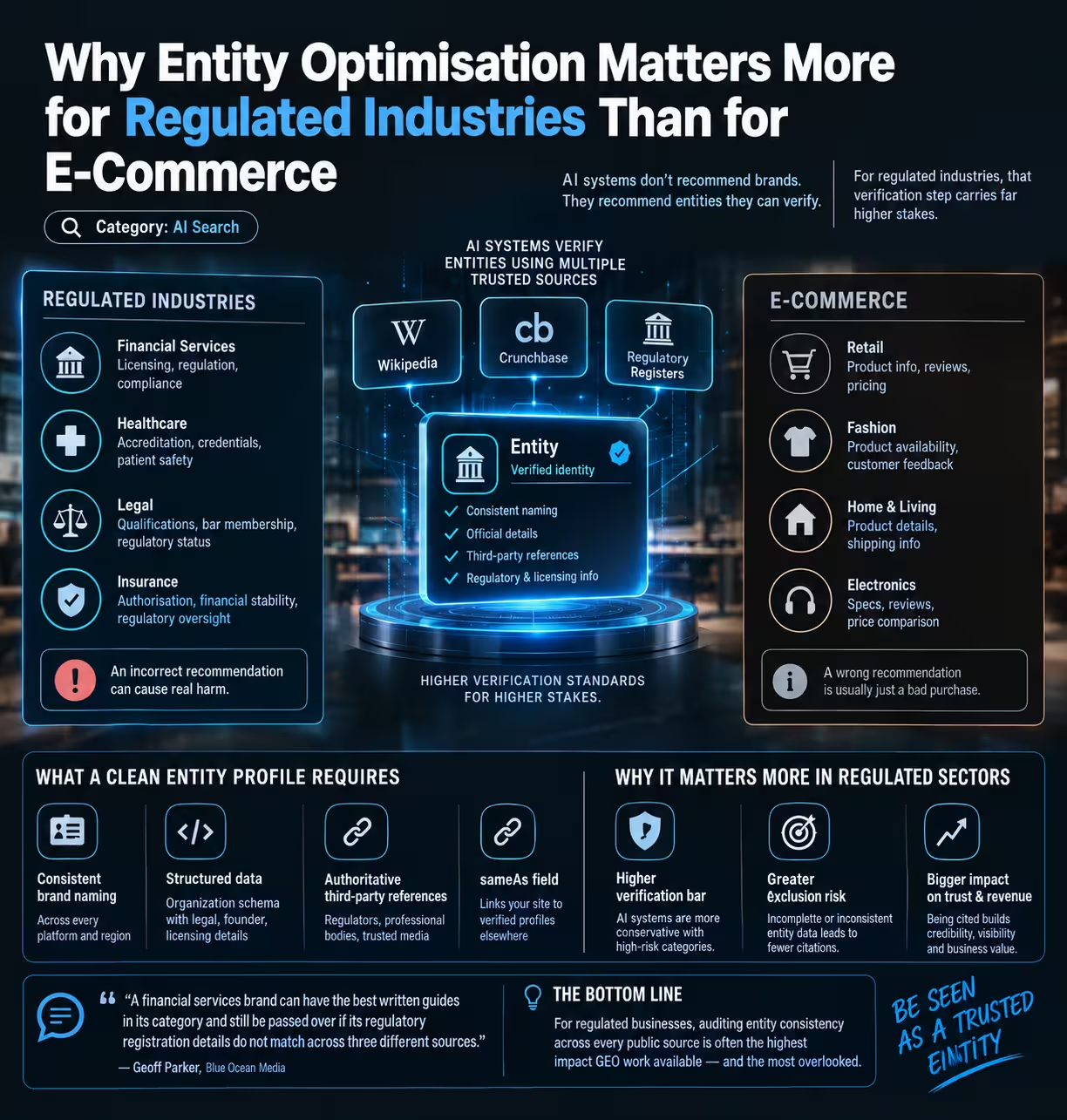
AI Overviews will not kill SEO, but they are forcing it to transform from rank-chasing to entity and authority building. Traffic and CTR declines are real, particularly for sites reliant on high-volume informational queries. However, experts highlight that being cited in AI answers and building strong brand entities can create higher-quality, better-converting traffic. SEO is expanding into GEO (Generative Engine Optimisation), AI citation strategies and multi-platform presence across Google, YouTube, Reddit, TikTok and AI assistants. Practitioners who adapt to this broader, AI-centric definition of SEO are expected to thrive, while low-effort content strategies fade.
Why can’t we turn off AI Overviews – why are they forced on some searches?
Users currently cannot fully disable AI Overviews in standard Google Search, as the feature is now baked into the core experience. Google views AI Overviews and AI Mode as strategic essentials for competing with other AI search tools and improving user satisfaction. The old opt-in Labs switch no longer controls mainstream AI Overviews, and there is no global “off” toggle in settings. Workarounds such as using special URL parameters (like udm=14), browser extensions that hide AI boxes, or alternative search engines can reduce or bypass AI Overviews. Despite feedback and frustration from some users and publishers, Google is focused on refining AI answers rather than offering a full opt-out.