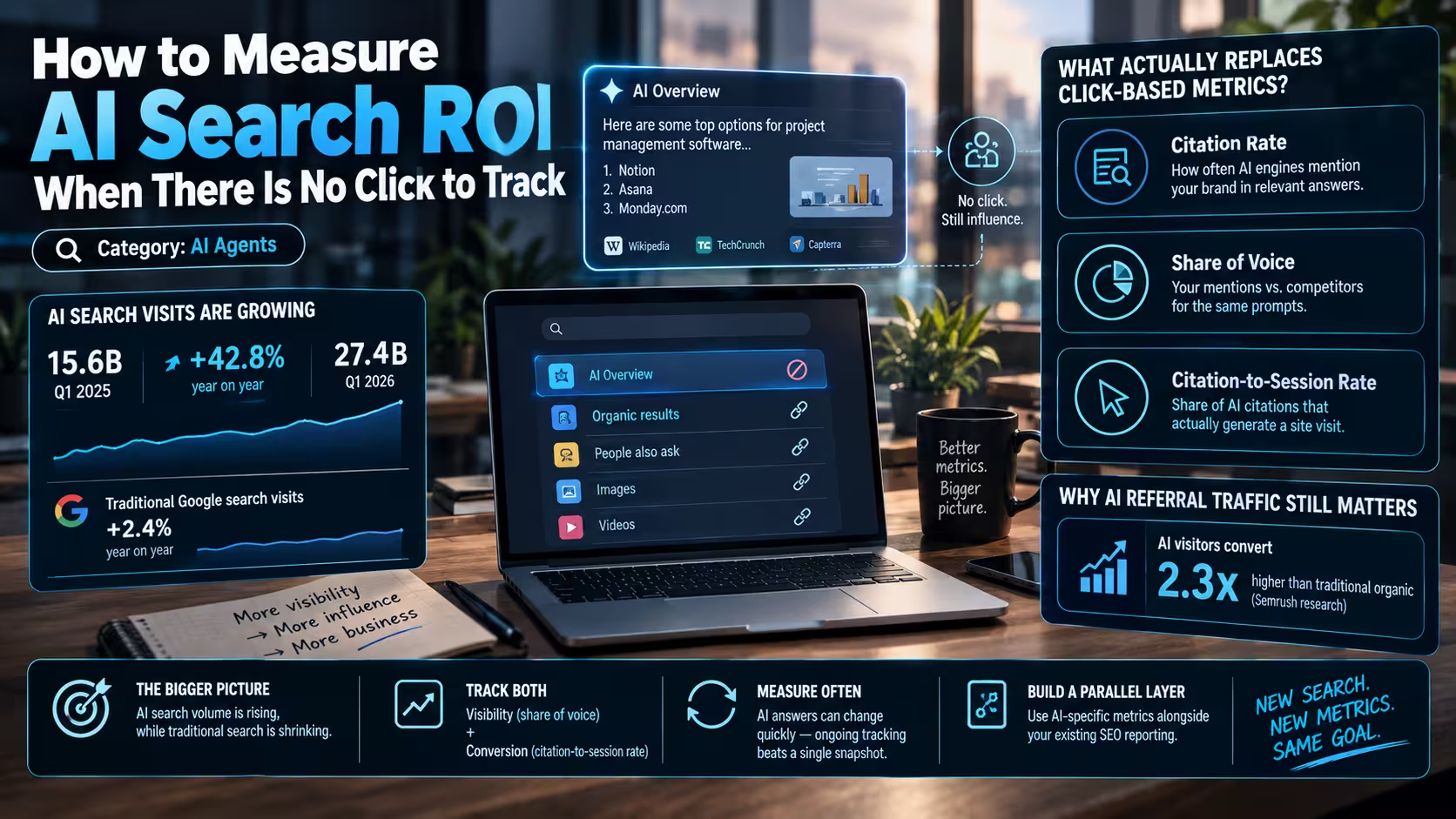

AI search visits grew 42.8% year on year, from 15.6 billion in the first quarter of 2025 to 27.4 billion in the first quarter of 2026, while traditional Google search visits grew just 2.4% over the same period (industry tracking data, 2026). A measurement framework still built entirely around Search Console clicks is reporting a shrinking channel while missing the one that is actually expanding fastest.
This article sets out how to measure AI Agents performance when a growing share of AI answers never produce a click at all, and which metrics actually replace the ones that traditional SEO reporting has relied on.
Why Click Based Metrics Miss Most of What Is Happening
Pew Research has found that only around 8% of users click any link at all when an AI summary appears above the results, and separate research puts the zero-click rate on Google specifically above 58%. That means the overwhelming majority of AI-mediated influence on a buying decision now happens inside the answer itself, somewhere a click-based reporting stack simply cannot see.
Traditional search volume itself is expected to fall by around a quarter by the end of 2026 as buyers shift queries to AI chatbots and assistants directly, according to Gartner forecasting. A reporting stack built to track that shrinking channel, without a parallel framework for the AI-native one replacing it, will systematically understate a brand’s actual visibility performance.
What Replaces the Old SEO Scoreboard
Citation rate, how often AI engines mention a brand across a defined set of buyer-intent prompts, is the closest equivalent to a keyword ranking. Share of voice, a brand’s mentions against competitors’ mentions for the same prompt set, is the closest equivalent to market share. Neither metric depends on a user clicking anything, since both are measured by directly querying the AI systems themselves rather than waiting for referral traffic to show up in analytics.
Why AI Referred Traffic Still Matters Despite Being Smaller
The traffic that does convert from AI answers is worth tracking closely even though it represents a small share of total volume, since AI-sourced visitors have been shown to convert at meaningfully higher rates than traditional organic traffic, roughly 2.3 times higher according to Semrush research. A smaller but higher-converting channel changes the ROI calculation considerably compared to treating AI referral traffic as simply a shrunken version of organic search.
Citation-to-session rate, the share of AI citations that actually generate a site visit, is the metric that connects the two worlds, showing whether growing visibility inside AI answers is translating into any traffic at all, even a small volume of it. Tracking that rate alongside share of voice gives a fuller picture than either metric alone, since a brand can have strong share of voice with poor citation-to-session conversion if its cited content does not give a reader a clear reason to click through.
What Is Being Said About GEO Measurement Right Now
Industry consensus has moved decisively towards treating competitive share of voice as the headline metric boards actually want to see, since it answers the specific business question, are we being recommended more or less often than our competitors, rather than an abstract visibility score. A parallel discussion has focused on measurement frequency, since AI answers can shift meaningfully between one query cycle and the next, making a single snapshot measurement far less reliable than ongoing tracking across a consistent prompt set.
Only 8% of Users Click a Link When an AI Summary Appears
Geoff Parker of Blue Ocean Media says the businesses getting GEO measurement right have stopped trying to force AI search into their existing analytics dashboard. “Clients keep asking us to show AI search performance inside the same reports they have always used, and the honest answer is that those reports were built for a click-based world that AI search does not operate in,” Parker says. “Share of voice and citation rate are not consolation metrics, they are the more accurate picture of what is actually happening to a brand’s visibility right now.”
For any business trying to prove AI search ROI to a board still expecting click-based numbers, the practical fix is building a parallel reporting layer around citation rate and share of voice from the outset, rather than trying to force AI search performance into a framework designed for a different kind of search entirely.