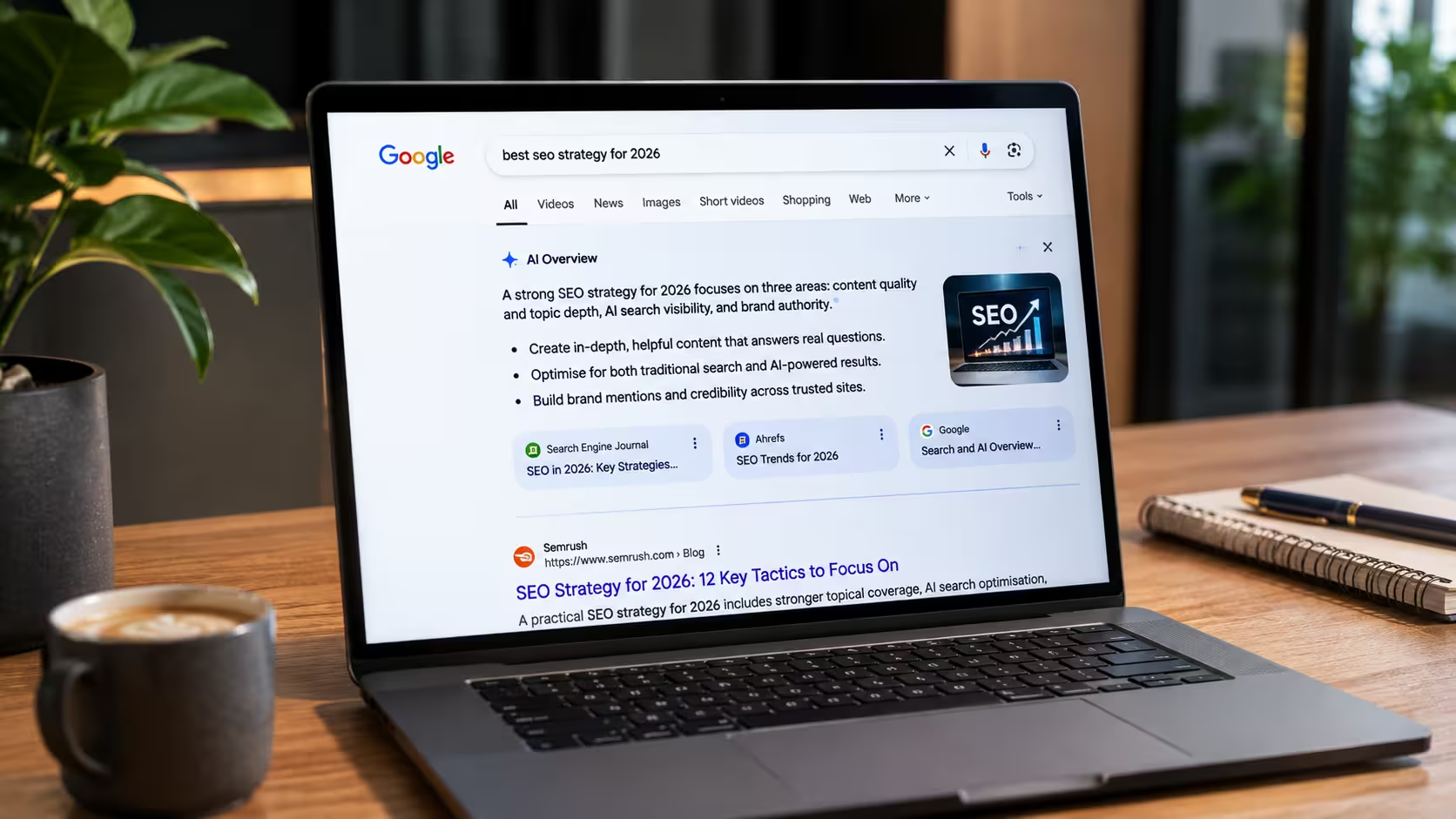

When an AI Overview appears above a search result, the top ranking page receives 58% fewer clicks on average, according to Ahrefs research published in February 2026. On 15 October 2026, Google announced a test that could change who gets the clicks that remain. AI Search will trial a dedicated section at the top of some AI answers, featuring what Google calls the one or two official places on the web to complete a specific task, with a short note explaining why each link is useful.
We have spent the past fortnight examining Google’s announcement, the early independent tests and the reaction from the search industry, and the picture is less straightforward than “more links, more traffic”. The test could reward brands that are clearly identifiable as the source of truth for their own products and services, while squeezing the publishers and comparison sites that currently sit between a question and an answer. This article explains what Google is testing, who stands to gain and lose, what is still unknown, and what businesses should do now to be recognised as the official destination for their own tasks.
What Is Google Testing in AI Answers?
Google is testing a new section at the top of some AI Search responses that highlights official websites for completing a task. Hema Budaraju, vice president of product management at Google, wrote that in some cases there are “only one or two official places on the web” to get something done, and that AI Search will prominently surface those links in a dedicated section, with context about why each is relevant.
The test was one of five changes announced together. Google also said it has made continued and substantial increases to inline links within AI answers, and that these links now appear higher in responses more often. It is making the related links at the end of some answers more visual, with image thumbnails. It is expanding news carousels and its Preferred Sources feature to more locations and languages. And it is testing clickable creator and publisher names on video results in AI Mode.
The official site section is explicitly a test. Google has not said how many users will see it, which markets are included, which queries trigger it or when, if ever, it will roll out more widely.
What Counts as an Official Site?
Google has not published a definition of an official site. Its announcement describes the test as an extension of how it already places a site front and centre when people search for a specific destination, which suggests the feature is designed around tasks rather than topics.
Coverage of the announcement has given examples such as a product’s help article, a sign up page or a pricing page for a software company, a service’s own documentation or a company’s account page. In each case, the official source is the organisation that actually provides the thing the searcher wants to do.
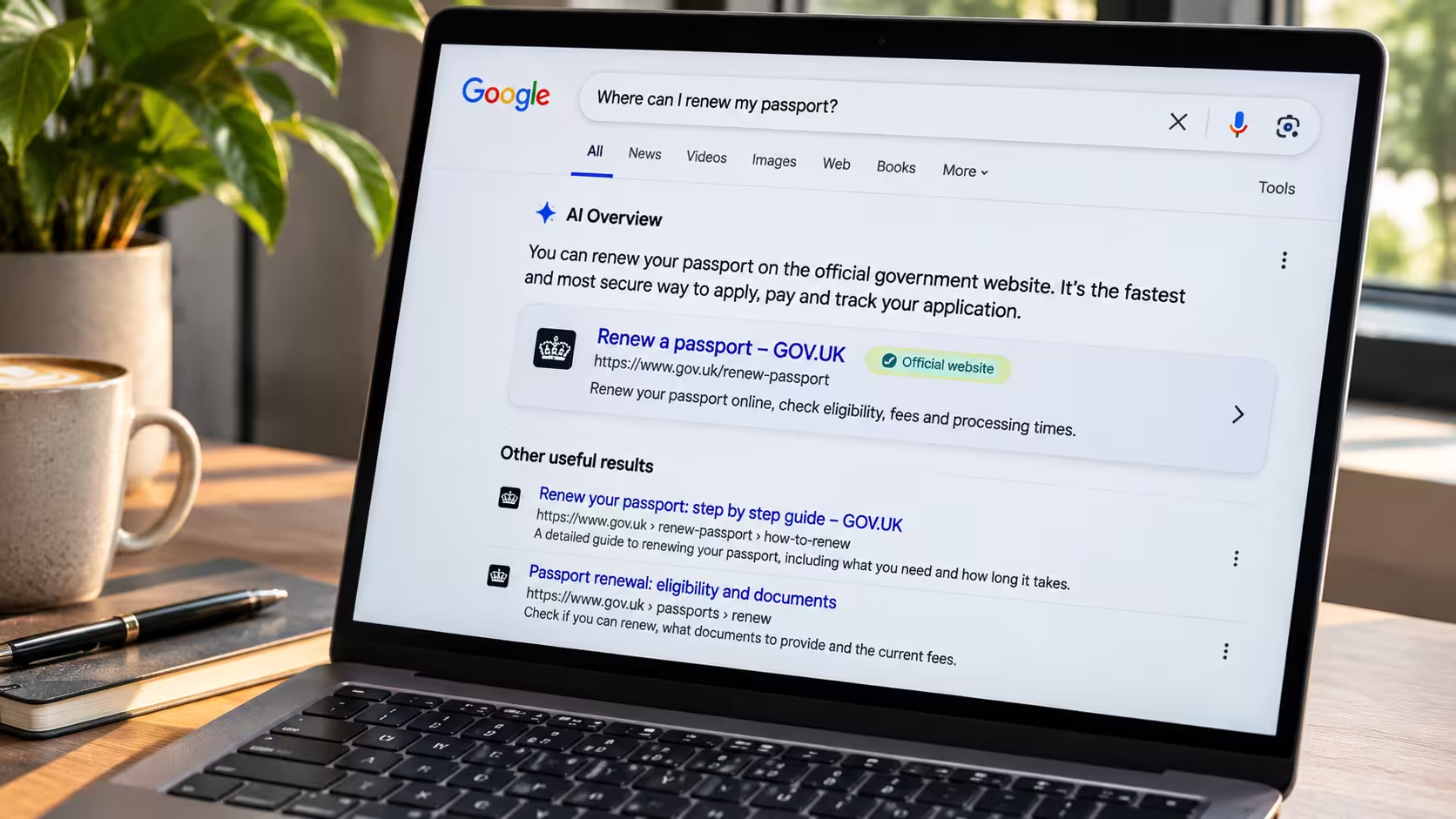
That distinction matters. An official site is not simply the most authoritative page on a topic. A detailed independent guide to renewing a passport may be more helpful than a government page, but only one of them is the place where the passport is actually renewed.
For businesses, the implication is clear. The pages most likely to be treated as official are the ones that complete a task, such as signing up, booking, paying, logging in or getting support, and they belong to the organisation that owns the product or service.
There is also a consumer protection case for the feature. UK shoppers have long been targeted by copycat websites that mimic official services, such as passport renewals, driving licence applications or health insurance cards, and charge unnecessary fees. A clearly labelled official section at the top of an AI answer could make it harder for those sites to intercept searchers, provided Google identifies the genuine destination correctly. Getting that wrong would carry real consequences, which may be one reason the feature remains a cautious test.
Why Is Google Adding More Links Now?
Google is adding more links because the pressure to show that AI answers still send traffic to the web has rarely been greater. A randomised study of 1,065 people in the US found that AI Overviews reduced outbound organic clicks by 39.8% and increased searches that ended without a click by 34.5%. Ahrefs found that the reduction in click through rate for top ranking pages had grown from 34.5% in April 2025 to 58% by February 2026.
The scale of the shift is enormous. AI Mode passed one billion monthly users by May 2026, and AI Overviews reportedly reach more than 2.5 billion. Every change to how those answers link out affects traffic across the web.
Regulation is adding to the pressure. In June 2026, the UK’s Competition and Markets Authority imposed a conduct requirement on Google that obliges it to give publishers effective controls over how their content is used in AI search, effective attribution through links, and publisher specific data on impressions and clicks from its AI features.
That last requirement is significant, because Google still does not publish click data for its AI answers. Its October announcement described more links, but did not include figures showing that those links generate more visits.
Who Wins and Who Loses from an Official Slot?
The clearest winners would be organisations that own the task a searcher wants to complete. Software companies, banks, utilities, retailers, airlines, public bodies and service businesses could all benefit if Google sends task based queries directly to their sign up, booking or support pages.
The likely losers are intermediaries. Affiliate sites, comparison platforms, how to guides and publishers that rank by explaining processes have long captured traffic for queries where the searcher ultimately wanted to reach an official destination. If an AI answer explains the process and then places the official link at the top, the intermediary step disappears.
This is the contrarian point that most coverage has missed. The test is being presented as a win for the open web because it adds links. In practice, it may concentrate clicks on fewer, larger destinations, and reduce the value of content that sits between a question and an answer.
For businesses that have built their visibility on informational content alone, the lesson is uncomfortable. Being the best explainer may matter less than being the official source.
Has Anyone Seen the Official Slot Yet?
Not reliably. The day after the announcement, Flying Cat tested seven task based prompts for business software products in AI Mode and found the official site section in none of them.
The same test offered a useful insight into how AI Mode currently links to brands. Across the seven answers, 27 inline links appeared, and 13 pointed to the product company’s own website. However, nine of those opened a homepage rather than the specific page needed to complete the task, and in three answers the relevant help page appeared only as a small source chip.
For a free trial prompt, three of the four inline links did open the vendor’s own trial, demo or access pages. That suggests AI Mode can already identify task pages when they are clear and well labelled, even without the new section.
The practical conclusion is that the official slot is not yet a reliable source of traffic. But the underlying behaviour, sending users to the brand’s own task pages, is already visible, and the test indicates where Google intends to take it.
5 Signals That Could Mark a Site as Official
Google has not said how it will choose official sites, and no technical change can guarantee inclusion in an experiment. But the logic of the test points to five signals that are likely to matter.
The first is clear entity identity. Search systems need to understand that a website belongs to a specific organisation, product or service, which is why consistent naming, contact details and descriptions across the web are increasingly important. This is the foundation of what is often called entity optimisation.
The second is dedicated task pages. A separate, clearly titled page for each key task, such as pricing, sign up, booking, support or cancellation, is far easier for an AI system to recognise than a single page that tries to do everything.
The third is accurate structured data. Organisation, product and service markup does not buy placement, but it helps search systems connect pages to the entity they represent and understand what each page does.
The fourth is consistency between sources. When a business’s own website, its Google Business Profile, directories and authoritative third party mentions all agree, it becomes easier for an AI system to treat that site as the definitive source.
The fifth is freshness. Official pages that are out of date, such as old pricing, closed services or broken sign up flows, undermine trust and give AI systems a reason to look elsewhere.
None of these is new. What has changed is the reward. Brands that already invest in AI search optimisation, focused on clarity of entity and task, are best placed if the test expands.
What Is the Search Industry Saying Online?
Online discussion among search marketers has been marked by scepticism. The most common reaction is that more links are welcome, but that Google’s claims about traffic cannot be verified without click data.
Publishers have been particularly critical. Many see the official site section as another way for Google to answer questions and send users to a final destination without passing through the sites that explain the process. Questions about how Google will define official, and whether large brands will be favoured over smaller ones, recur frequently.
At the same time, B2B and software marketers have shown more interest. For companies whose visibility depends on getting users to sign up, book or log in, the test is seen as a potential opportunity, provided their task pages are clear and well structured.
There is also growing awareness that AI search is moving from answering questions to completing tasks. The same logic that underpins the official slot is driving interest in AI agents that can book, buy or apply on a user’s behalf, which will rely on knowing where the official place to complete a task actually is.
AI Overviews Cut Top Page Clicks by 58% Before Google Added More Links
Ahrefs measured a 58% drop in clicks for top ranking pages when an AI Overview appeared, and Google’s new official slot is its latest attempt to show that AI answers can still send traffic to the right places. Whether it does so will depend on how Google defines official, and on data it has not yet published.
Geoff Parker, Managing Director of Blue Ocean Media, said: “The official site test tells us exactly where AI search is heading. Google is trying to send people to the place where a task actually gets done, not to the page that explains it best. For businesses, that means the priority is to be unmistakably recognised as the source of truth for your own products and services. Clear task pages, consistent entity information and accurate data matter more than another blog post.”
If your business depends on people finding you to buy, book, sign up or get support, now is the time to review whether each of those tasks has a clear, dedicated page, whether your organisation is described consistently across the web, and whether AI systems can tell that your site is the official source. The test may still be small, but the direction is clear, and the businesses that prepare now will be the ones AI answers point to first.