

SEO is no longer just about ranking top of 10 blue links on a page.
Google, Bing and emerging AI-powered search engines now use machine learning, entity understanding and generative systems to interpret queries, summarise content and recommend brands. Traditional SEO tactics alone are no longer enough.
AI SEO is the evolution of search optimisation — designed specifically for AI-driven search engines, semantic ranking systems and generative SERPs.
Our AI SEO services help brands stay visible, competitive and authoritative in a search landscape increasingly shaped by artificial intelligence.

AI SEO is the practice of optimising your website for modern, AI-powered search engines that rely on:
Machine learning ranking systems
Entity-based indexing
Semantic understanding
Passage and answer extraction
Generative search experiences
Rather than focusing purely on keywords and backlinks, AI SEO focuses on how search engines interpret meaning, context, authority and trust.
It is SEO 2.0, built for how engines work now to retrieve information – and also for where it is heading.


Search engines no longer just rank pages. They now:
Generate answers directly in the SERP
Summarise multiple sources into AI overviews
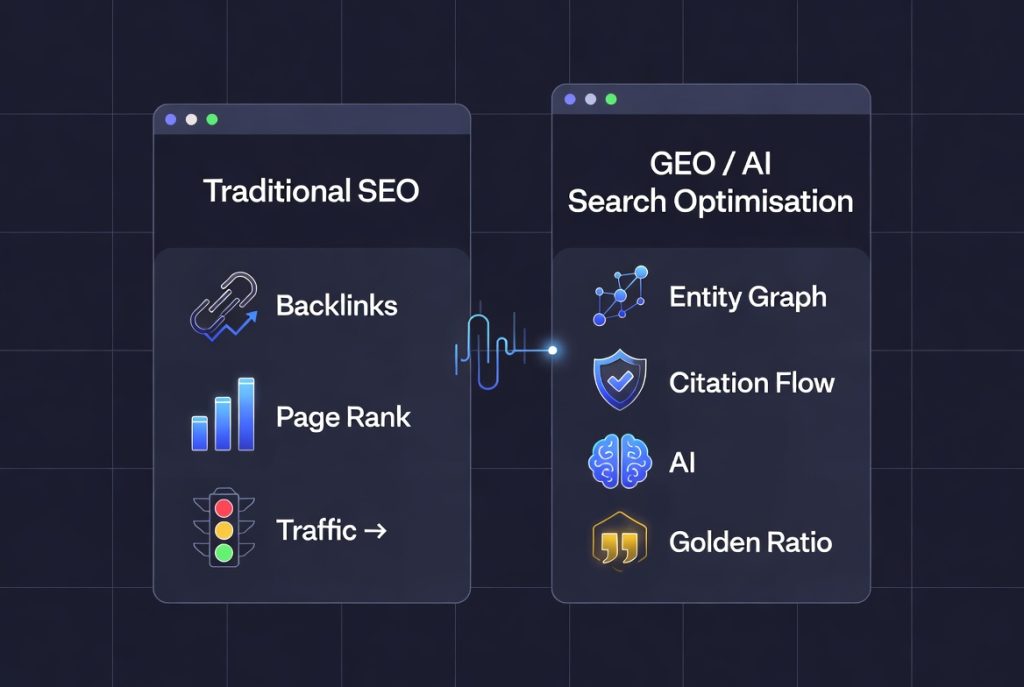
Rank entities, not just URLs
Extract passages instead of whole pages
Evaluate expertise and brand authority
This fundamentally changes how visibility is earned.
Brands that fail to adapt risk:
Losing traffic to AI summaries
Being outranked by better-structured competitors
Becoming invisible in generative results
Losing authority signals to larger publishers
AI SEO ensures your brand remains discoverable, trusted and competitive across this new generation of search.
Our AI SEO service includes:
AI SERP visibility tracking
Generative result monitoring
Entity presence reporting
AI keyword opportunity mapping
Competitor AI gap analysis
Monthly performance insights
You will see exactly where your brand appears — and where it should.
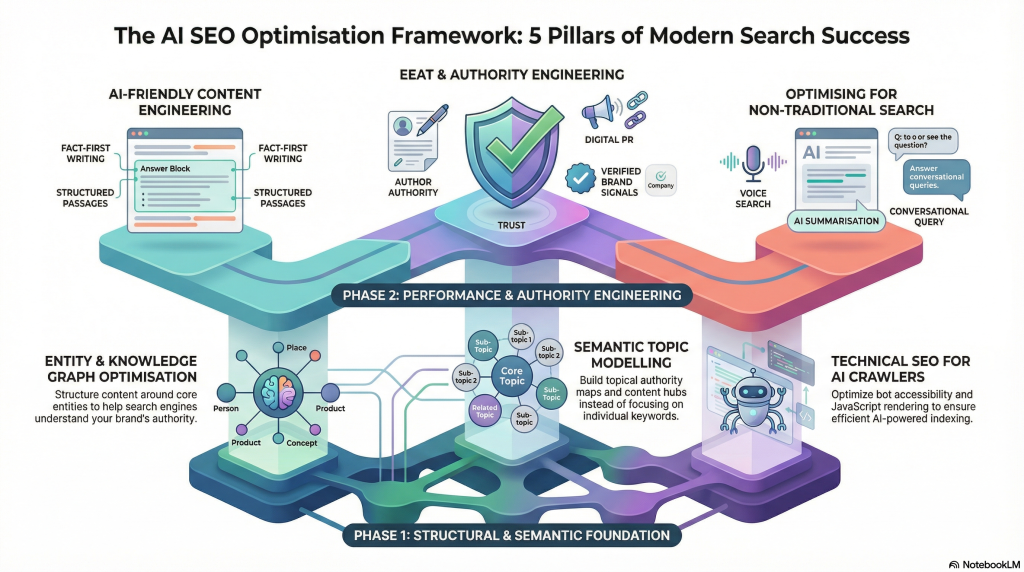
Our AI SEO methodology is built for how modern search engines now crawl, interpret and rank content. We combine AI-friendly content engineering, advanced technical optimisation and authority-building strategies to ensure your website is easy for AI systems to understand, trust and recommend. By structuring content for passage extraction and generative summaries, optimising your site for AI-powered crawlers and strengthening your brand’s expertise and credibility across the web, we position your business for long-term visibility across AI-driven search experiences.
Search engines now build knowledge graphs to understand brands, people, products and concepts. We optimise your brand as an entity by: Structuring content around core entities; Improving brand recognition across the web; Optimising for knowledge panels and entity associations; and Strengthening topical relevance and trust signals. This helps search engines understand exactly who you are and what you are authoritative in.
AI search engines evaluate entire topic clusters, not just individual pages. We build: Topical authority maps; Semantic content hubs; Buyer intent models; and Long-tail AI query coverage. This ensures your site becomes a recognised authority across your entire sector — not just for a handful of keywords.
Modern search engines extract and rank individual passages rather than entire pages. We structure your content so it can be easily interpreted and recommended by AI systems, optimising it for answer extraction, featured snippets, AI summaries, passage ranking, and voice search. This includes clear semantic structure, fact-first writing, structured answer sections, and AI-friendly formatting.
AI-powered search engines rely on more advanced crawling and indexing systems. We optimise your site for AI bot accessibility, crawl efficiency, deep indexation, JavaScript rendering and vector-based retrieval. Our technical work also covers structured data, Core Web Vitals, clean information architecture and intelligent internal linking.
AI ranking systems prioritise trust, expertise and brand authority. We strengthen your EEAT signals through author authority optimisation, brand trust building, digital PR and citations, review ecosystem optimisation, and high-authority publisher placements, improving your credibility with both users and AI search engines.
Models pull information from a blend of training data, real-time search APIs, trusted databases and your own digital footprint.
AI systems build structured “understandings” of your business: who you are, what you do, where you operate, and what you are known for.
The model strengthens its confidence in your business through patterns of consistent content, citations, signals and external validation
Models often cross-check information through reliable sources such as official websites, third-party directories and structured data formats
Geoff Parker has worked in digital marketing and SEO since 2005. He has helped start businesses to mid size corporations to large pan European household brands achieve their online marketing goals. To name but a few companies, he has worked with the likes of Allianz, Sports Direct, Hills Pet Food and many more.
Since November 2024, Geoff has specialised in AI Search Optimisation and the practical application of Generative Engine Optimisation for B2B clients in the UK. His early adoption of LLM-focused strategies has placed Blue Ocean Media at the forefront of AI search marketing, and he now leads the GEO offering as an AI optimisation consultant supporting forward-thinking B2B organisations.
GEO Geoff says “As of 2025, the average business is receiving up to 5% of their website visits from AI search. By 2030 this number is expected to be 50% for those that are optimised. Already we have seen optimised results for clients up to 78% of their traffic from AI search results. The time for companies to act is now.”

AI SEO (often called AEO or GEO) is the process of optimising content to be directly cited or recommended in AI-generated answers rather than just ranking for clicks on traditional search results. Traditional SEO remains the core foundation, as AI tools frequently pull from top Google/Bing rankings, but the key difference lies in prioritising clear, quotable, structured content that builds trust and entity recognition for AI summarisation.
AI SEO is very real and increasingly critical as AI assistants handle more queries where citations drive brand authority and indirect influence. While some tactics are overhyped, real-world tests show strong digital footprints and mentions lead to higher visibility in AI responses, making it an evolution of SEO rather than pure snake oil.
The most effective way to optimise for AI search results is to create clear, concise, structured content with direct answers, headings, bullets, tables, schema markup, and factual depth that AI can easily extract and cite. Build topical authority and entity strength through consistent mentions on trusted platforms like Reddit and YouTube, while maintaining solid traditional SEO to ensure retrieval.
The best tools for AI SEO and tracking include platforms like MentionDesk, SE Ranking, Profound, PeecAI, and Otterly for monitoring citations across LLMs, alongside manual querying of AI tools. Many succeed with free methods by focusing on content quality, but paid tools excel at scale and trend spotting.
You should continue investing in traditional SEO as the essential foundation, since strong Google/Bing rankings are often the prerequisite for AI citations. AI optimisation layers on top by emphasising quotability and trust signals. We recommend doing both rather than abandoning one for the other.
Brand mentions, citations, and entity optimisation are extremely important—often more so than traditional backlinks—for AI visibility, as models prioritise consistent, positive references across the web to establish trust. Appearing in "best of" lists, Reddit threads, reviews, and authoritative discussions builds the entity signals that make your brand the go-to source for AI answers.
The content formats that work best for AI citations are question-based ones like FAQs, how-to guides, comparison tables, listicles ("best X for Y"), and data-rich summaries with short paragraphs and structured elements. These allow AI to pull direct, factual excerpts easily, especially when combined with original insights and credentials.
AI-generated content is only effective for SEO/AI SEO in 2026 when heavily human-edited, refined with expertise, data, and originality—raw output often underperforms or faces penalties. Use AI for speed on outlines and drafts, but human oversight ensures quality, E-E-A-T signals, and unique value that AI models favour.
The best way to find unanswered questions or content gaps for AI SEO is to mine real user discussions on Reddit, Quora, forums, and support channels using search operators like site:reddit.com "I need help" or "recommendations". Tools like AnswerThePublic, Keywordly, or community monitors help scale this, targeting high-intent buyer or problem-solving queries.
Beginners should focus first on nailing foundational traditional SEO—fast sites, mobile optimisation, schema, strong on-page elements, and core rankings—before layering AI-friendly tweaks. Start testing by querying major AI tools with your audience's questions to identify gaps, then prioritise clear summaries, question headings, and building mentions.
AI may kill traditional SEO over the next 10 years. In the short term it will reduce clicks for some informational queries answered directly in summaries, shifting traffic patterns rather than eliminating them. Transactional and local searches still drive visits, so focus on becoming the trusted source AI cites while maintaining authority.
Success in AI SEO is measured by tracking citations and mentions in key AI tools (ChatGPT, Perplexity, Gemini, Google AI Overviews), brand visibility reports, and indirect signals like branded searches or authority growth. Combine tool-based monitoring with manual checks, as it's less precise than traditional rankings but reveals citation impact. The biggest measure, however, is the number of enquiries or sales a business gets from these sources.
FAQs and structured data are still highly useful—and often underrated—for AI optimisation, as they make content easy to extract for direct answers in overviews and LLMs. Schema like FAQPage, Article, and Organisation, paired with natural Q&A formats, boosts citability across both Google and conversational AI.
YouTube, Reddit, and Quora play a massive role in AI SEO, as AI heavily sources from these "wisdom of the crowd" platforms for authentic opinions, reviews, and answers. Optimise videos with strong titles/descriptions/captions and contribute genuinely helpful posts to build mentions that increase citation likelihood.
You need some technical fixes like ensuring crawlability (don't block AI bots), minimising heavy client-side JS (as many AI crawlers don't render it fully), and maintaining fast Core Web Vitals. However, standard technical SEO covers most needs—no drastic overhauls are typically required beyond these basics.
To get featured or recommended as the "best" in AI answers, secure placements on "best X" listicles, reviews, comparisons, and discussions on high-trust sites that AI pulls from. Build authority through PR, consistent positive sentiment, and strong entity signals to become the clear expert in relevant topic clusters.
Paid adverts, as of 2026, are not yet here on LLMs like ChatGPT, Grok, Perplexity etc, but it is only a matter of time. We expect this to happening during 2026.
Google AI Overviews have changed SEO strategies by pushing a focus on comprehensive, multi-step answers and being easily citable in summaries, often reducing informational clicks. Monitor for inaccuracies, report them where possible, and reward high-quality, authoritative sources over generic content.
The mistakes most people commonly make with AI for SEO are over-relying on unedited raw AI content, ignoring foundational traditional SEO, chasing hype tactics instead of building real authority, and neglecting entity/reputation signals. Treating AI optimisation as entirely separate from Google often results in poor outcomes.
The future of SEO with AI is adaptation rather than irrelevance, with a shift towards being retrievable, trustworthy, and helpful for both humans and AI agents. Brand authority, expertise, multi-platform presence, and optimising for AI's research process will keep you competitive as search evolves.