
B2B leaders are waking up to a new reality: buyers are no longer starting with Google. They’re starting with ChatGPT, Gemini and Perplexity — and the answers they get are shaping the vendors they trust. It’s been obvious for a while that AI search would eventually replace traditional SERPs, but the speed of this shift has left many businesses stunned. One moment you’re ranking well in organic search; the next, ChatGPT is confidently recommending your competitor, sometimes using your own content to do it. Not to mention the growth of AI Mode on Google and all the different ways you can get ranked.
The data behind this shift is impossible to ignore. AI-driven research now influences 70% of B2B purchase decisions, according to recent surveys, yet only 14% of brands are actively tracking their visibility inside AI engines. And with 85% of AI search queries now bypassing links entirely, replaced by fully synthesised answers, the stakes for B2B brands have silently, and dramatically, changed.
The question for everyone is no longer “How do I rank on Google?” but “How do I get cited inside ChatGPT or Gemini responses?” Because if an AI model doesn’t mention you, for many buyers, you effectively don’t exist. In this article we explore specifically what happens on ChatGPT and Gemini and how we can optimise websites for appearances on them.
AI Search Has Become the New Discovery Layer
AI search has slipped into the B2B buying journey almost unnoticed. Traditional behaviour — Google a problem, click a link, read a comparison page — has been replaced with a single question typed into an AI assistant. Instead of ten blue links, buyers get a confident, personalised recommendation summarising “the best tools”, “the most reliable providers” or “top B2B services” for their niche.
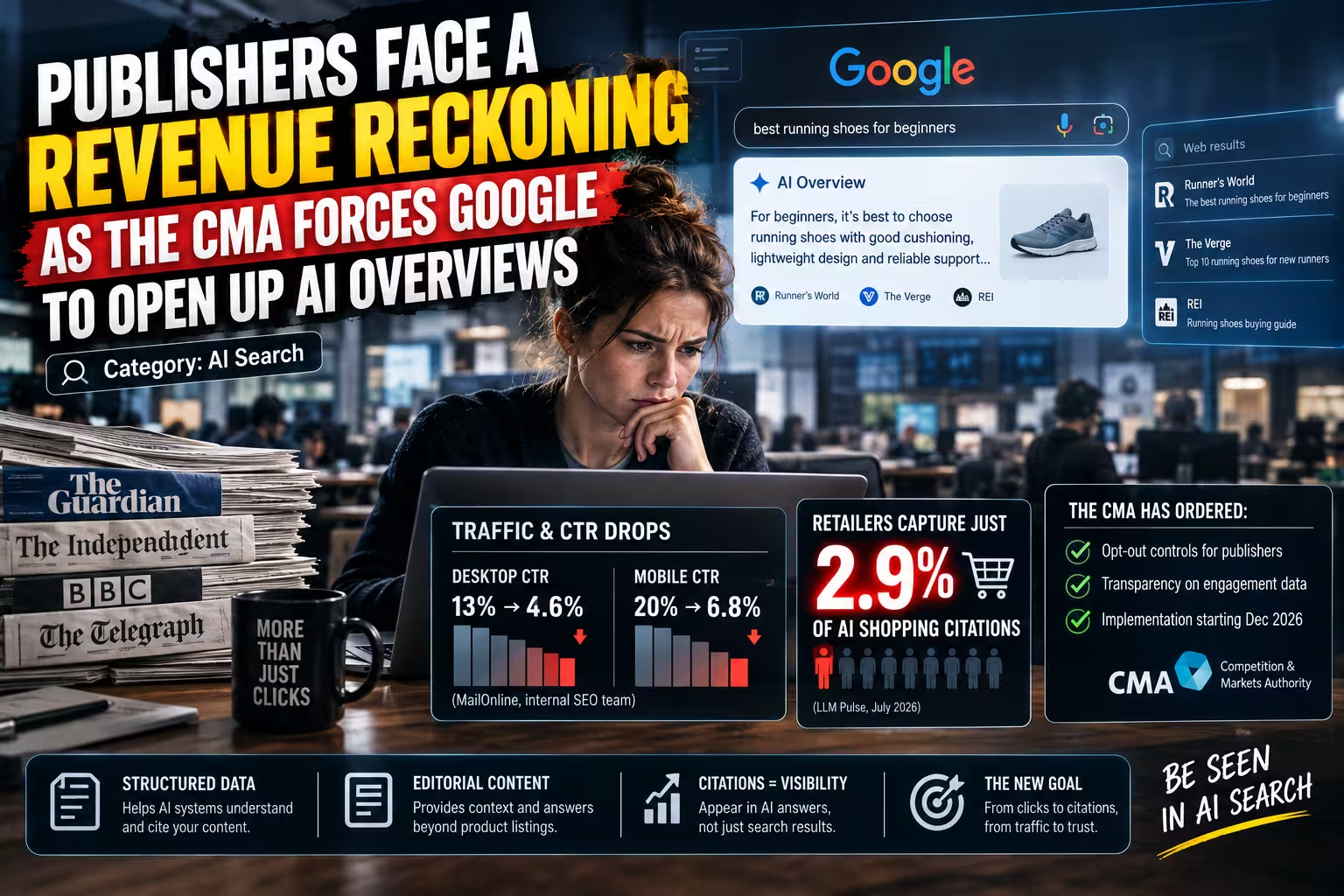
This shift explains why 85% of AI queries bypass websites entirely, generating “zero-click” answers that leave no trace in analytics dashboards. What would previously have been dozens of discovery searches such as “best logistics software UK”, “top compliance automation tools”, “alternatives to X provider” and so on, now happen inside models like GPT-4o or Gemini without a single visit to a website.
For B2B companies that rely on inbound marketing, this is a seismic change. High-trust, high-ticket decisions are increasingly being shaped by AI models that pick winners from patterns in their training data, real-time web sources and entity signals scattered across the internet. If you aren’t part of the dataset, you aren’t part of the conversation.
How ChatGPT, Gemini and Perplexity Decide Which Brands to Cite
Understanding how AI makes these decisions is the first step in influencing them. ChatGPT, Gemini and Perplexity don’t crawl the web the way Google does. They predict responses based on a blend of training data, real-time retrieval and statistical co-occurrence. That means the brands that show up in answers are those models have repeatedly encountered in high-trust contexts.
Training data plays a huge role. An Ahrefs analysis of 75,000 brands found that “branded web mentions” correlate 0.664 with AI visibility — far higher than backlinks, which traditionally drive SEO. If your brand name appears consistently across credible sites, forums, directories and long-form explanations, the model begins to associate you with those topics. It’s this semantic fusion that determines which brands feel “right” to recommend.
Real-time retrieval introduces a second layer. ChatGPT’s browsing mode and Gemini’s deep integration with Google Search and the Knowledge Graph allow them to pull from current indexes. They prefer fresh, structured, well-explained content with verifiable sources. This is why models tend to surface vendor blogs with strong formatting, well-cited statistics and clear definitions.
But the process isn’t perfect. ChatGPT still hallucinates 2.38% of its citations, sometimes making up URLs entirely, while Gemini sits at 0.86%. Models need clean, consistent, machine-readable information to reduce uncertainty. When brand signals are weak or inconsistent — for example, calling your service “AI support agent” on one channel and “AI customer assistant” on another — the model simply chooses a competitor with clearer semantic footprints.
Platform behaviour differs too. ChatGPT leans heavily on vendor content, citing platforms like Thinkific for educational technology topics, whereas Gemini cites third-party review sites in nearly half (48.73%) of recommendations. If ChatGPT seems to “ignore your site”, the culprit is usually entity ambiguity. Models value consistency and repetition far more than keyword optimisation.
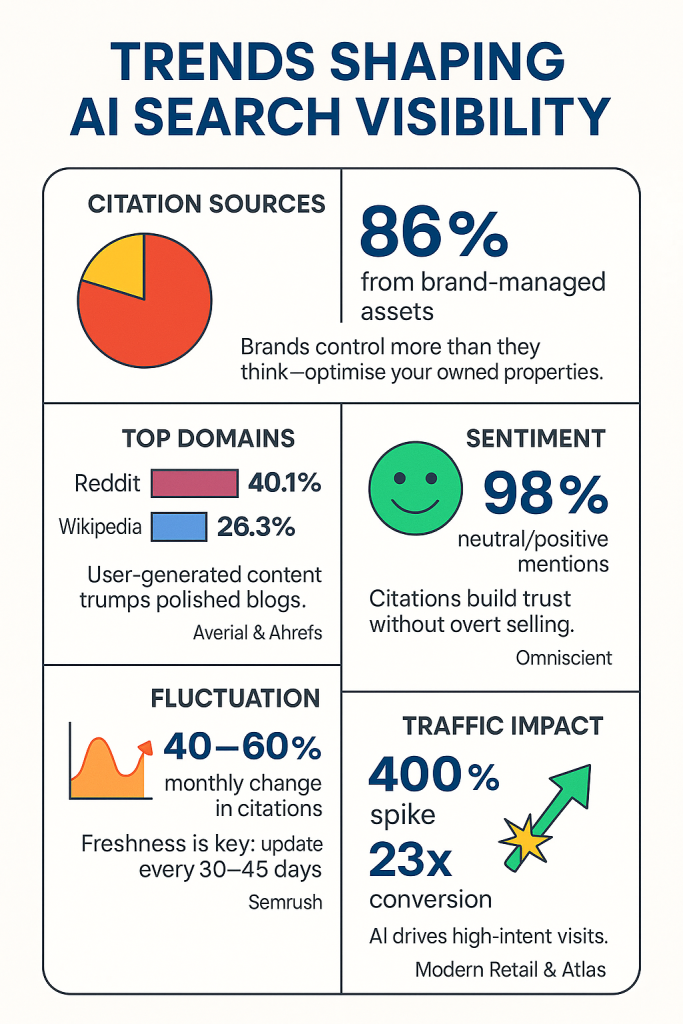
Trends Shaping AI Search Visibility Infographic
Four Signals AI Models Use Most
AI citation behaviour may feel mysterious, but it relies on identifiable signals.
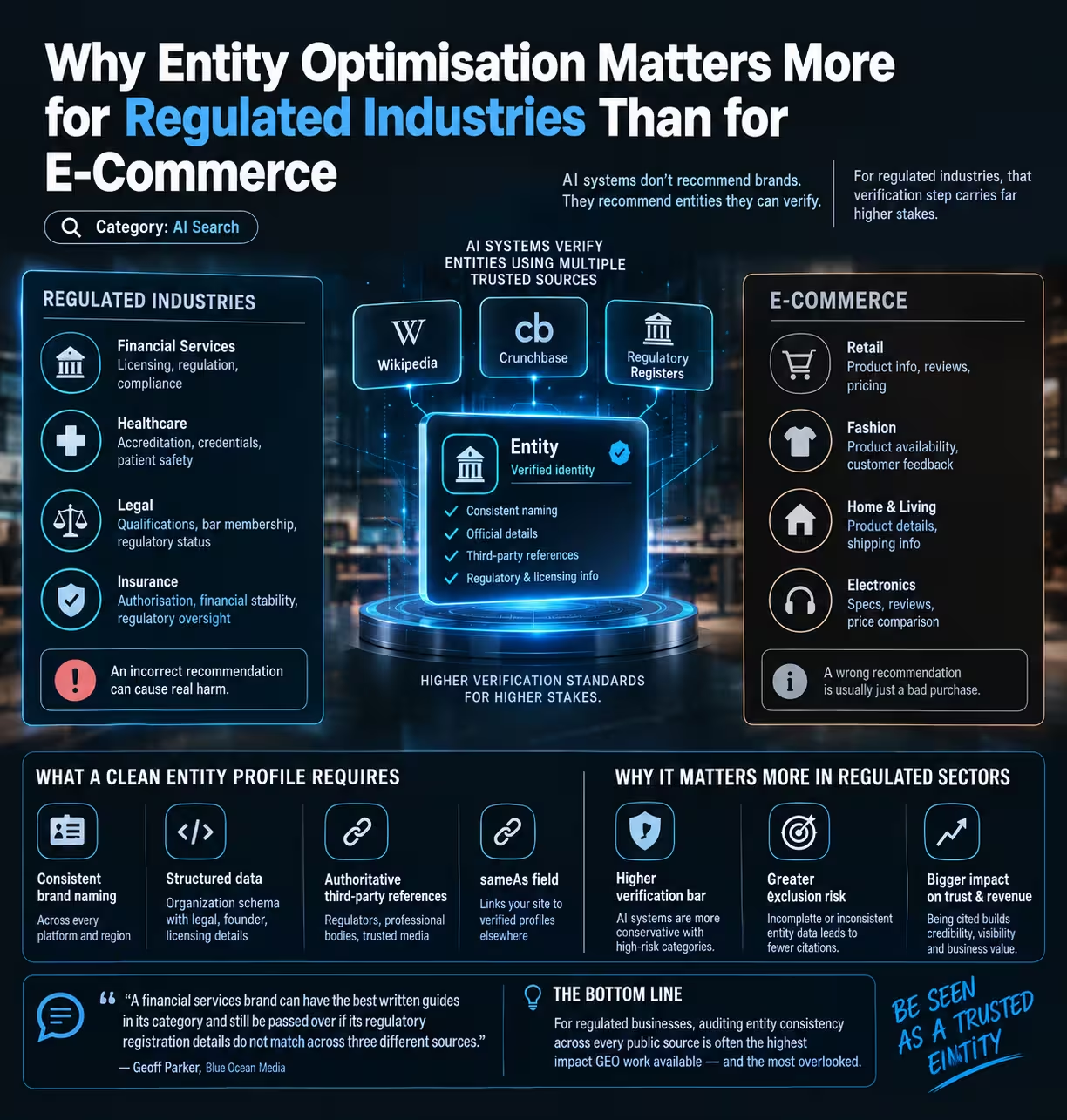
Entity consistency is the most important. AI models treat brands, founders, products and categories as entities, not as keywords. This means the wording around your brand must be stable across every public channel. A CRM platform that calls itself “CRM software”, “customer platform”, “business operating system” and “relationship management tool” across the web will confuse the model. A competitor that uses one phrase everywhere becomes the safer choice.
Semantic proximity drives recommendations. AI looks for consistent patterns: a brand name appearing repeatedly next to “best payroll software”, “top UK HR tools” or “SaaS billing automation”. The more often those associations appear, the more confidently the model cites the brand.
Recency matters too. Models prefer current information, prioritising content updated in the last few months. This is why monthly refresh cycles now outperform once-a-year content strategies.
External validation remains essential. AI models trust information from stable, reputable domains: government datasets, industry publications, trusted directories and high-authority niche sites. It’s why startups can outrank enterprises if they dominate conversations in trusted third-party spaces.
Semrush summarised this shift perfectly in their AI playbook: “LLMs cite content without clicking. They recommend competitors even if they cite your content.” Visibility no longer guarantees traffic — but it does guarantee influence.
What is Entity Optimisation?
If SEO was built on keywords, AI search is built on entities. For a brand to appear in ChatGPT or Gemini responses, the model needs to clearly understand who you are, what you do and which problems you solve. This clarity is created through entity optimisation, the emerging backbone of AI search marketing.
It begins with structured data. Schema markup, especially Organisation, Product and FAQ schema, gives AI models machine-readable clarity. Company profiles matter too: LinkedIn pages, Google Business Profiles, Crunchbase listings and founder bios all work together to create a consistent entity footprint across the web.
Language anchors are equally important. If you want to be cited as “Chatbase for AI agents”, you must use that exact phrase everywhere — on your website, LinkedIn posts, YouTube captions, directories, Reddit threads and external articles. AI doesn’t infer brand messaging; it mirrors what it can repeatedly verify.
Below is a table summarising the essential entity signals and where they must appear online.
Essential Entity Signals and Where They Must Appear Online
| Entity Signal | Why It Matters | Example | Required Channels |
| Brand Name + Category | Establishes semantic identity | “Blue Ocean Media – AI search marketing agency” | Website, LinkedIn, Google Business, directories |
| Founder Profile | Strengthens authority | “Geoff Parker, MD, specialising in AI search optimisation” | LinkedIn, About pages, interviews |
| Service Labels | Clarifies offerings | “AI agent development”, “content marketing for B2B” | Website, social captions, case studies |
| Structured Data | Machine readability | Organisation, FAQ, Product schema | Website |
| External Mentions | Third-party trust | Coverage in niche publications | DR50+ blogs, trade media |
| Social Language Consistency | Reinforces entity patterns | Repeating the same service descriptors | LinkedIn, X, YouTube captions |
One myth to address: LLMs.txt, the proposed opt-out file, has shown no measurable influence across 300,000 domains. AI models rarely consult it. Brands should focus on inclusion, not exclusion.
Creating Content for AI Models
AI models select information that is easy to understand, extract and verify. This has created a quiet revolution in content structure. Fluffy, promotional prose is being ignored; concise, factual, well-formatted content is winning.
The strongest formats for AI citability are question-led pieces, comparisons, step-by-step explanations and listicles with statistics. Q&A sections are particularly potent because they mirror natural queries typed into AI assistants. Models gravitate towards content that mirrors their own communication logic.
“Mirror the heading in the first sentence; answer immediately,” advises one team behind Semrush’s AI Visibility Toolkit. AI prefers directness over storytelling. TL;DR summaries at the top of pages, bolded statistics and explicit definitions all increase extractability. A simple example is a section titled “What is B2B AI search optimisation?” followed immediately by a sentence beginning, “B2B AI search optimisation is…”.
Case studies play a growing role too. X users frequently highlight that “Publish detailed case studies with measurable results” is one of the fastest ways to anchor a brand to a category. Models like high-signal, low-ambiguity data.
Reddit deserves special mention. It now drives 40% of citations in some categories because AI models treat its discussions as authentic, high-context and peer-generated. Well-structured contributions to relevant threads can have disproportionate impact.
Build Authority Beyond Your Own Website
One of the biggest misconceptions about AI visibility is that it’s earned on your website. In reality, your domain typically accounts for less than 20% of your total citation footprint. AI models prefer corroboration from the wider web.
Directories such as G2 and Capterra play an outsized role because they provide clear, structured comparisons. Industry-specific review platforms offer the same advantage. A brand that dominates these spaces appears more trustworthy to an AI model that must assemble an impartial recommendation.
External mentions matter too. Securing placements on DR50+ sites that already appear in AI citations has a compounding effect. Models repeatedly scan those domains for reliable patterns, and if your brand appears there, it becomes part of their recommendation vocabulary.
Language consistency across platforms is an underappreciated factor. When your LinkedIn posts, YouTube descriptions, and X captions all use the same phrasing, it creates semantic strength. AI doesn’t infer your messaging, it detects patterns.
Although 86% of citations come from brand-controlled sources, third-party reinforcement is essential for confidence scoring. Without external validation, a model may still recommend your competitor.
A Four-Step Process to ranking in AI Search
For B2B brands looking to increase their AI visibility, the path forward is much faster than traditional SEO cycles.
Step 1 — Audit and Track AI Visibility
Most B2B companies discover they have 0% share of voice when they first run an AI visibility audit. Tools like Semrush’s AI Visibility Toolkit aggregate brand mentions across prompts, while free options like AI Mentions Tracker scan ChatGPT, Gemini and Perplexity.
To get a meaningful picture, test 20–50 bottom-funnel prompts. A cybersecurity provider, for example, should test queries like “best UK penetration testing service” or “top GDPR compliance vendors”. Cross-model prompting helps identify hallucinations, inconsistencies and missing entity information.
Step 2 — Create Citable Content
LLMs thrive on clarity. Your content needs to be structured with extractability in mind. Q&A formats, listicles with statistics, product comparison pages, detailed case studies and TL;DR sections all significantly increase citation likelihood.
Schema markup supports this. FAQs, “How to…”, and Product schema make content machine-readable, improving retrieval accuracy. Publish content that answers precise questions buyers ask, and update it monthly to maintain freshness.
Step 3 — Build Authority Beyond Your Domain
Your website alone won’t secure visibility. Appear in directories, expert roundups and trade sites. Encourage discussions on Reddit and Quora, where third-party mentions generate high trust signals. Target DR50+ placements, especially from publications already cited by AI models.
Language consistency is non-negotiable. Repeat your brand positioning verbatim across major platforms.
Step 4 — Iterate
Real-time integrations amplify presence. Shopify’s ChatGPT connection for product feeds is an early example of how brands can inject structured data directly into AI assistants. B2B equivalents are emerging rapidly.
Refresh content monthly. AI prioritises recency. Add new statistics, expand case studies and update definitions. As one expert puts it, “Be everywhere people explain things. Write educational content, not promotional fluff.”
Case Studies: B2B Brands Winning AI Visibility
Real-world examples show how quickly the landscape can change.
Semrush increased its AI share of voice from 13% to 32% in a single month by auditing prompts, injecting high-citable content, and securing external mentions. This boost tripled its visibility for “best AI monitoring tools”.
Webflow and Chime, working through AirOps, achieved a 40% traffic lift and tripled citations within 30 days. They tracked gaps in AI answers and filled them with structured, data-rich content. Chime’s integration of first-party data for “billing support AI” queries became a stand-out tactic.
Deepgram delivered one of the biggest wins to date: a 24× traffic surge (from 37,000 to 1.5 million visitors) in 60 days through consistent entity signalling and AI-scannable content. They now dominate ChatGPT responses for “speech-to-text”.
Our own clients in Real Estate and Product Manufacturing have seen leads overall increase 50% with ChatGPT and CoPilot leading the source. Our processes with valuable content and entity optimisation have been critical in achieving this.
“The Time to Act is Now”
The brands that act fastest in AI search will be the ones most deeply embedded in the next decade of B2B purchasing. As GEO Geoff, MD of Blue Ocean Media, puts it: “Brands took years to grasp PPC and then SEO. The same happened to an extent with social media. Before companies get to grips with AI search it will have gobbled up all of these marketing methods in one go. The time to act is now.
His point is simple: by the time your competitor realises AI is the new discovery layer, the model may already have fused them semantically with your category. Once those patterns form, unpicking them is slow.
The shift is already accelerating. Citation volatility fluctuates between 40% and 60% week-to-week, favouring agile B2B brands over large enterprises. Meanwhile, AI referrals convert at far higher rates — some X users report up to 23× improvement — even though they deliver fewer clicks. It’s proof that the quality of exposure now outweighs quantity.
B2B brands must decide whether to shape this new discovery landscape or be shaped by it.
AI to make up 50% of all B2B queries by 2026
The biggest takeaway from this shift is scale. By 2026, half of all B2B searches are expected to be AI-native. When that happens, the brands cited inside ChatGPT and Gemini will hold the visibility their competitors can no longer buy. At Blue Ocean Media we are AI search optimisation specialists and AI Agent developers increasing visibility, traffic and sales for B2B companies in the UK. We have seen that only 10% of websites have implemented any strategies to improve indexing in AI search results, and only 0.3% of commercial websites are doing anything at all on this front. We are at the very early stages of this new method of Information Retrieval. GEO Geoff has specialised in this area since 2005 and is determined to stay at the forefront of this market through to 2030 for all clients. If we can help you further with you AI search marketing efforts then please do get in touch today.