
Search visibility used to follow a reassuring pattern. You’d optimise your pages, build relationships that earned links, watch your rankings climb, and welcome the traffic. But that familiar dance is changing. More and more people are getting their answers directly from AI tools, where your brand might be mentioned, summarised in passing, or skipped over entirely without you ever knowing.
We’re entering a world where being retrieved matters more than being ranked. This article explores the shifts you’ll need to make if you want your content to show up when people ask ChatGPT and similar tools for answers, rather than watching your visibility quietly slip away. This is the same shift driving growing interest in AI search optimisation among B2B companies that can already see traditional SEO becoming less predictable.
Write in extractable content chunks
Think of extractable chunks as self-contained ideas that make sense on their own, even if someone pulls them out of context. AI tools don’t read your content the way humans do, following the narrative thread from start to finish. They grab discrete pieces that answer specific questions.
This means rethinking how you write longer articles. Each section needs to stand on its own two feet, with its own context and payoff. When paragraphs meander across multiple ideas or assume the reader remembers what you said three sections ago, AI tools struggle to use them confidently.
The practical upshot is simple. If you’re still writing purely for people who will read from top to bottom, you’re missing half your potential audience. This is increasingly shaping how effective content marketing performs in AI-led discovery environments.
Put the answer first, then the explanation
Start each section with your clearest statement, the definition, the conclusion, the core fact, then unpack it from there. AI tools prioritise content that gets to the point quickly because it helps them match responses to questions with confidence.
Traditional writing often builds toward a conclusion, saving the best bit for last. But if your most useful sentence is buried halfway down, AI tools are less likely to find and use it, no matter how elegant your prose.
This is one of the reasons businesses relying purely on legacy SEO playbooks are seeing diminishing returns, even when they continue investing in optimisation work.
Structure content so it can be quoted, not just read
When your content is well structured, it survives being lifted out of context. Clear headings that capture the essence of each section, comparison tables, and step-by-step lists all translate cleanly when AI tools cite them in answers.
Flowing, unstructured prose, even when it’s insightful and beautifully written, forces AI to heavily paraphrase. And when that happens, there is less trust in the output and more chance your work gets left out entirely.
Over time, this is one of the quiet forces separating brands that become cited authorities from those that remain invisible, even if their expertise is comparable.
Publish information gain, not rewritten consensus
Information gain means saying something new rather than echoing what everyone else has already said. AI models have been trained on enormous volumes of generic content, so repeating the same points in slightly different words does nothing to improve your visibility.
What does work is original research, firsthand analysis, and clear observations drawn from real client experience. This is where thought leadership stops being a buzzword and starts becoming a genuine differentiator.
It also explains why businesses investing in deeper SEO strategy are now shifting focus away from volume and toward substance.
Write for conversational prompts, not keywords
People talk to AI tools differently than they typed into Google. They ask full questions in natural language rather than abbreviated keyword phrases.
If your content is still written around rigid keyword patterns that no human would ever say out loud, you’re optimising for technology that is already being sidelined.
This shift is blurring the line between good SEO and good writing, and that is a change that benefits businesses willing to adapt early.
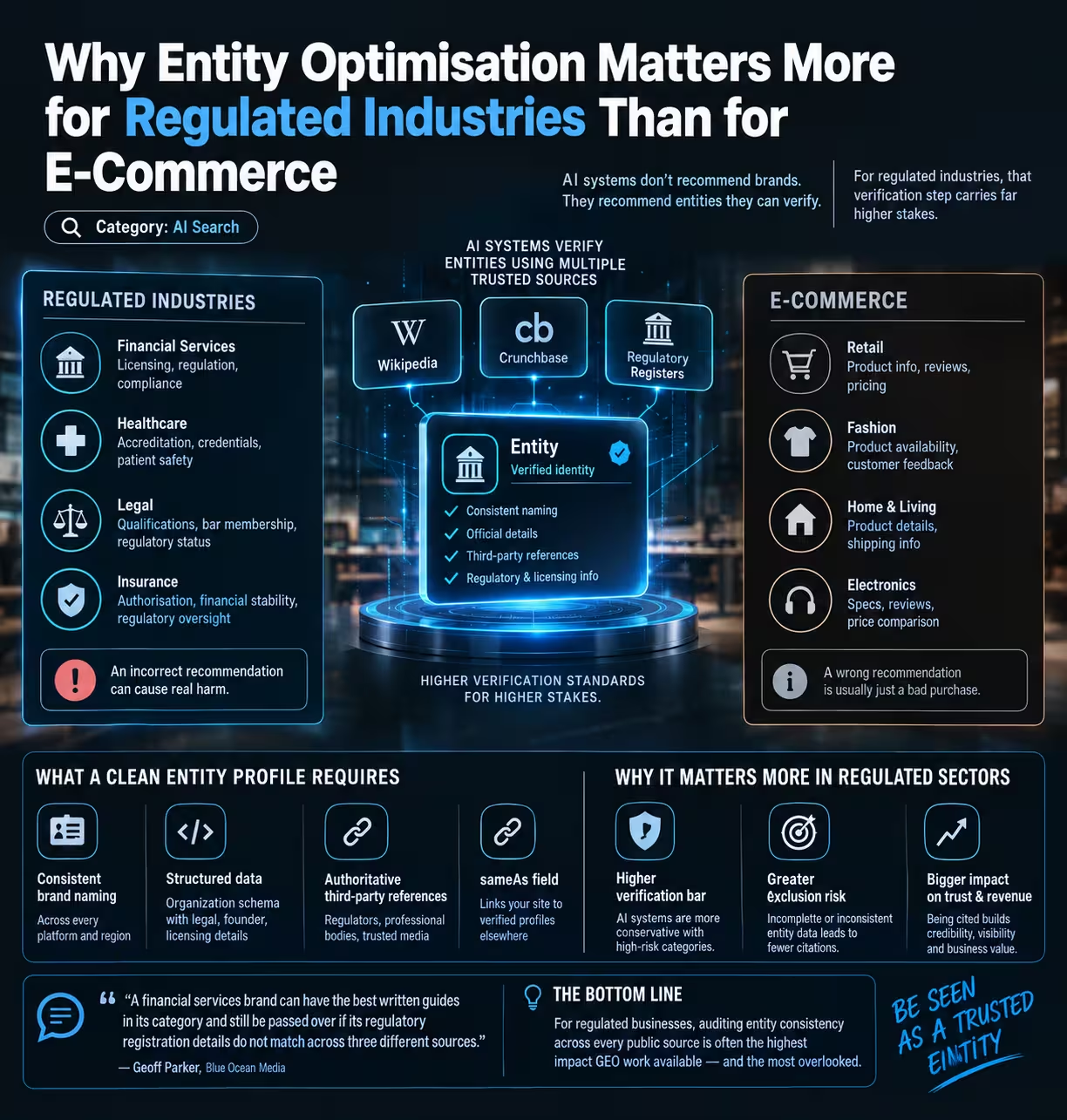
Build topical authority through entity clarity
Topical authority grows when you consistently cover a subject area with clear, specific references to tools, concepts, organisations, and real-world examples. This helps AI systems understand what you are known for, not just what a single page happens to mention.
When your expertise, services, and positioning are clearly reinforced across your site, AI models become more confident associating your brand with that topic. This is why authority is increasingly built at a site level, not page by page.
It is also why businesses are now reassessing how their services are explained across core pages such as their About page and service descriptions.
Use structured data to reinforce intent
Structured data makes the purpose of your content explicit to machines. Schema formats such as Article, FAQ, and HowTo reduce ambiguity and improve how content is indexed and retrieved.
While structured data does not create authority on its own, it removes friction and helps existing authority travel further across AI-assisted systems.
This is increasingly being treated as a practical extension of technical SEO rather than an optional enhancement.
Keep content current and visibly maintained
Freshness is no longer just about publication dates. AI systems assess whether content appears actively maintained, particularly when it includes tools, tactics, or recommendations.
Outdated screenshots, obsolete references, and stale examples quietly erode trust, even if the underlying advice remains sound.
This is pushing businesses to treat content as a living asset, something already reflected in how ongoing digital marketing services are being delivered.
Earn third-party corroboration, not just backlinks
Corroboration happens when independent sources reference the same ideas or brands without coordination. Community discussions, editorial articles, and neutral forums all play a role here.
AI tools lean heavily on these independent signals when forming balanced answers, which reduces the impact of purely self-published content.
As a result, visibility increasingly depends on whether others are talking about you, not just whether you are talking about yourself.
Measure AI visibility directly and iterate
Measuring AI visibility means testing real prompts and observing how often your brand or ideas appear in responses. This is the only reliable way to understand what is working.
Without this feedback loop, AI visibility remains abstract. With it, patterns emerge around structure, phrasing, and depth.
This is where optimisation becomes empirical again rather than speculative.
What people are saying is driving AI visibility right now
The conversation across social platforms in mid-January 2026 is not about shortcuts. It is about depth and sustained focus. Practitioners consistently report that years of concentrated publishing on a single topic outperform tactical experimentation.
Geoff Parker, Managing Director of Blue Ocean Media, puts it plainly. “AI systems are not looking for the best page, they are looking for the most reliable source. That reliability is built over time by showing up again and again on the same topic, with clarity, consistency and evidence.”
Topical authority is becoming the gateway to AI discovery
The clearest signal emerging from this shift is that owning a topic matters more than perfecting individual pages. Businesses delaying this transition are exposing themselves to long-term visibility risk.
Moving now is not about chasing a new channel. It is about adapting to the one that is already replacing the old model, and ensuring your expertise remains visible where decisions are increasingly being made.