
If you are a business owner looking to streamline operations, boost productivity, or simply stay competitive in 2026, you have probably heard of ChatGPT, and most recently Grok in the news, but have you heard of Claude AI? Claude is rapidly growing as one of the most competent AI LLMs for various tasks, such as copywriting and coding. This guide will walk you through everything you need to know about Claude, from its origins to its practical applications, all explained in plain English without the technical jargon.
What is Claude AI?
Claude AI is a family of large language models developed by Anthropic, designed to serve as a versatile AI assistant. Think of it as a highly capable digital team member that can tackle complex challenges, assist with coding, analyse data, and help with strategic planning. For business owners, this translates into real practical benefits. Claude can automate routine administrative tasks, generate insightful reports, and support your team in creating sales pitches or marketing content.
What sets Claude apart from other AI tools is its focus on safety and reliability. Built on Constitutional AI principles, Claude ensures its outputs are helpful, honest, and harmless. This makes it particularly valuable for enterprise environments where compliance and trustworthiness matter. In 2025, Claude achieved over 30 million monthly active users, with a 32% market share in enterprise AI applications. These numbers reflect its growing adoption for business critical tasks like customer segmentation and workflow automation.
Claude supports multimodal inputs, meaning it can work with text, images, and documents. As a business owner, you can upload sales data for analysis or marketing visuals for critique, making decision making faster and more informed. Its integration with tools like Google Drive and web search allows seamless access to real time information. According to 2026 benchmarks, this capability has boosted productivity in administrative roles by up to 40%.
The history behind Claude AI
Anthropic, the company behind Claude, was founded in 2021 as a public benefit corporation. The founders were former OpenAI researchers who left to prioritise AI safety and alignment over rapid commercialisation. Their mission was clear from the start to build AI systems that are safe, beneficial, and aligned with human values. The first Claude model launched in March 2023, evolving from early versions like Claude Instant to the advanced Claude 4.5 series by late 2025.
The growth trajectory has been remarkable. By 2025, Claude saw explosive expansion, with enterprise revenue increasing 4.5 times and overall run rate exceeding $5 billion by early 2026. This growth was driven by strategic partnerships with platforms like Amazon Bedrock and Google Cloud. For business owners, this history positions Claude as a reliable tool that has proven its value in real world enterprise applications.
Key milestones in Claude’s development include the introduction of multimodal capabilities in 2024 and agentic features in 2025. Claude Code, their specialised coding product, alone generated $1 billion in run rate revenue within months of launch. These capabilities enable businesses to accelerate software development and automate marketing and administrative tasks with minimal technical overhead.
Who created Claude and why
Anthropic was co founded by siblings Dario Amodei, who serves as CEO, and Daniela Amodei, who serves as President. They were joined by several talented former OpenAI researchers including Jared Kaplan, Jack Clark, Ben Mann, Sam McCandlish, Chris Olah, and Tom Brown. This team left OpenAI in 2020 and 2021 due to differing views on AI safety and commercialisation strategies.
Dario Amodei, a leading advocate for AI safety, has been vocal about the need for responsible development. He has predicted that human level AI could arrive by 2027, bringing both significant risks and tremendous potential benefits if managed properly. This philosophy permeates everything Anthropic builds, making Claude a particularly trustworthy choice for businesses handling sensitive data.
The leadership team’s interdisciplinary expertise in machine learning, policy, and operations has guided Anthropic to a $183 billion valuation by 2025. Major investments include $13 billion from ICONIQ and $4 billion from Amazon, providing the resources needed to develop robust AI tools. The company’s board includes notable figures like Yasmin Razavi, Jay Kreps, and Reed Hastings, with a Long Term Benefit Trust overseeing decisions to ensure AI benefits humanity broadly.
Core principles that guide Claude
Anthropic’s Constitutional AI framework is the foundation of how Claude operates. The system trains Claude to adhere to a set of ethical rules drawn from sources like the UN Declaration of Human Rights. This ensures outputs are helpful, honest, and harmless. For business owners, particularly those in regulated industries like finance or healthcare, this approach reduces biases and risks significantly.
The core values include acting for global good, igniting a race to the top on safety, and putting the mission first. In practice, this translates to transparent AI systems that business leaders can trust for administrative automation or marketing strategies without ethical pitfalls. The 2026 updates to the constitution emphasise Claude’s role as a brilliant friend with expert knowledge, enhancing its utility for collaborative team environments.
By focusing on empirical, simple solutions that actually work, Anthropic ensures these principles support practical business applications. For example, Claude demonstrates honest uncertainty in its responses, helping avoid misleading sales forecasts or marketing claims that could damage your business reputation.
The Claude 4.5 model family
As of February 2026, the Claude 4.5 series represents Anthropic’s latest generation. The family comprises three models: Haiku 4.5, Sonnet 4.5, and Opus 4.5. Each model is designed for different use cases, allowing you to select based on your specific business needs.
Haiku is optimised for quick administrative queries at low cost. Sonnet provides balanced performance for marketing automation tasks. Opus, the flagship model, excels at complex enterprise tasks like in depth sales analysis, handling up to 1 million tokens in context. This means Opus can process enormous amounts of information in a single query, something particularly valuable for detailed business intelligence work.
Released progressively throughout 2025 (Sonnet in September, Haiku in October, Opus in November), these models offer hybrid reasoning modes for fast or deep thinking. Benchmarks show Opus 4.5 achieving 80.9% accuracy on SWE bench, a challenging coding evaluation. Haiku matches Sonnet’s coding performance at one third the cost and four to five times the speed, making it highly cost effective for teams with high volume tasks.
Text generation and writing capabilities
Claude excels at generating high quality written content. Whether you need case studies, grant proposals, video scripts, or marketing copy, Claude produces nuanced, coherent writing that typically requires minimal editing. For business owners, this means your team can brainstorm ideas more effectively, refine writing styles, and create communications tailored to specific audiences.
The writing quality consistently outperforms competitors in capturing subtlety and maintaining context over long documents. Features like Artifacts create interactive outputs such as checklists or study guides, which are particularly useful for administrative tasks like report summarisation or sales proposal drafting. Statistics show Claude achieves 95% accuracy in basic tasks, making it ideal for teams needing polished, ethical content without AI hallucinations.
Coding and development strengths
Claude’s coding capabilities, especially through Claude Code, represent a significant advantage for businesses with technical needs. The system can write code autonomously, debug existing code, and handle multi file edits. Opus 4.5 achieves 80.9% on SWE bench, demonstrating its ability to solve real world software engineering challenges.
For business owners with technical teams, this enables rapid prototyping and development. Case studies show development time reductions of up to 10 times in some projects, such as those at Schrödinger. This makes it ideal for building custom marketing tools or administrative automations without extensive development resources.
The integration with git workflows and tools enables agentic development, where Claude handles long running tasks with minimal supervision. Even for non technical users, vibe coding allows intuitive collaboration. Remarkably, 90% of Claude Code’s own codebase was written by Claude itself, demonstrating the potential for sales teams to build simple CRM scripts or marketing dashboards without full developer resources.
Analysis and research capabilities
Claude excels at breaking down complex problems, conducting deep research, and analysing data from uploaded documents. This supports business owners in strategic thinking tasks like market analysis or sales forecasting. With features like web search and memory, it can handle multi step workflows effectively, improving quality in research tasks where it leads industry benchmarks.
For administrative and marketing functions, Claude can prepare materials for interviews, generate insights from documents, and automate data segmentation. Reports from 2026 show it enables efficiency boosts of up to 40% in analysis tasks. The low misalignment rates ensure reliable outputs in enterprise settings, giving you confidence in the results.
Multimodal features and integrations
Claude processes images, voice inputs, and documents, making it valuable for tasks requiring visual aids or explanations. The system integrates seamlessly with Google Drive, Slack, Canva, and numerous other platforms, creating smooth workflows for business operations. You can use this for marketing visual analysis or administrative file management.
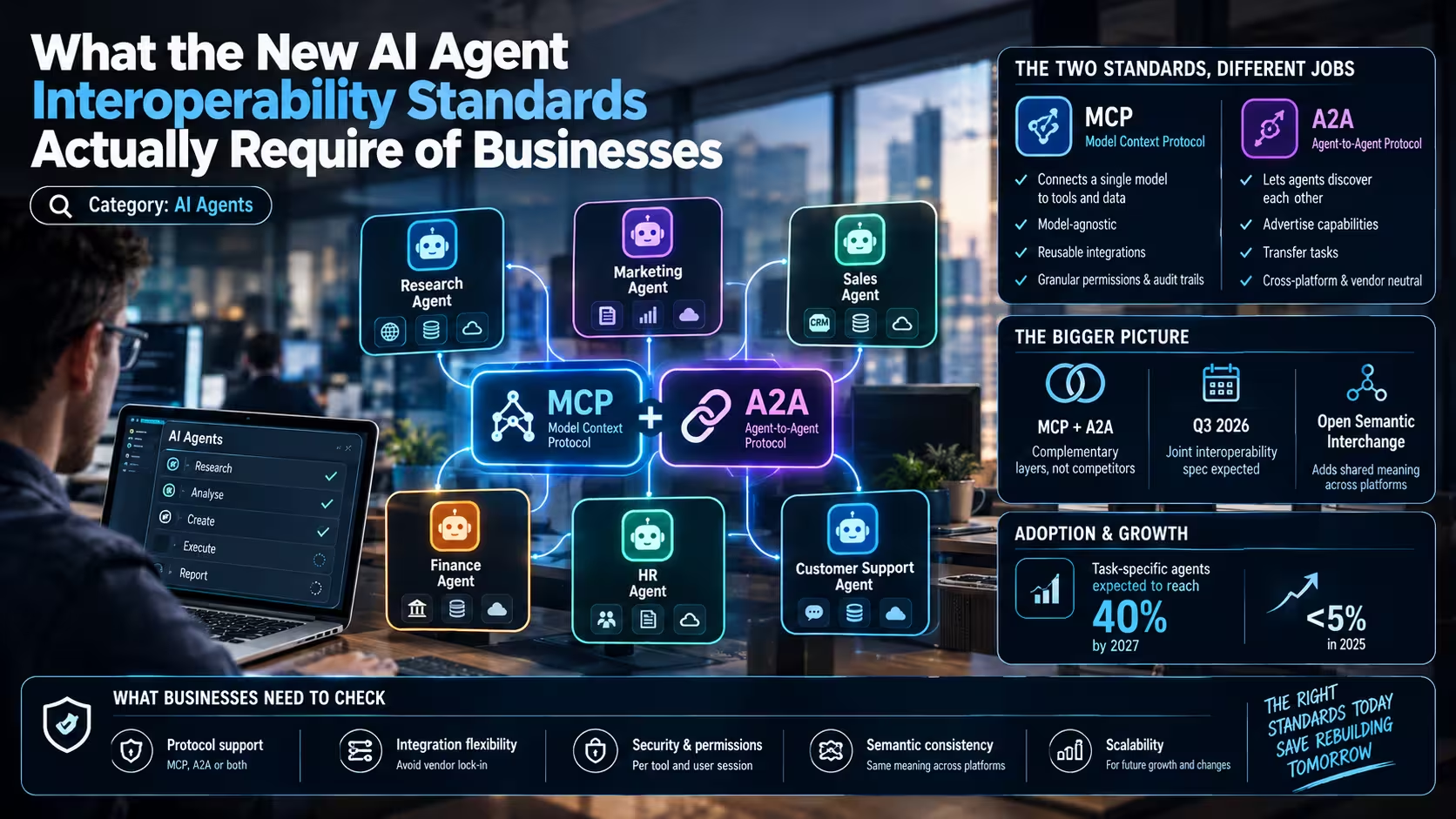
New 2026 integrations include platforms like Salesforce, enhancing sales automation capabilities. Features like Artifacts create interactive elements within conversations, whilst the Model Context Protocol allows custom tool connections. In specialised industries like life sciences and healthcare, Claude connects to platforms like Benchling, supporting teams in data heavy industries with secure, HIPAA ready access.
Who should use Claude AI
Claude targets individuals, teams, developers, researchers, educators, and businesses across creative and technical fields. For business owners, it is particularly ideal for problem solvers working in sales (such as lead generation), marketing (content creation), administration (workflow automation), and development (application building). The platform now serves over 3 billion API requests monthly, demonstrating its scale and reliability.
Enterprise users benefit especially from the safety focus, with significant adoption in fintech, healthcare, and other regulated sectors. The system suits teams of all sizes, from small groups to large organisations. Features like shared projects enhance collaboration, making it easier for distributed teams to work together effectively using AI agents.
Pricing and how to access Claude
Claude offers several pricing tiers to suit different business needs. The free tier provides limited messages (30 to 100 per day), which is sufficient for initial testing. The Pro plan costs $20 per month and offers five times the usage with priority access. Max tiers range from $100 to $200 per month for high capacity needs. The Team plan costs $25 to $30 per user per month with a minimum of five users.
For enterprise deployments, plans start at $30 or more per user per month with custom support options. This makes Claude accessible whether you are a solo business owner or scaling to a full team. API pricing operates on a usage basis. Haiku 4.5 costs $1 per million input tokens and $5 per million output tokens. Sonnet 4.5 costs $3 for input and $15 for output (with higher rates for large contexts). Opus 4.5 costs $5 for input and $25 for output.
Prompt caching can save up to 90% on repetitive queries, whilst batch processing offers 50% cost reduction for non urgent tasks. Access is available through the web interface at claude.ai, through the API, or via integrations with platforms like AWS Bedrock. Academic discounts are also available, ensuring cost effectiveness for businesses with volume based requirements.
How Claude compares to other AI tools
Claude outperforms competitors in several key areas, particularly safety, ethical alignment, and long context handling. Whilst ChatGPT offers more versatility and Gemini provides strong multimodal capabilities, Claude excels in nuanced analysis and coding tasks. The 2025 to 2026 benchmarks consistently show Claude leading in coding accuracy (80.9% on SWE bench) and balanced performance across different task types.
The Constitutional AI approach significantly reduces hallucinations and biases compared to alternatives. For businesses, this reliability translates directly into better outcomes. The structured thinking capability excels particularly in writing and research tasks. Compared to open source options like Llama, which offers flexibility, or Mistral, which provides specialisation, Claude’s enterprise focus delivers superior tool use for sales and marketing automation.
Cost efficiency represents another advantage. Haiku offers performance at one third the cost of Opus, providing options for different budget levels. The extensive integrations and enterprise market share growth of 40% in 2025 demonstrate strong business adoption and trust. These factors combine to make Claude particularly suitable for businesses prioritising reliability and ethical AI use.
Limitations to consider
Whilst Claude offers significant advantages, business owners should understand its limitations. Like all AI systems, Claude can occasionally hallucinate or introduce technical debt in coding tasks. This means human oversight remains essential for critical systems. The system is not fully autonomous, and occasional output mistakes can occur, making it less suitable for high stakes administrative tasks without verification.
Compared to Gemini, Claude has shallower multimodal depth in some scenarios. Strategic thinking may require user guidance to achieve optimal results. The closed source nature limits customisation options compared to open source alternatives. Higher costs for premium features may challenge smaller businesses with tight budgets.
In classification or subjective tasks, biases can persist despite the Constitutional AI framework. The energy usage for training is substantial, raising environmental considerations. For marketing content, responses can sometimes be verbose and require editing. The system can also be slower for short queries compared to lighter weight models, though this trade off generally favours quality over speed.
Future developments and direction
Anthropic continues to expand Claude’s capabilities and reach. Plans include expanded integrations with business tools, global initiatives such as AI training programmes for educators, and a new office in Bengaluru. Recent achievements demonstrate the breadth of potential applications, including Claude assisted Mars rover operations and significant funding rounds totalling $13 billion for enterprise growth.
CEO Dario Amodei forecasts human level AI arriving by 2027, which could significantly disrupt job markets whilst enabling substantial benefits like disease cures and economic growth. For businesses, this trajectory suggests evolution toward increasingly sophisticated multi modal, agentic systems for sales and marketing automation. The emphasis will remain on hybrid reasoning capabilities and enhanced tool integration.
Future focus areas include greater specialisation for industry specific needs, continued competition with open source alternatives, and production grade safety features. Claude is positioned to lead in developing long memory agents and optimising cost to compute trade offs, making it increasingly valuable for team scalability and complex business operations.
Making Claude work for your business
Choose Claude when safety, ethical outputs, and superior coding or analytical capabilities are priorities over raw versatility. The transparency and harm reduction measures make it particularly suitable for enterprises handling sensitive information. The cost effective options allow scaling from individual use (Haiku for speed) to complex tasks (Opus for depth), supporting the 4.5 times revenue growth achieved in 2025.
For business owners, Claude’s long context handling and agentic tools like Claude Code enable efficient team workflows across sales, marketing, and administration. The reliability, demonstrated through lower misalignment rates and better benchmark performance on complex tasks, provides confidence in business critical applications.
Start with the free tier to test whether Claude suits your specific needs. Graduate to Pro for regular use, or consider Team plans when collaborating across departments. For high volume or specialised requirements, the enterprise plans with custom support ensure you receive the assistance needed to maximise value.
Getting found in AI search results
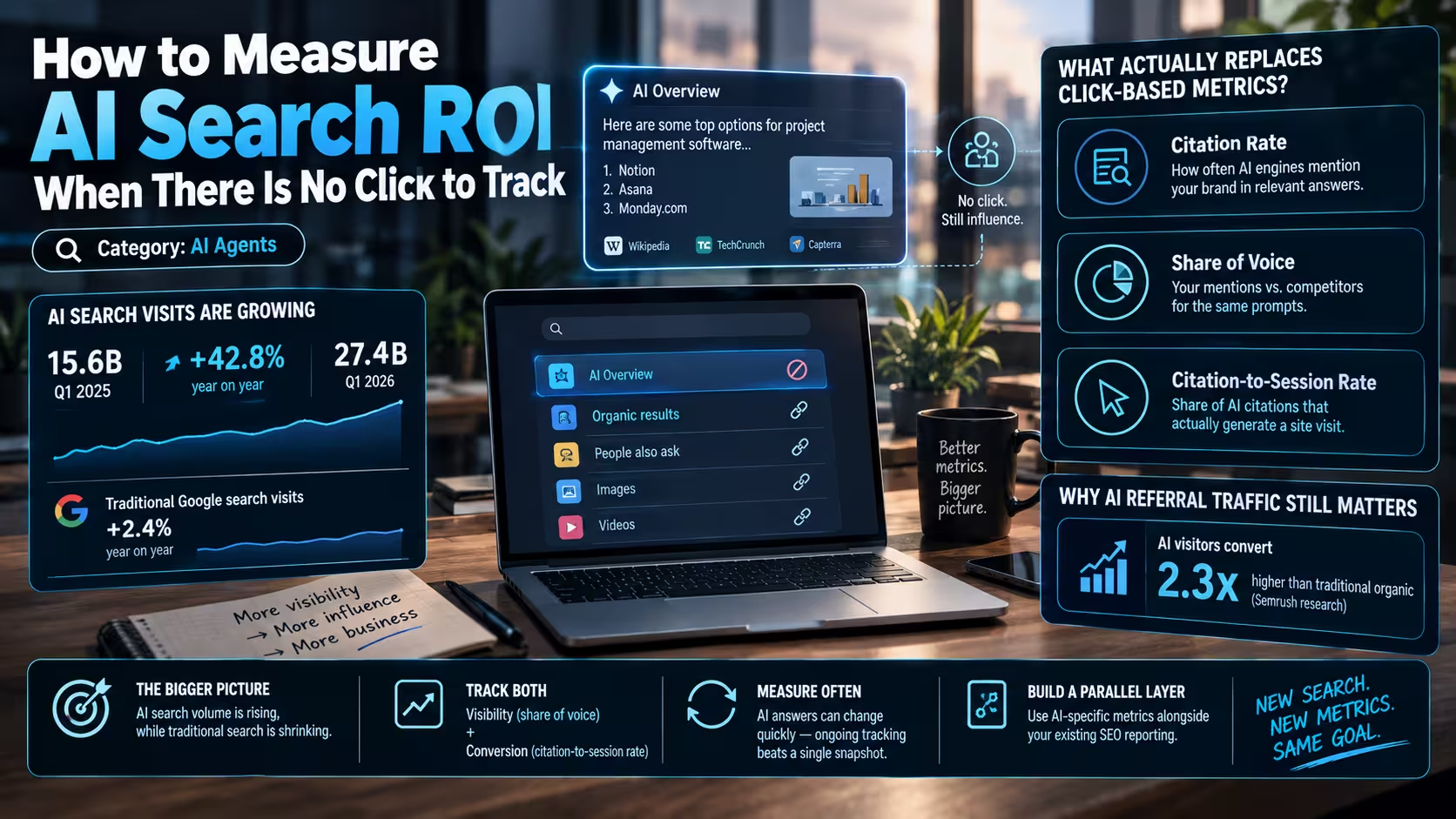
As AI assistants like Claude become central to how people find information, ensuring your business appears in AI generated responses grows increasingly important. Traditional SEO alone no longer suffices when potential customers ask AI tools for recommendations instead of searching Google. This shift represents both a challenge and an opportunity for forward thinking businesses.
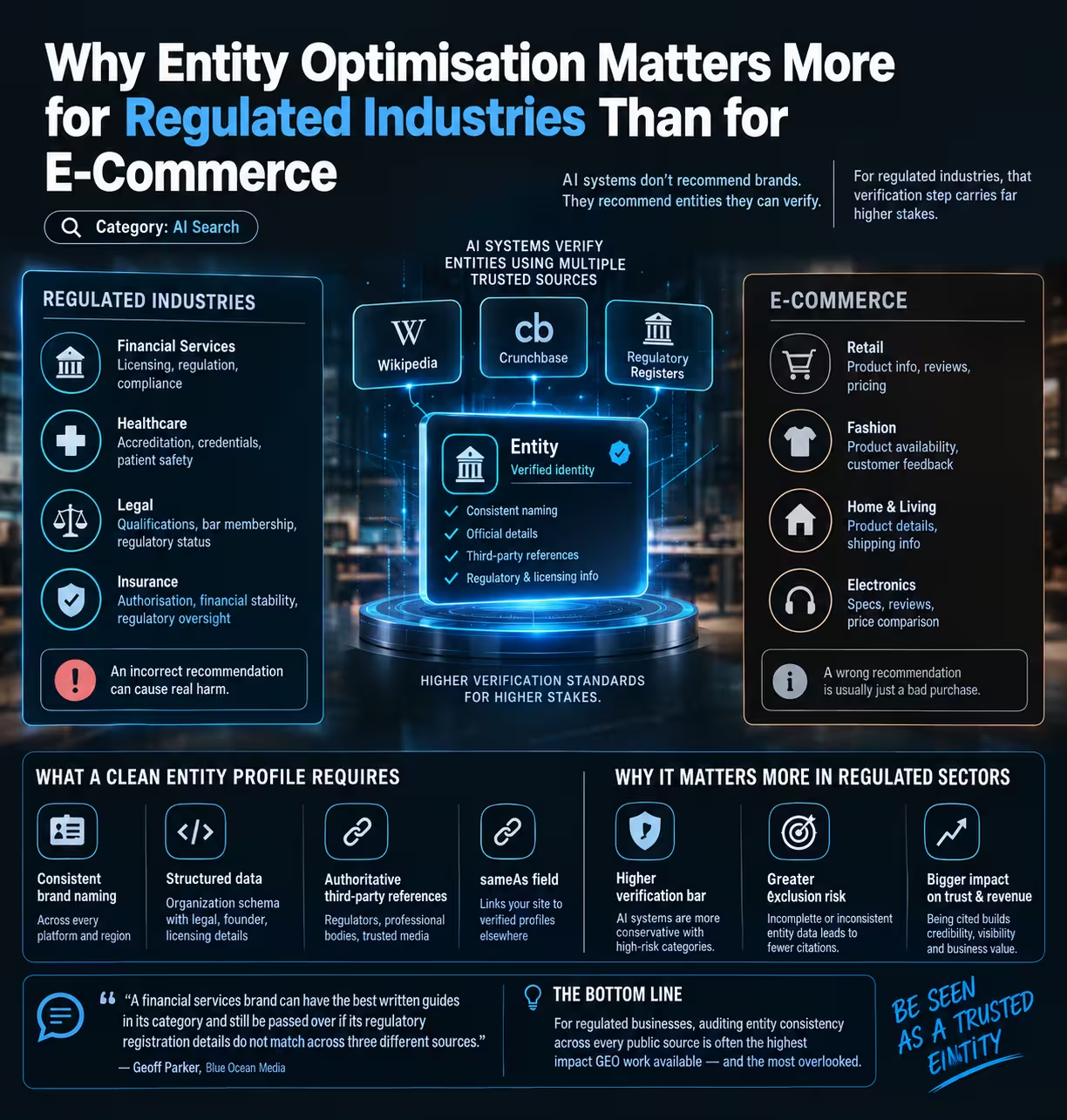
Optimising content for AI answer engines requires a different approach from traditional search optimisation. Your business needs to be cited when Claude, ChatGPT, or other AI systems answer questions in your industry. This involves creating authoritative, well structured content that AI models recognise as trustworthy and relevant. The strategies differ significantly from traditional SEO, focusing on semantic clarity, expertise demonstration, and strategic content positioning.
Whether you call it Generative Engine Optimisation, AI Search Optimisation, or AISEO, the fundamental goal remains the same: ensuring your business gets cited when AI models generate answers. This emerging field represents the next evolution of digital visibility, and early adopters will gain significant competitive advantages as more customers shift to AI assisted research and decision making.
Understanding Claude AI and its capabilities provides a foundation for leveraging artificial intelligence in your business. Yet the real opportunity lies not just in using these tools yourself, but in ensuring your business remains visible when others use them to make purchasing decisions. As AI reshapes how information flows and how customers discover solutions, positioning your business to be cited and recommended becomes as crucial as the operational efficiencies AI provides. The businesses that master both dimensions will thrive in this rapidly evolving landscape.