
As AI-powered search tools become the primary way users get information, a new visibility question has emerged. It is no longer just about ranking well or producing high-quality content. It is about whether an AI model chooses to name your brand at all.
When users ask for explanations, comparisons, or recommendations, AI systems increasingly respond with fully formed answers. Some brands are mentioned repeatedly. Others, including well-known ones, are absent entirely. This selection process is not random, nor is it a simple reflection of traditional SEO performance. It follows a different set of signals and priorities that many organisations are only beginning to understand.
AI Models Optimise for Synthesis, Not Attribution
At a fundamental level, AI models are designed to generate coherent, helpful responses rather than to credit sources. Their primary objective is to synthesise information into a clear answer that feels complete and unbiased. Brand mentions are included only when they meaningfully contribute to that goal.
This means that even when a brand’s content strongly informs an answer, the brand itself may be removed during synthesis. Models often generalise insights to avoid appearing promotional or partial. As a result, attribution is treated as optional, not essential.
In practice, this creates a bias toward generic language. Unless a brand is widely recognised as a category-defining example or uniquely associated with a concept, it may be excluded in favour of neutral phrasing.
Authority Signals Matter More Than Rankings
While SEO rankings still influence what AI systems can access, they do not determine who gets cited. AI models look for authority signals that extend beyond a single page or keyword position. Consistency across the wider web plays a major role.
Brands that appear frequently in third-party articles, research summaries, industry explainers, and comparative content are easier for models to recognise as authoritative entities. These repeated mentions act as reinforcement signals. The brand becomes part of the collective understanding of a topic, not just a self-promoted source.
By contrast, brands that rely heavily on owned content, even if well optimised, often struggle to break into AI-generated answers. Without external validation, their inclusion appears riskier from a model perspective.
Neutrality Bias Shapes Brand Inclusion
AI systems are explicitly designed to avoid bias. This has an unintended consequence for brand visibility. When a question can be answered without naming specific providers, models often choose that route to remain neutral.
This is particularly visible in recommendation-style queries. Instead of listing brands, AI responses frequently describe what to look for in a product or service. The model avoids endorsing any one option unless there is overwhelming consensus or the brand itself is inseparable from the category.
As a result, brands must earn the right to be mentioned. Inclusion tends to happen when a brand is framed as an example rather than a recommendation, or when it is so widely referenced that omission would reduce clarity.
Structure and Clarity Influence Reusability
How information is presented matters as much as what it says. AI models favour content that is easy to parse, summarise, and recombine. Clear definitions, step-by-step explanations, and well-scoped insights are more likely to be reused in generated answers.
Brands that publish explanatory content, original frameworks, or clearly articulated viewpoints make it easier for models to reference them without distortion. Conversely, heavily branded, sales-oriented language is harder to integrate into neutral answers and is often filtered out.
This explains why some brands appear more often in “what is” or “how does” queries than in direct commercial ones. Their content aligns better with the model’s need for clarity and generalisation.
The Role of Corroboration and Consensus
AI models are trained to identify patterns across multiple sources. When several independent sources reference the same brand in a similar context, the model gains confidence that mentioning it is appropriate.
Single-source dominance is less effective than broad corroboration. A brand mentioned consistently across media, academic commentary, industry blogs, and comparison sites is more likely to surface than one that publishes extensively but in isolation.
This also means that visibility builds gradually. Brands rarely appear in AI answers overnight. Inclusion tends to follow sustained presence across the wider information ecosystem.
Why Some Brands Are Repeatedly Omitted
Omission does not necessarily indicate poor quality. Often, it reflects misalignment with how AI models construct answers. Brands that focus exclusively on conversion, that lack third-party mentions, or that operate in crowded categories without clear differentiation are easier to generalise away.
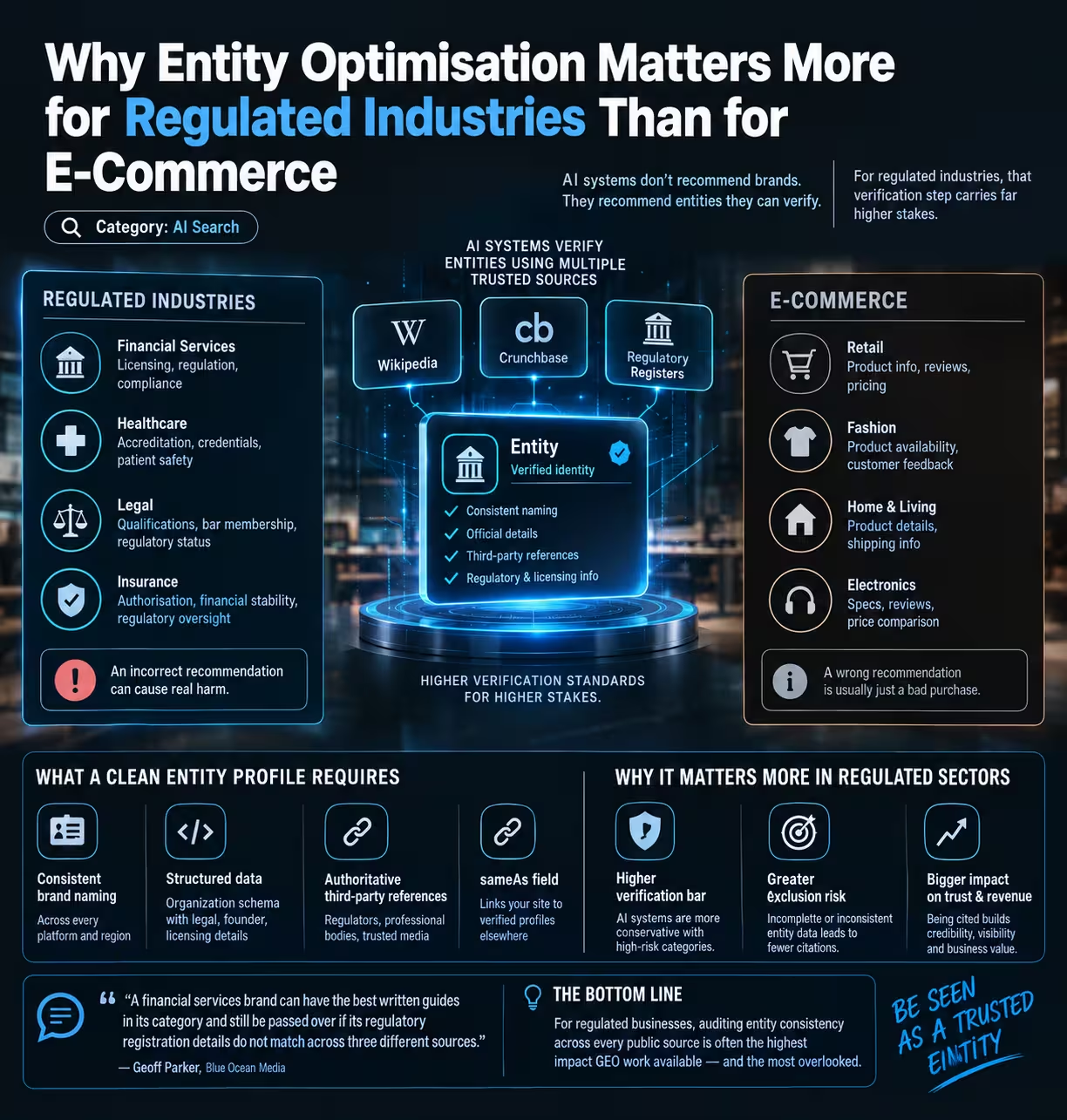
In some cases, models actively avoid naming brands to reduce legal or factual risk. If there is ambiguity, overlap, or potential for misrepresentation, the safest option is omission.
This makes brand invisibility a structural issue rather than a performance failure.
What This Means for Brand Strategy
Understanding how AI models decide whom to cite forces a shift in strategy. Visibility is no longer about winning a single ranking battle. It is about becoming a recognised reference point across many contexts.
The real shift is in marketing strategies for 2026 and beyond. No longer is SEO the main strategy, it’s now AI SEO or Generative Search Optimisation. Brands that want to be cited must focus on being informative, widely referenced, and easy to integrate into neutral explanations, which is all part of a leading AI SEO strategy. This requires investment in thought leadership, third-party validation, and content designed to be reused rather than clicked.