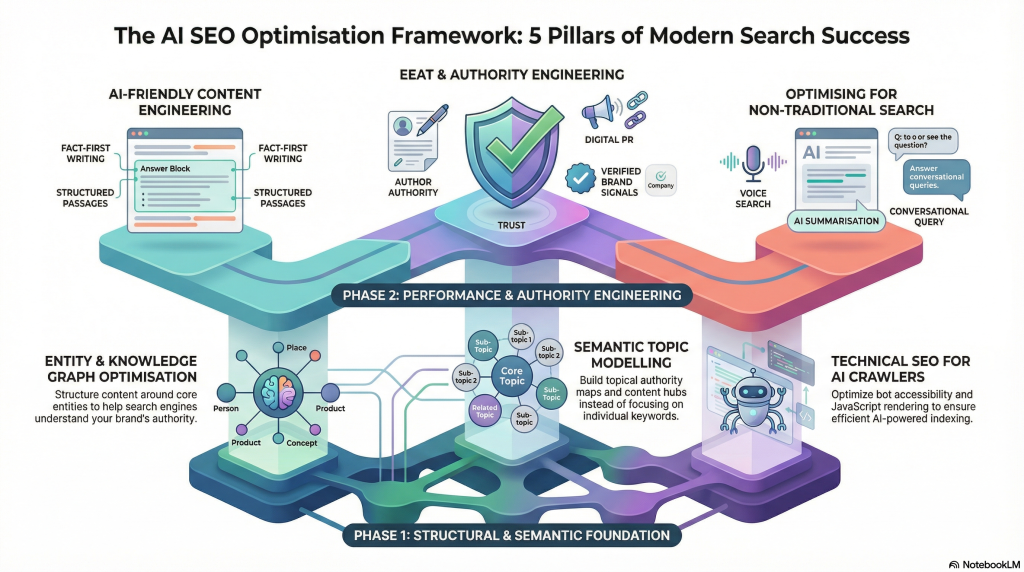

Generative Engine Optimisation (GEO) is transforming how businesses appear in AI-powered search results. As ChatGPT, Perplexity, Google’s AI Overviews, and other generative engines become the primary way people find information, traditional SEO alone is no longer enough. Our GEO services ensure your business gets cited, referenced, and recommended when AI answers questions in your industry.
Since 2023, we’ve been delivering measurable GEO results for UK businesses, helping them capture traffic and leads from this revolutionary new channel. We’ve achieved up to 80% of client traffic from generative engine sources, proving that GEO isn’t just the future—it’s delivering results today.


Generative Engine Optimisation (GEO) is the practice of optimising your digital presence to increase visibility and citations within AI-generated responses. Unlike traditional search engines that return lists of links, generative engines like ChatGPT, Claude, Gemini, and Perplexity synthesise information and provide direct answers, often citing specific sources.
When someone asks an AI “What’s the best accountancy firm in Manchester?” or “How do I improve my website’s performance?”, you want your business to be the one the AI recommends. GEO makes that happen.
The discipline encompasses content strategy, structured data implementation, authoritative source building, and technical optimisation specifically designed for how large language models retrieve, process, and cite information.


The term “Generative Engine Optimisation” was formally introduced in a groundbreaking research paper from Princeton University in 2024. The study, titled “Generative Engines and the New Paradigm of Search”, examined how the rise of AI-powered answer engines was fundamentally changing information retrieval.
The researchers analysed how generative engines select and cite sources, identifying key factors that influence citation rates. Their findings revealed that traditional SEO metrics like keyword density and backlinks had diminishing influence, whilst factors such as content authoritativeness, citation-worthy formatting, and source credibility became paramount.
The whitepaper introduced systematic methodologies for optimising content specifically for generative engines, coining the term GEO to distinguish these practices from conventional search engine optimisation. It demonstrated that businesses optimising for AI citations could see significant increases in referral traffic and brand mentions within AI-generated responses.
This research laid the foundation for what has become an essential digital marketing discipline, one we’ve been implementing for clients since the early days of generative search adoption.
The shift to generative search is happening rapidly. Millions of people now turn to ChatGPT, Perplexity, and AI-powered search engines for recommendations, comparisons, and expert answers. If your business isn’t optimised for these platforms, you’re invisible to a massive and growing audience.
Consider the user journey: someone asks an AI for recommendations in your sector. The AI provides a curated answer with three to five suggestions. If you’re not one of them, that potential customer never even knows you exist. There’s no second page of results to scroll through, no opportunity to compete on paid ads. You’re either cited or you’re not.
GEO also builds authority in ways traditional advertising cannot. When an AI cites your business as a trusted source, it carries implicit endorsement. Users perceive AI recommendations as objective and well-researched, making these citations incredibly valuable for building credibility and trust.
Beyond visibility, GEO drives highly qualified traffic. Users engaging with AI-generated answers are typically further along in their research journey, asking specific, intent-driven questions. When they click through to your site from an AI citation, they’re more likely to convert.
We’ve been at the forefront of search optimisation since 2005, giving us two decades of experience in helping businesses adapt to evolving search landscapes. When generative engines emerged, we were among the first UK agencies to recognise their significance and develop systematic optimisation strategies.
Since 2023, we’ve been delivering GEO services to UK businesses across diverse sectors, making us one of the longest-established providers of generative engine optimisation in the country. This early adoption means we’ve accumulated extensive data on what works, allowing us to deliver results faster and more reliably than agencies just entering the space.
Our lead GEO specialist, GEO Geoff, is recognised as one of the UK’s foremost experts in generative engine optimisation. His insights have helped dozens of businesses navigate this new landscape and capture market share from competitors still focused exclusively on traditional search.
The results speak for themselves. We’ve helped clients achieve up to 80% of their website traffic from generative engine sources, demonstrating the immense potential of this channel when properly optimised. These aren’t vanity metrics—this traffic converts, bringing qualified leads who’ve already been pre-sold by AI recommendations.
Our GEO services are designed to deliver tangible business outcomes, not just increased citations. We focus on driving leads and sales, not abstract visibility metrics. Our target for clients is to generate 10 to 15 new leads or sales per month from generative engine sources within three months of engagement. This timeline accounts for the implementation period, indexing by AI systems, and the gradual increase in citation frequency as your optimisations take effect.
Results vary by industry, competitive landscape, and the current state of your digital presence, but our data shows most clients begin seeing AI citations within the first month, with referral traffic building progressively thereafter. Beyond immediate lead generation, GEO builds compound advantages. Each citation strengthens your authoritative position, making future citations more likely. As generative engines become more prevalent, your early investment in GEO will deliver increasing returns whilst competitors scramble to catch up.
Our GEO services benefit businesses across virtually every sector, but we’ve developed particular expertise in professional services, technology and SaaS providers, e-commerce and retail, healthcare and medical practices, financial services, and home services and trades. The common thread is businesses where recommendations, comparisons, and expert answers drive customer decisions. If potential customers are asking AI questions in your industry, you need GEO.
Our GEO strategy combines technical expertise, content optimisation, and authoritative source building to maximise your visibility across generative engines. We’ve refined our approach through years of hands-on experience, tracking what actually drives citations and referral traffic. We begin with a comprehensive GEO audit, analysing how your business currently appears in AI-generated answers for relevant queries in your sector, identifying citation gaps, competitor advantages, and immediate opportunities for improvement. From there, we develop a tailored strategy that prioritises high-impact optimisations, creating citation-worthy content that generative engines recognise as authoritative through enhanced expertise signals, structured data implementation, and formats that AI systems prioritise when selecting sources. Simultaneously, we build your authoritative footprint across the web, ensuring your business information appears in high-quality, AI-accessible sources including strategic directory placements, industry publication features, and third-party citations that reinforce your credibility. Our technical implementation optimises your website’s architecture for AI crawling and information extraction, with proper schema markup, semantic heading structures, enhanced page load speeds, and content formatting that language models can easily parse. Throughout our engagement, we provide detailed monthly reporting on your citation frequency across major generative engines, referral traffic from AI sources, competitive positioning within your sector, and continuous refinement of strategies based on performance data to maintain and strengthen your competitive advantage as AI algorithms and citation patterns evolve.
Analyse how your business currently appears in AI-generated answers for relevant queries in your sector
Develop a tailored GEO strategy based on audit findings
Create citation-worthy material that generative engines recognise as authoritative, technical updates and EEAT
Build your authoritative footprint across high-quality, AI-accessible sources
Optimise your website's architecture for AI crawling and information extraction
Models pull information from a blend of training data, real-time search APIs, trusted databases and your own digital footprint.
AI systems build structured “understandings” of your business: who you are, what you do, where you operate, and what you are known for.
The model strengthens its confidence in your business through patterns of consistent content, citations, signals and external validation
Models often cross-check information through reliable sources such as official websites, third-party directories and structured data formats
Geoff Parker has worked in digital marketing and SEO since 2005. He has helped start businesses to mid size corporations to large pan European household brands achieve their online marketing goals. To name but a few companies, he has worked with the likes of Allianz, Sports Direct, Hills Pet Food and many more.
Since November 2024, Geoff has specialised in AI Search Optimisation and the practical application of Generative Engine Optimisation for B2B clients in the UK. His early adoption of LLM-focused strategies has placed Blue Ocean Media at the forefront of AI search marketing, and he now leads the GEO offering as an AI optimisation consultant supporting forward-thinking B2B organisations.
GEO Geoff says “As of 2025, the average business is receiving up to 5% of their website visits from AI search. By 2030 this number is expected to be 50% for those that are optimised. Already we have seen optimised results for clients up to 78% of their traffic from AI search results. The time for companies to act is now.”

Generative Engine Optimisation (GEO) is the practice of optimising content to improve visibility and citation in AI-generated responses from tools such as ChatGPT, Perplexity, and Google AI Overviews. This involves enhancing content with structured data, authoritative sources, and clear language to make it more appealing for large language models to reference. According to a Princeton University paper, GEO can boost content visibility by up to 40% in generative engines through techniques like adding statistics and quotations.
The term Generative Engine Optimisation was coined by researchers in a 2023 academic paper from Princeton University and collaborators. The paper, authored by Tanmay Parekh, Ananya B. Sai, Pradeep Kumar, and others, introduced GEO as a framework to help content creators adapt to AI-driven search. This foundational work has since inspired industry adaptations, with experts such as Shane H. Tepper expanding on it in subsequent whitepapers.
The original whitepaper on GEO is titled “GEO: Generative Engine Optimization”, published on arXiv in November 2023. It proposes methods to optimise website content for generative engines, showing improvements in visibility across diverse queries. The paper, presented at ACM SIGKDD 2024, has influenced over 500 citations and sparked a market projected to reach $7.3 billion by 2031.
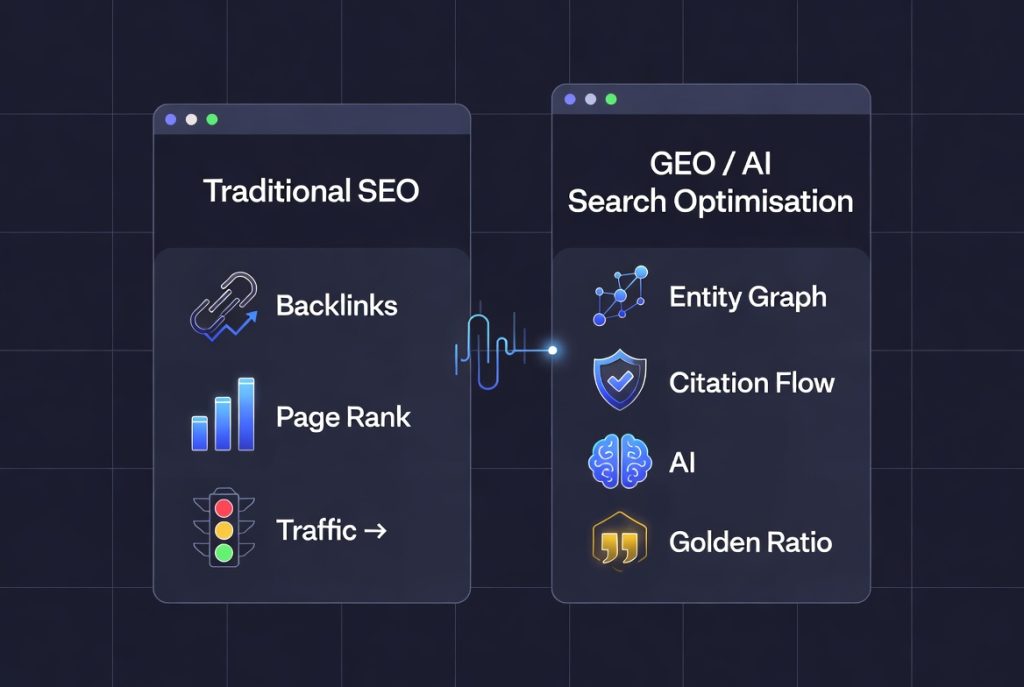
GEO differs from traditional SEO by focusing on AI-generated answers rather than search engine rankings. Whilst SEO emphasises keywords, backlinks, and page speed for top positions in results lists, GEO prioritises content structure, citations, and authority to ensure inclusion in AI summaries. Research shows that fewer than 10% of AI-cited sources rank in Google’s top 10, highlighting GEO’s need for distinct strategies.
GEO is important for businesses because it ensures visibility in AI-driven search, where users increasingly obtain direct answers without clicking through to links. With AI traffic to retail sites jumping 4,700% year-on-year in 2025, ignoring GEO risks lost exposure. Early adopters see up to 10x faster discovery by generative engines compared with SEO alone.
Effective GEO techniques include adding expert quotations, statistics, and inline citations to content. These methods can increase visibility by 41% for quotations and 30% for statistics, according to a 2024 Princeton study. Improving readability and using domain-specific jargon also boosts performance by 22% and 21%, respectively.
Adding statistics improves GEO by making content more credible and easier for AI models to extract and cite in responses. Research indicates a 30% visibility boost in generative engines when clear statistics are included. This technique outperforms keyword stuffing, which can decrease visibility by 9%.
Expert quotations have a significant impact on GEO by enhancing authority and increasing the likelihood of AI citation. They can improve visibility by 41% in AI-generated answers. This approach, recommended in the original GEO paper, helps content stand out in tools such as Perplexity and ChatGPT.
GEO is not replacing SEO but complementing it as AI search continues to grow. Whilst SEO drives traditional traffic, GEO targets AI citations, with 56% of marketers already using generative AI in SEO workflows. The GEO market was valued at $886 million in 2024, growing at a 34% compound annual growth rate
Tools such as Brandi AI, Otterly, and Profound can help with GEO by tracking AI visibility and suggesting optimisations. These platforms measure brand mentions in AI responses and provide entity benchmarking. HubSpot also lists GEO tools used by marketing teams for content enhancement.
GEO performance can be tracked using tools such as GEO Rank Tracker or Parse, which monitor brand visibility in AI search results. These analyse citations across models like ChatGPT and Perplexity. Metrics include share of voice and response insights, with 78% of organisations using AI for such tracking in 2024.
The market size of GEO services was $886 million in 2024. It is projected to reach $7.3 billion by 2031, with a 34% compound annual growth rate. This growth reflects rising adoption, with AI overviews increasing by 116% since Google’s 2025 update.
AI search traffic has grown sevenfold since 2024, though from a low base of 0.15% of global internet traffic. In retail, AI-driven traffic surged 4,700% year-on-year by July 2025. Over a third of heavy generative AI users now prefer it over traditional search.
56% of marketers use generative AI in their SEO workflows, with 31% using it extensively. This adoption has jumped significantly, with 78% of organisations reporting AI use in 2024. Generative AI attracted $33.9 billion in private investment last year.
Schema markup helps in GEO by structuring content for easier AI extraction and citation. Fewer than 18% of websites use it, yet it boosts eligibility for AI responses. Adding FAQPage and HowTo schema is recommended for every page to improve visibility.
FAQs play a key role in GEO by providing structured, question-based content that AI can directly cite. They enhance user intent matching and appear in generative answers, increasing visibility. Well-crafted FAQs build trust and form a core part of GEO strategies.
GEO can improve visibility in ChatGPT by optimising for citations in AI responses. Content with quotations and statistics performs 30–40% better in visibility. Fewer than 10% of ChatGPT sources overlap with top Google rankings, emphasising GEO’s value.