
The artificial intelligence landscape is experiencing a significant shift. Whilst Large Language Models (LLMs) continue to dominate headlines with their impressive capabilities, a more pragmatic revolution is quietly transforming how businesses approach AI adoption. Small Language Models (SLMs) are emerging as the strategic choice for organisations seeking targeted, efficient, and cost-effective AI solutions that deliver real-world results without the astronomical overheads of their larger counterparts.
For businesses exploring AI implementation, understanding SLMs isn’t just beneficial; it’s becoming essential. These compact yet powerful models are reshaping enterprise AI strategies, enabling everything from edge computing to privacy-first deployments, and they’re doing so with remarkable efficiency.
Understanding Small Language Models
Small Language Models are artificial intelligence systems designed for natural language processing tasks but with significantly fewer parameters than their larger relatives. Typically ranging from a few million to around 10 billion parameters, SLMs represent a fundamentally different approach to AI implementation, one that prioritises efficiency, specificity, and deployability over sheer scale.
Unlike general-purpose LLMs such as GPT-4, which can possess over 175 billion parameters, SLMs are purpose-built for focused applications. According to recent research from ACM Digital Library, SLMs are now downloaded more frequently than larger models in the Hugging Face community, indicating a clear shift in developer and enterprise preferences towards these more manageable solutions.
The defining characteristic of SLMs lies not merely in their parameter count but in their operational philosophy. These models are trained on curated, high-quality datasets tailored to specific domains, employing sophisticated techniques such as knowledge distillation, where a smaller ‘student’ model learns from a larger ‘teacher’ model, or parameter-efficient fine-tuning methods like LoRA (Low-Rank Adaptation). This focused approach enables SLMs to achieve exceptional accuracy in niche tasks whilst minimising computational demands.
Microsoft’s Phi series exemplifies this efficiency perfectly. With just 3.8 billion parameters, the Phi models demonstrate that SLMs can match or exceed LLM performance in focused areas such as coding or mathematics, but with inference speeds up to 30 times faster. Similarly, Google’s Gemma models (ranging from 2 to 9 billion parameters) and Mistral AI’s Ministral 8B showcase how thoughtful architecture can deliver enterprise-grade performance in a compact package.
The Technical Foundation of SLMs
The superior performance of SLMs stems from several key technical innovations. Unlike their larger cousins, SLMs employ streamlined architectures that make them inherently more efficient. Modern SLMs typically incorporate advanced features such as Grouped Query Attention (GQA), gated feedforward networks, and optimised activation functions that enhance performance whilst reducing computational overhead.
The compact design of SLMs is achieved through techniques such as knowledge distillation, pruning, and quantisation, methods that enable these models to capture the core capabilities of larger models whilst consuming a fraction of the resources. Research shows that approximately 72% of SLMs and their associated methods are publicly available, confirming a strong trend towards open science and collaborative development.
One particularly innovative aspect of SLM development is the use of model compression techniques. Pruning removes unnecessary neural connections, quantisation reduces the precision of model weights, and knowledge distillation transfers knowledge from larger models to smaller ones. Together, these techniques enable SLMs to maintain high accuracy whilst operating within strict resource constraints.
The result is a new generation of AI models that can run effectively on standard hardware such as laptops, mobile devices, or edge computing systems, eliminating the need for extensive cloud resources or expensive GPU clusters. Research indicates that serving a 7-billion parameter SLM is 10 to 30 times cheaper in terms of latency, energy consumption, and computational operations than a 70 to 175-billion parameter LLM, enabling real-time agentic responses at scale.
The Business Case for Small Language Models
For enterprises, the appeal of SLMs extends far beyond their technical elegance. These models address several critical business challenges that have historically hindered AI adoption, particularly amongst small and medium-sized enterprises.
Cost Efficiency and Return on Investment
The financial advantages of SLMs are substantial and multifaceted. Training and deployment expenses for SLMs are typically 75 to 90% lower than those for LLMs, with inference costs up to 30 times cheaper. This dramatic cost reduction enables businesses to achieve rapid return on investment, often measured in weeks rather than months.
Consider the development costs. Developing an SLM from scratch for small-scale models under 1 billion parameters can cost between £500 and £50,000 in compute resources, far lower than the millions required for LLMs. However, most businesses opt for fine-tuning pre-trained open-source SLMs, which typically ranges from £500 to £5,000 using techniques like LoRA on a single GPU.
For mid-range SLMs in the 3 to 14 billion parameter range, full training might reach £10,000 to £100,000, but platforms such as Hugging Face or Azure offer serverless options at around £4 per million tokens, making advanced AI accessible for SMEs. AT&T’s deployment of Mistral’s Ministral 8B achieved 90% cost savings and 70% latency improvements compared to frontier LLMs, demonstrating the tangible financial benefits of SLM adoption.
The ongoing operational costs tell an equally compelling story. When self-hosted, SLMs incur inference costs of mere pennies per million tokens, versus £5 to 30 for proprietary LLMs. This affordability is driving SLM adoption, with implementations reducing operational costs by 70 to 90% in enterprise settings.
Energy Efficiency and Sustainability
In an era where environmental responsibility is increasingly scrutinised, SLMs offer a sustainable path to AI adoption. These models consume up to 70% less energy than LLMs, directly addressing concerns about the carbon footprint of artificial intelligence.
Small models consumed 90% less energy than their large counterparts in 2025, representing a significant alignment of AI advancement with sustainability goals. For enterprises committed to reducing their environmental impact, this energy efficiency isn’t just a technical benefit; it’s a strategic advantage that supports corporate social responsibility objectives.
The sustainability benefits extend beyond raw energy consumption. Because SLMs can run on existing hardware rather than requiring specialised GPU clusters, they eliminate the need for additional infrastructure investments and the associated environmental costs of manufacturing and powering dedicated AI hardware.
Privacy and Data Security
For organisations operating in regulated industries, data privacy isn’t optional; it’s fundamental. SLMs excel in this domain by enabling on-premises deployment that keeps sensitive information entirely within organisational boundaries.
Approximately 75% of enterprise AI deployments now use local SLMs for sensitive data, a figure that underscores the importance of privacy-preserving AI solutions. In sectors such as healthcare, finance, and legal services, the ability to process information locally whilst complying with regulations such as GDPR, HIPAA, or financial services regulations represents a transformative capability.
Epic Systems, a major healthcare software provider, exemplifies this advantage. By adopting Microsoft’s Phi-3 SLM for its patient support system, Epic operates the model entirely on-premises, keeping sensitive health information secure and fully compliant with HIPAA regulations. This approach demonstrates how SLMs enable organisations to harness AI’s power without compromising their data governance requirements.
Performance and Precision
Contrary to the assumption that smaller means less capable, SLMs often outperform larger models in specialised tasks. This superior performance stems from their focused training on domain-specific data, which reduces issues such as hallucinations whilst enhancing accuracy in targeted applications.
According to Gartner’s 2025 AI Adoption Survey, 68% of enterprises that deployed SLMs reported improved model accuracy and faster ROI compared to those using general-purpose models. Similarly, an IBM Watson study found that enterprises using SLMs in regulated sectors achieved 35% fewer critical AI output errors than those relying on general-purpose LLMs.
In practice, this precision translates to tangible business outcomes. Customisation through fine-tuning on proprietary data can deliver up to 37% better accuracy in domain-specific tasks, dramatically improving reliability. When a legal firm increased research efficiency by three times whilst reducing hallucination errors by 72% after adopting an SLM, it demonstrated the practical value of targeted AI systems.
Real-World Applications of SLMs across Industries
The versatility of SLMs is perhaps best illustrated through their diverse applications across various industry sectors. These implementations showcase how organisations are leveraging SLMs to solve specific challenges, improve efficiency, and deliver measurable value.
Healthcare: Privacy-First Patient Support
Healthcare organisations face unique challenges in AI adoption, balancing the need for advanced capabilities with strict privacy requirements. Epic Systems’ implementation of Microsoft’s Phi-3 SLM for on-premises patient support exemplifies how SLMs address these challenges.
By deploying the model locally, Epic ensures complete HIPAA compliance whilst dramatically reducing response times for routine patient queries. This has led to streamlined workflows, lower manual interventions, and significant productivity gains through the automation of standard inquiries with high domain-specific accuracy.
The healthcare sector’s embrace of SLMs extends beyond patient support. Medical record summarisation, diagnostic assistance, and clinical documentation improvement all benefit from SLMs’ ability to process sensitive information locally whilst maintaining the precision required for healthcare applications.
Finance: Compliance and Fraud Detection
In the financial services sector, precision and compliance are non-negotiable. Infosys demonstrates this perfectly with its deployment of Topaz BankingSLM and ITOpsSLM, developed using NVIDIA technology for compliance checks and fraud detection.
These implementations are saving millions annually through 90% cost reductions and improved security without cloud reliance. The SLMs process transactions in real time, minimising losses from anomalies whilst ensuring all operations meet stringent regulatory requirements.
The finance sector’s adoption of SLMs is driven by their ability to handle domain-specific jargon, understand complex regulatory frameworks, and operate within strict data residency requirements. Whether analysing credit applications, detecting suspicious transactions, or ensuring regulatory compliance, SLMs deliver the specialised intelligence that financial institutions require.
Manufacturing: Edge Intelligence
Manufacturing environments present unique challenges for AI deployment, including the need for real-time decision-making in resource-constrained settings. Rockwell Automation’s integration of Phi-3 provides operators with natural language troubleshooting capabilities, cutting downtime and energy use on local hardware.
In agriculture, Bayer’s E.L.Y. SLM guides farmers on compliance matters, saving up to four hours weekly per user and boosting decision accuracy by 40%. These implementations demonstrate how SLMs bring advanced AI capabilities directly to the point of need, even in environments where cloud connectivity might be limited or unreliable.
Automotive: Offline Intelligence
The automotive sector illustrates another compelling SLM use case. Cerence’s CaLLM Edge SLM enables offline voice commands in vehicles, reducing latency for automakers whilst enhancing the user experience. This capability is particularly valuable in scenarios where consistent internet connectivity cannot be guaranteed, such as rural areas or underground parking facilities.
By processing commands locally, automotive SLMs deliver immediate responses whilst protecting user privacy, as voice data never leaves the vehicle. This combination of performance and privacy represents exactly the type of value proposition that’s driving SLM adoption across industries.
Retail and Telecommunications: Customer Experience
In retail and telecommunications, SLMs are transforming customer service operations. Telecom operators using SLMs to resolve customer inquiries have achieved 40% fewer human-handled calls with precise, company-specific responses that maintain brand voice whilst dramatically reducing operational costs.
These implementations showcase how SLMs excel at handling routine, repetitive tasks that require consistent accuracy but don’t demand the broad knowledge base of larger models. By automating these interactions, organisations free human agents to focus on complex issues that genuinely require human judgement and creativity.
SLMs in the Broader AI Ecosystem
Understanding where SLMs fit within the larger AI landscape is crucial for making informed implementation decisions. These models don’t exist in isolation; rather, they represent one component of increasingly sophisticated AI architectures.
SLMs and Custom GPTs
A common question concerns the relationship between SLMs and Custom GPTs available through platforms like OpenAI’s ChatGPT. Whilst both offer customisation, they differ fundamentally in their architecture and deployment models.
Custom GPTs primarily leverage proprietary large models like GPT-4o or its variants, which possess hundreds of billions of parameters. They function as customised interfaces built on top of these large models using prompt engineering and retrieval-augmented generation, allowing users to tailor responses without creating a new model from scratch.
Recent updates have introduced options to base custom GPTs on smaller variants like GPT-4o mini, which qualifies as an SLM with fewer parameters, offering faster and cheaper performance for specific tasks. GPT-4o mini provides near-equivalent accuracy to larger models in targeted applications but at a fraction of the cost, approximately 100 times cheaper per token.
However, the key distinction lies in accessibility and independence. True SLMs, such as open-source options from Hugging Face like DistilBERT, can be downloaded and run locally with complete control over the model, whereas Custom GPTs remain API-bound and dependent on OpenAI’s infrastructure. This proprietary nature limits their classification as independent SLMs, even when using efficient bases.
SLMs Versus Large Language Models
The relationship between SLMs and LLMs isn’t one of competition but complementarity. Both have valuable roles to play, and the question isn’t which is superior but rather which is appropriate for a given task.
LLMs excel at tasks requiring broad knowledge, creative synthesis, and complex reasoning across diverse domains. They’re the appropriate choice when flexibility and breadth of capability justify the associated costs and computational requirements. However, deploying an LLM for routine tasks that SLMs handle effectively is akin to using a supercomputer where a workstation will suffice.
SLMs, conversely, prioritise precision over breadth. They excel in repetitive subtasks, domain-specific applications, and scenarios where speed, cost efficiency, and data privacy are paramount. Modern advances in distillation, high-quality training data, and post-training techniques have significantly narrowed the capability gap, making SLMs viable for an ever-expanding range of production workloads.
Many forward-thinking organisations are adopting hybrid approaches, deploying SLMs for routine operations whilst reserving LLMs for complex, ambiguous scenarios that require extensive reasoning. Research indicates that SLMs are ideal for 40 to 70% of agentic AI calls, with hybrid systems enabling agents to reserve LLMs only for situations requiring their broader capabilities.
SLMs and AI Agents
The distinction between SLMs and custom AI agents is equally important. SLMs are compact neural networks focused on language tasks such as text generation or classification. They possess limited autonomy, serving as the ‘brain’ in systems but requiring external prompts to function.
Custom AI agents, by contrast, are complete architectures that incorporate SLMs or LLMs alongside tools, memory, and planning loops for goal-directed, iterative behaviour. An SLM like Llama 3.1B handles text prediction passively, whilst an AI agent built with frameworks like LangChain might use it to orchestrate multi-step workflows autonomously.
The deployment differs as well. SLMs often run locally for privacy and efficiency, whilst agents can be cloud-based or local but are inherently more complex to debug, relying on the underlying model’s quality for overall performance. In practice, AI agents in customer support use SLMs for 80 to 90% of routine tasks, invoking larger models only for escalations requiring broader reasoning.
This modular approach, sometimes described as ‘Lego-like’ composition of agentic intelligence, represents the future of AI systems: scaling out by adding small, specialised experts instead of scaling up monolithic models.
The Growing SLM Market and Future Outlook
The market momentum behind SLMs tells its own compelling story. The global SLM market is projected to grow from $0.93 billion in 2025 to $5.45 billion by 2032, representing a compound annual growth rate of 28.7%. This explosive growth reflects not mere hype but fundamental shifts in how organisations approach AI implementation.
Several factors drive this expansion. The rise of edge computing has created demand for AI models that can operate effectively on smartphones, IoT sensors, drones, and embedded systems rather than depending on cloud infrastructure. This shift addresses critical concerns around latency, data security, and energy consumption by minimising reliance on centralised servers.
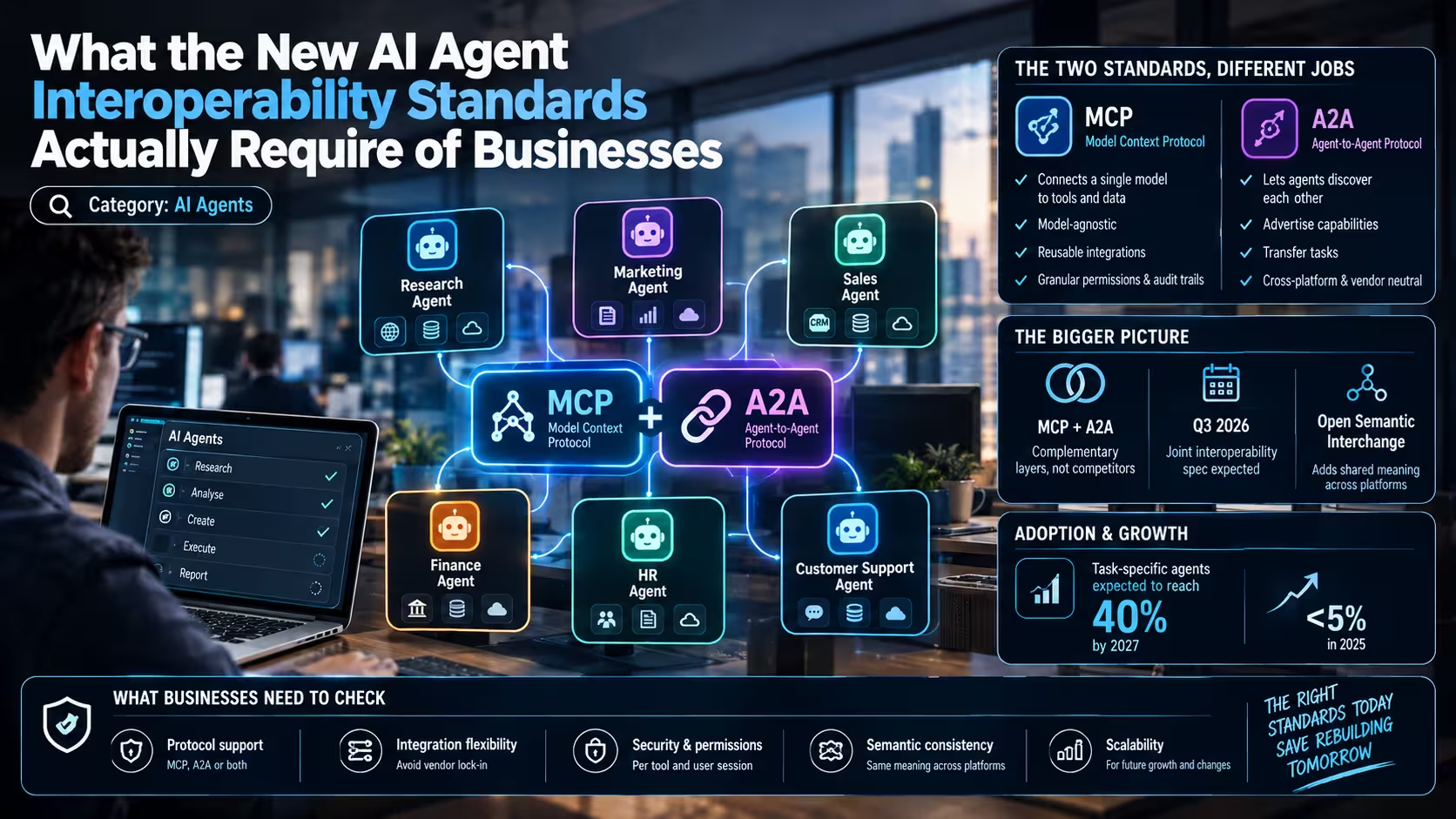
By 2026, over 80% of enterprises are expected to have deployed generative AI applications or APIs, up from less than 5% in 2023, reflecting a rapid transition from experimentation to production deployment. Within this broader trend, SLMs are claiming an increasingly prominent role as organisations discover their practical advantages.
Industry analysts project that 2026 will mark a pivotal transition from monolithic, general-purpose AI systems to engineered, heterogeneous architectures where specialised SLMs act as core cognitive components. The dominant narrative emerging from recent research is clear: performance is no longer strictly coupled with parameter count. Instead, the future lies in heterogeneous model fleets where specialised SLMs are orchestrated within agentic workflows.
Major technology companies including Microsoft, Google, Meta, IBM, and Mistral AI are actively investing in SLM development, recognising that these models represent not a compromise but a strategic opportunity. North America currently leads the SLM market, owing to its advanced AI infrastructure, strong research and development ecosystem, and concentration of top technology firms.
The trend towards SLM adoption is particularly pronounced in regulated sectors and amongst organisations with specific privacy requirements. Approximately 75% of enterprise AI deployments now use local SLMs for sensitive data, demonstrating how these models enable AI adoption in contexts where cloud-based solutions face significant barriers.
Looking ahead, several key trends are shaping the SLM landscape. Advanced collaborative protocols between models in heterogeneous fleets will enable more sophisticated multi-model systems. Improvements in training methodologies, including better approaches to instilling generalised reasoning capabilities in smaller architectures, will continue narrowing the capability gap with larger models. Unified evaluation frameworks that measure the performance, safety, and economic efficiency of entire heterogeneous model systems will provide better tools for assessing real-world effectiveness.
Small Language Model Market to Grow 6X in 6 Years
Small Language Models represent far more than a mere technical innovation; they embody a fundamental rethinking of how organisations approach artificial intelligence. By prioritising efficiency, precision, and deployability over sheer scale, SLMs make advanced AI accessible to enterprises of all sizes whilst addressing critical concerns around cost, privacy, and sustainability.
The projected growth of the SLM market from $0.93 billion in 2025 to $5.45 billion by 2032 reflects widespread recognition that targeted, efficient AI delivers superior value for most real-world applications. As organisations transition from experimental AI to production deployments, SLMs are emerging as the pragmatic choice, delivering 80 to 90% of large model capabilities at a fraction of the cost and environmental impact.
For businesses considering AI implementation, particularly those in regulated sectors or with specific privacy requirements, SLMs offer a pathway to harness AI’s transformative potential without compromising on data governance, budget constraints, or sustainability commitments. The technology has matured beyond early adoption; it’s now ready for mainstream deployment.
At Blue Ocean Media Ltd, we understand that successful AI implementation requires more than simply deploying models; it demands strategic thinking about how AI enhances your specific business objectives. Whether you’re exploring AI-powered content optimisation for AEO and GEO, developing intelligent agents for customer engagement, or seeking to increase your visibility in AI-generated answers, the right AI strategy can transform your digital presence.
As 2026 progresses and beyond, the question for forward-thinking enterprises isn’t whether to adopt AI but how to do so strategically, efficiently, and sustainably. Small Language Models provide compelling answers to all three considerations, making them not merely a trend to watch but a technology to embrace.
Small Language Model FAQs
An SLM is a compact AI system designed for natural language processing with far fewer parameters than large language models. SLMs typically range from a few million to around 10–15 billion parameters, whereas LLMs often exceed hundreds of billions or even reach trillions. This smaller scale allows efficient deployment on standard hardware and edge devices.
SLMs differ from LLMs chiefly through their much lower parameter count and their focus on specialised tasks. Modern SLMs frequently achieve 80–90% of LLM performance on benchmarks at roughly 1/100th of the cost, thanks to techniques such as knowledge distillation and domain-specific training. In many cases, fine-tuned SLMs outperform general-purpose LLMs within their specialised domains owing to higher accuracy on focused datasets.
Yes, modern SLMs can carry out complex tasks very effectively within their specialised domains. Enterprises that have deployed SLMs often report improved accuracy, with surveys indicating that many achieve better results than general-purpose models in real-world settings. SLMs manage sophisticated workflows such as fraud detection, clinical decision support, and multi-step agentic processes, frequently handling 80–90% of routine yet intricate tasks autonomously.
Fine-tuning an SLM for specific domains involves selecting a suitable pre-trained model and applying efficient techniques such as LoRA or QLoRA. These parameter-efficient methods enable customisation using modest hardware, often at a cost of £500 to £5,000 on a single GPU. Tools including the Hugging Face Transformers library, PEFT libraries, and PyTorch simplify the process, with high-quality domain-specific data being essential for strong performance improvements.
Yes, SLMs are significantly more cost-effective than LLMs across training, deployment, and inference. Training and running costs for SLMs are typically 75–90% lower, with real-world examples such as AT&T’s Ministral deployment delivering 90% cost savings and 70% lower latency. When self-hosted, SLMs cost only pennies per million tokens compared with £5–30 for proprietary LLMs, resulting in substantial savings at scale.
SLMs require far more modest hardware than LLMs and can often run on a single GPU or a standard laptop. Models in the 1–10 billion parameter range perform comfortably on consumer-grade systems, particularly when using quantised versions. More than 2 billion smartphones now support local SLMs, enabling offline and privacy-focused applications on edge devices and IoT hardware.
Open-source SLMs include Microsoft’s Phi family, Google’s Gemma series, Meta’s smaller Llama variants, Alibaba’s Qwen models, and Mistral’s Ministral series. Phi-4 excels at mathematics and reasoning, Gemma-3n handles multimodal inputs across more than 100 languages, and Qwen3-0.6B delivers strong agent capabilities despite its compact size. These models regularly achieve 80–90% of larger LLM performance at a fraction of the cost, with domain-specific fine-tuning further increasing accuracy.
Open-source SLMs deliver impressive performance and frequently match or surpass older LLMs in targeted areas. Well-designed SLMs reach 80–90% of frontier LLM benchmark scores while using far fewer resources. Custom fine-tuned versions can improve accuracy by up to 37% in specialised domains compared with general-purpose alternatives.
Yes, SLMs make an excellent foundation for multi-agent systems thanks to their efficiency and ability to specialise. They support modular architectures in which different SLMs handle distinct roles, cutting costs by 10–30 times in latency, energy use, and compute compared with all-LLM setups. In practice, SLM-based agents routinely manage 80–90% of routine tasks in customer support, reserving larger models only for rare complex cases.
Language models can be remarkably small—under 10 million parameters—and still produce coherent output when trained properly. Studies such as TinyStories have shown that models below 10 million parameters can generate fluent, grammatically correct text with reasoning ability when using carefully curated, high-quality data. For general-purpose conversation, 1–3 billion parameters usually ensure reliable coherence, though domain-specific tasks can succeed with even fewer parameters when data quality is prioritised over size.
SLMs are set to play a central role in enterprise AI, particularly in privacy-sensitive sectors such as healthcare and finance. By 2026–2027, organisations are expected to favour task-specific SLMs far more than general-purpose LLMs, with many deployments running locally to meet data compliance requirements. In regulated industries, SLMs enable on-premises processing for applications such as clinical decision support and fraud detection, while aligning with regulations and reducing energy consumption by up to 90%.