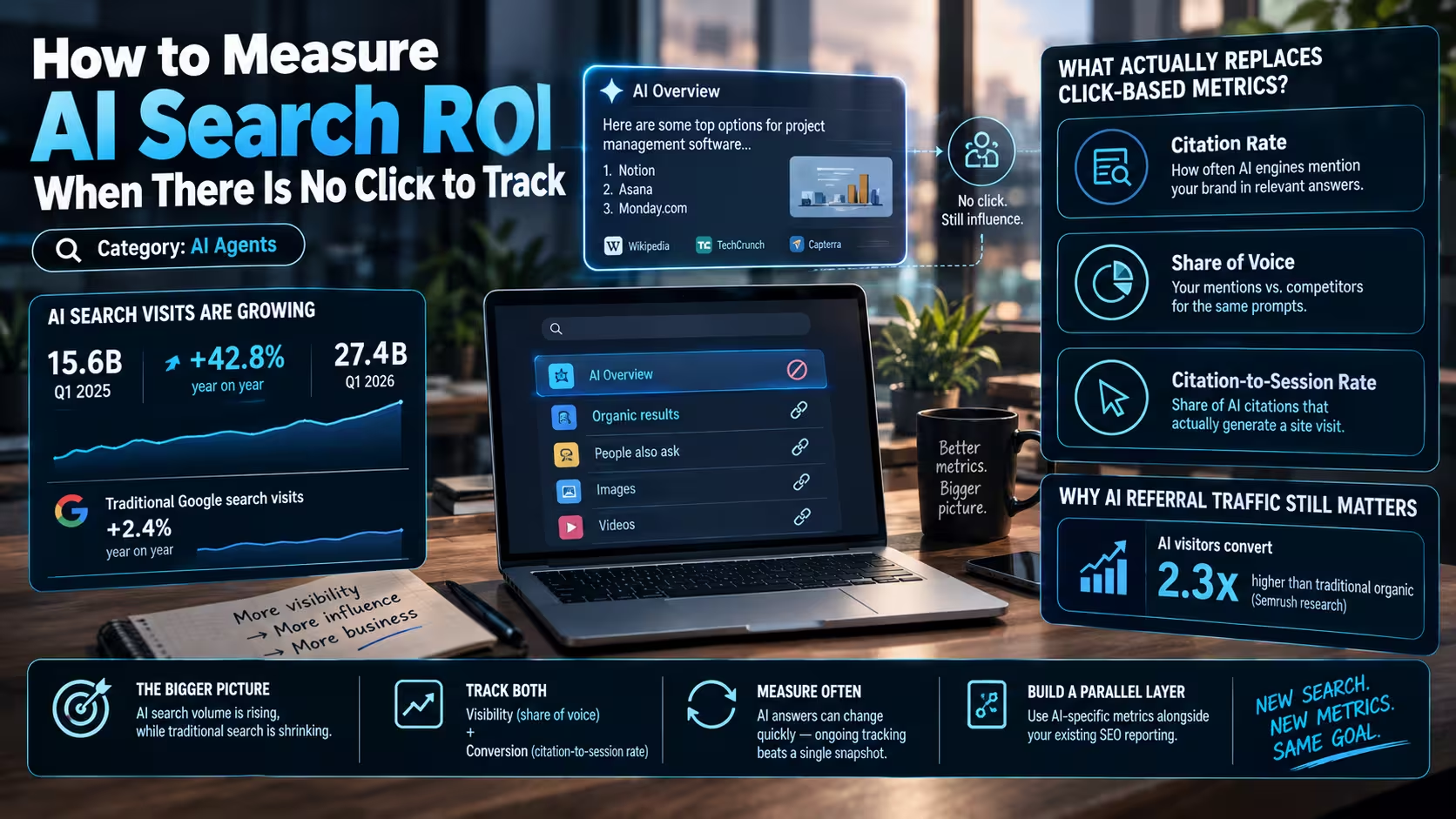

We have spent more than a decade optimising websites to rank on search engine results pages, yet the fastest-growing source of visibility is now arriving without a click. Research shows that over 60% of informational searches now end without a website visit, as users receive direct answers from AI interfaces such as ChatGPT, Perplexity and Google’s AI Overviews (SparkToro, 2024). For B2B companies in particular, this shift quietly removes entire stages of the traditional funnel.
The question is no longer how to rank higher on Google, but how a website becomes trusted enough to be cited at all. This article examines how AI systems choose which sources appear in their answers, and why structural decisions now matter more than stylistic ones for visibility.
What does it mean to appear in AI search answers?
Appearing in AI search answers means a website’s content is extracted, referenced or cited directly within an AI-generated response rather than surfaced as a ranked link. These systems prioritise sources that can be parsed quickly, validated with confidence and recombined without ambiguity.
Analysis of more than one million AI-driven queries found that websites designed for extraction achieved 40% higher visibility in AI answers than traditional long-form pages (Conductor, Dec 2025). This distinction matters because AI engines do not reward narrative depth in the same way as human readers. They reward clarity, modularity and entity consistency, which alters how content needs to be constructed if it is to be surfaced at all.
Why does atomic content perform better in AI search citations?
Atomic content is defined as self-contained units of information that retain meaning when isolated from the page they sit on. These units may be short paragraphs, explicit definitions, clearly scoped explanations or tightly framed data points. Large language models extract these units because they reduce contextual risk when generating answers.
A controlled study found that restructuring pages into modular, entity-rich sections increased AI citation rates by 25–30%, as models consistently favoured concise, verifiable snippets over dense narrative blocks (OMNIUS, 2025). This preference reflects how LLMs manage uncertainty. Smaller units with explicit context are easier to reuse without distorting meaning.
In practice, atomic content changes how websites are interpreted. Instead of being read sequentially, they are mined selectively, which rewards publishers who design information for recombination rather than linear consumption.
How does atomic content change commercial outcomes?
The impact of atomic content extends beyond visibility into measurable commercial performance. A real-world GEO case study showed that AI-sourced visitors converted at 27% higher rates than traditional organic traffic, driven by closer alignment between extracted answers and underlying intent (Single Grain, Oct 2025).
Another study analysing content clusters found that websites built from interlinked atomic elements achieved 40% higher AI answer visibility than monolithic resource pages (Conductor, Dec 2025). A separate brand-led case reported a threefold increase in leads after reformatting content into modular explanations and data-led sections designed for citation (Go Fish Digital, Sep 2025).
These outcomes suggest that AI search does not simply redistribute traffic. It concentrates attention on sources that minimise friction between question and answer.
What technical signals do AI systems prioritise?
Technical signals refers to whether AI crawlers can reach, parse and interpret a website without obstruction. This includes crawlability, mobile optimisation, HTTPS, fast load times and avoiding JavaScript barriers that prevent content extraction. Accessibility also covers semantic clarity, such as alt text and readable document structures.
Data from 41 million AI results showed that technically accessible sites appeared in 35% more AI overviews than comparable sites with blocking or rendering issues (SEOMator, 2025). WCAG-compliant websites also recorded 23% more organic traffic and ranked 27% higher in AI search results, reflecting the overlap between human and machine accessibility (Accessibility Works, Sep 2025).
These gains are not cosmetic. AI systems depend on clean inputs to reduce inference errors, which elevates technically accessible sites by default.
Why has EEAT become an AI risk control mechanism?
EEAT signals, covering experience, expertise, authoritativeness and trustworthiness, act as safeguards against hallucination in AI systems. Models favour sources that demonstrate accountability through authorship, credentials, citations and consistent topical authority.
One case study recorded a 2,300% increase in AI-driven traffic after strengthening EEAT signals through expert bios, cited data and transparent sourcing (Search Initiative, 2025). Broader analysis found that EEAT-aligned content generated 45% more generative mentions, while also reducing volatility in AI rankings by 25% (BrightEdge, May 2025).
As Aleyda Solis noted, “AI systems need confidence signals, not just relevance signals, which is why attribution and expertise are increasingly decisive” (Aleyda Solis, Jul 2025). This framing explains why anonymous or thinly attributed content struggles to surface in AI answers regardless of keyword coverage.
How does structured content supports AI citation?
Structured content provides the scaffolding that allows AI models to extract information reliably. Headings, tables, clearly defined sections and explicit claims reduce ambiguity and improve verification. Google guidance indicates that structured formats increase AI visibility by 30–40%, particularly for factual and explanatory queries (Google, May 2025).
A study by DMI reported a 40% increase in AI citations when content presented verifiable claims in structured formats, while Seer Interactive observed similar gains from list-based explanations and tables (DMI, Nov 2025; Seer, May 2024). These structures help models distinguish core facts from supporting context.
| Content format | Primary AI use |
| Definitions | Entity grounding |
| Tables | Comparison and verification |
| Short sections | Citation-ready extraction |
| Explicit stats | Answer confidence |
The pattern reinforces a consistent theme. AI visibility is shaped by how information is organised as much as by what it contains.
What is LLMS.txt?
LLMS.txt is a root-level file that guides large language model crawlers on how to interpret and access site content. It functions as a declarative map rather than a ranking signal, helping AI systems locate authoritative sections and summaries efficiently.
Adoption has accelerated rapidly, with over 844,000 websites now implementing LLMS.txt to improve AI discoverability and citation accuracy (Search Engine Land, Mar 2025). Studies show that providing structured summaries via LLMS.txt reduces hallucination risk and improves citation accuracy by 20–30% (GetPublii, Oct 2025).
Rather than acting as a shortcut, LLMS.txt reinforces a broader shift towards explicit machine communication alongside human-readable content.
Why does schema markup helps AI recognise entities?
Schema markup adds semantic context that allows AI systems to identify entities, relationships and attributes with greater certainty. This clarity reduces ambiguity when models generate answers that reference organisations, services or products.
Research shows that pages using schema appear in 36% more AI-generated summaries, while semantic enhancements drive 20–30% improvements in overall AI visibility (WP Riders, Dec 2025; Schema App, Sep 2025). These gains reflect how entity recognition underpins citation confidence.
Schema does not replace content quality, but it clarifies meaning at scale, which is essential when AI systems compare multiple sources rapidly.
What marketers are saying about AI search right now
Discussion on X reflects growing recognition that AI search rewards structure over volume. Threads referencing atomic audits, schema implementation and LLMS.txt adoption consistently emphasise reusability and entity clarity. Tools designed to detect atomic signals are being shared widely, with practitioners reporting increased brand mentions when content is designed for extraction rather than persuasion (Atomic AGI on X, 2025).
The tone of these discussions is pragmatic rather than speculative. AI search is being treated as an engineering problem, not a creative one.
Blue Ocean Media perspective on AI search optimisation
Geoff Parker, Managing Director of Blue Ocean Media, frames the shift bluntly. “AI search is not replacing SEO, but it is bypassing poorly structured websites altogether. It won’t be long before we see more traffic from AI queries than from Google queries. Searchers want the correct answer as quick as possible – at the moment AI driven responses are winning that race”.
This perspective reflects operational reality. Structural changes take time to implement, and AI systems reward consistency rather than short-term optimisation.
AI search will influence 50% of B2B discovery decisions by 2026
Forecasts suggest that AI-driven interfaces will influence half of all B2B discovery journeys by 2026, reshaping how buyers encounter expertise and evaluate suppliers (Gartner, 2025). For companies relying on search visibility, 2026 will be the year that AI search optimisation will be the integral marketing strategy, ahead of SEO. We are already seeing that AI systems do not surface every credible website. They surface the ones designed to be understood. Acting now is less about chasing novelty and more about aligning content with how information is actually consumed in an AI-first environment.