
Search has changed. Not slowly, over years, but measurably, in months. If you are a business owner still measuring success purely by Google rankings and organic traffic, there is a very real chance you are missing a significant and growing slice of the customers who are looking for exactly what you offer.
That is where AISEO comes in. It is the practice of optimising your brand and content to be referenced, cited or recommended by AI-powered search and answer platforms, including ChatGPT, Microsoft Copilot, Perplexity, and Google’s AI Overviews.
A quick note on terminology before we go further: “AISEO” can sometimes refer to an AI writing software tool. This article is nothing to do with that. Here, AISEO refers to the emerging strategic discipline of AI Search Engine Optimisation, a growing field that also goes by names such as GEO (Generative Engine Optimisation) and AEO (Answer Engine Optimisation). The naming is a little chaotic, but the underlying shift is very real and worth understanding.
So, What Has Actually Changed?
For most of the last twenty years, search looked like this: someone types a query into Google, a list of blue links appears, and the most relevant one gets the click. Your job as a business was to rank as high as possible in those results so that more of those clicks landed on your website.
That model still exists, but it is being disrupted. AI-powered platforms now synthesise answers from across the web and deliver them directly, without the user needing to click through to a website at all. Your potential customer asks ChatGPT “who are the best estate agents in Birmingham for first-time buyers?” and ChatGPT names three companies, explains why they stand out, and offers a recommendation. If your business is not one of those three, you simply do not exist in that moment.
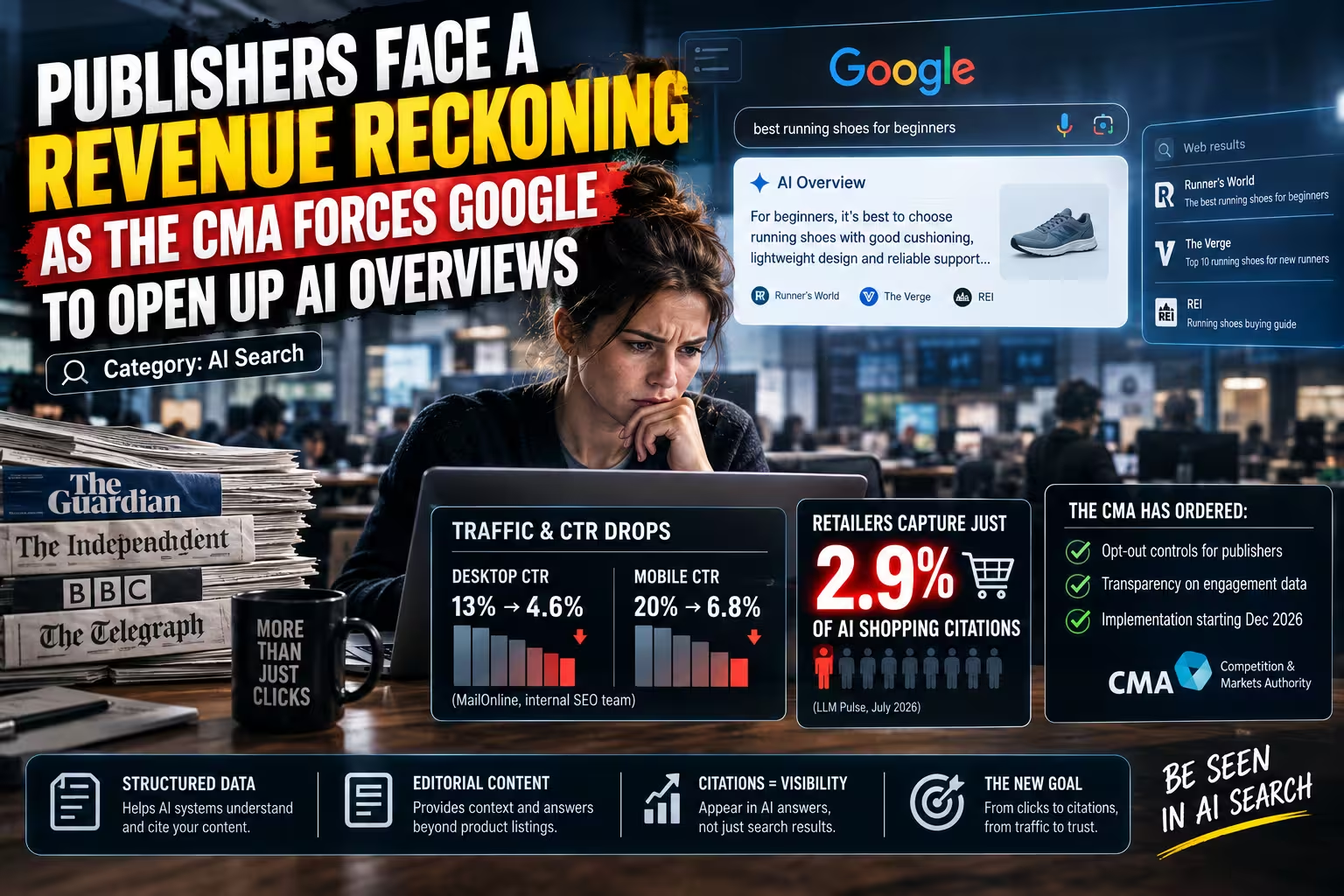
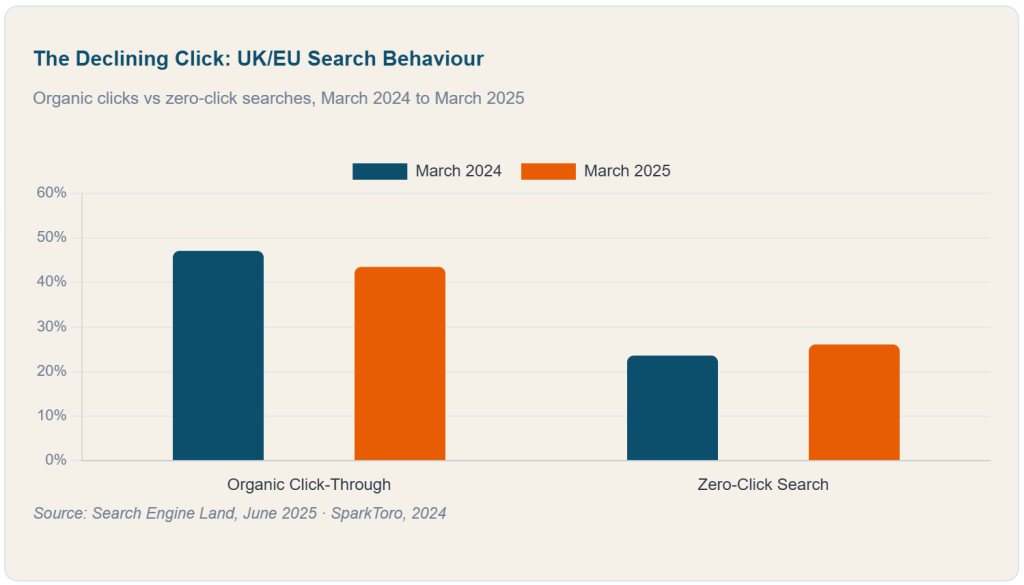
The numbers back this up. In the EU and UK, the proportion of Google searches resulting in a click through to a website fell from 47.1% in March 2024 to 43.5% by March 2025, while zero-click searches, where the user gets their answer without clicking anything, rose from 23.6% to 26.1% over the same period. After Google launched its AI Overviews feature, zero-click behaviour jumped even more sharply.
This is not a reason to panic. It is a reason to adapt. And the businesses that adapt early are already seeing the rewards.
Visibility vs Clicks: Why They Are No Longer the Same Thing
This is perhaps the most important mindset shift AISEO requires. Visibility and clicks used to move in lockstep; the higher you ranked, the more people clicked through to your site. But in an AI-first search environment, the two can decouple entirely.
An AI platform might mention your business twenty times a week in response to relevant queries, building familiarity and trust in the minds of potential customers, without sending a single person directly to your website. Those people may then search for your brand by name, call you directly, or simply arrive at your door already knowing who you are and why they trust you.
If your reporting still begins and ends with “sessions from organic search,” you are already under-measuring your brand’s influence. The businesses winning in AI search are those tracking a broader picture: brand mentions in AI responses, branded search volume, direct traffic trends, and ultimately the quality and volume of enquiries.
How AI Search Engines Decide What to Mention
This is the technical heart of AISEO and understanding it makes the whole strategy make sense.
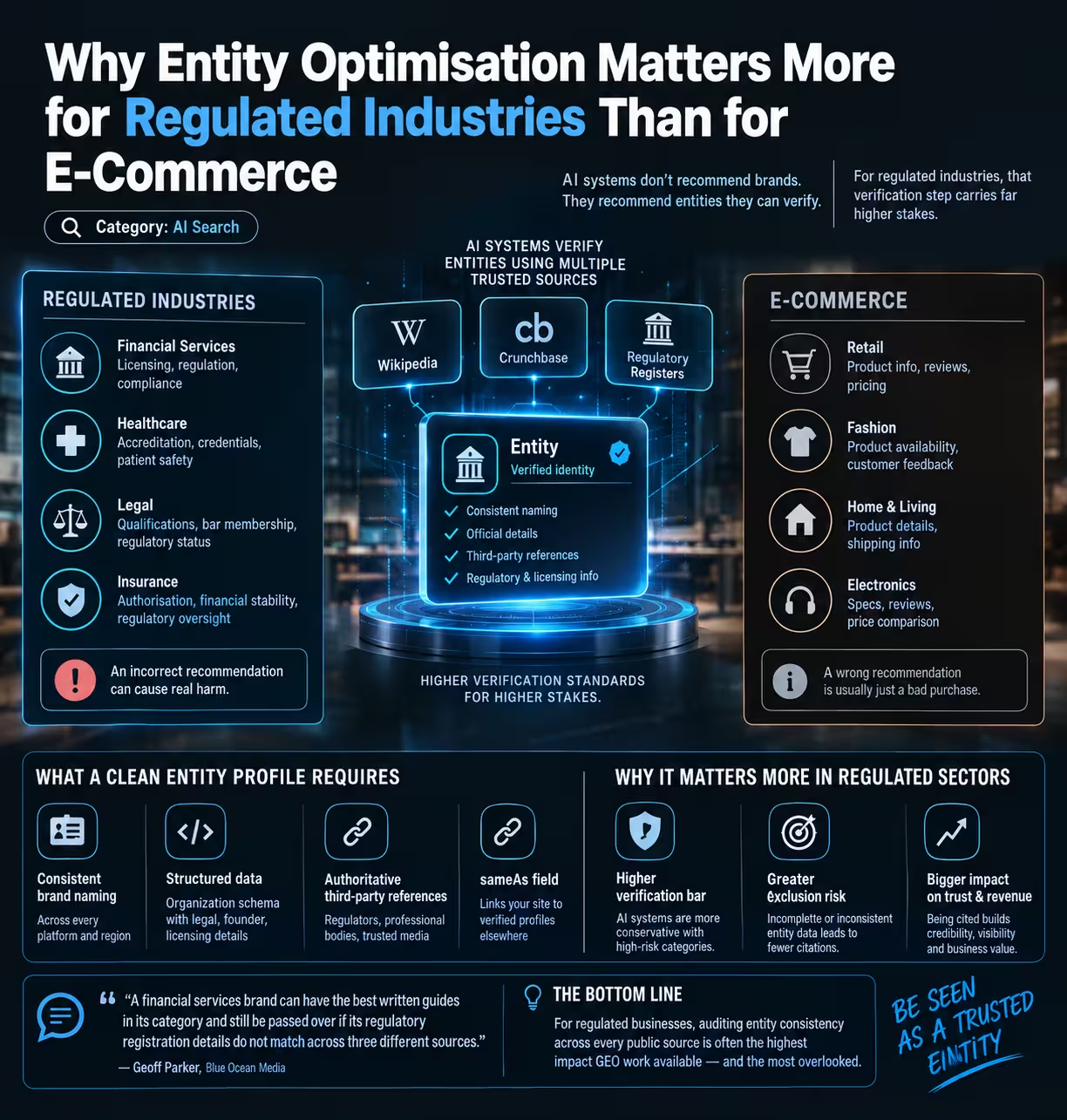
Traditional SEO rewards the page that is most relevant to a query, using signals like keywords, inbound links, and user behaviour. AI search works differently. It looks for consensus. When an AI platform synthesises an answer, it is far more confident recommending or citing a business when multiple credible, independent sources corroborate the same information about that business.
Your Website Is No Longer Your Only Asset
Think of your brand’s presence across the internet as your “surface area.” The larger and more consistent that surface area, the more likely AI platforms are to trust and cite you. This means your website matters, but so does your presence on industry directories, trade publications, review platforms, partner sites, and any third-party source that AI systems draw from when building their answers.
A business might have a beautifully optimised website with excellent content, but if that content is the only place on the internet where their expertise is referenced, an AI platform will be cautious about citing them. A competitor with a slightly less polished website but with consistent mentions across a dozen credible third-party sources will appear in AI responses far more reliably.
This is the “consensus and corroboration” principle that practitioners working in AI search have been discussing since at least 2025, and it is one of the most practical frameworks for understanding what AISEO actually involves.
Which Businesses Benefit Most from AISEO?
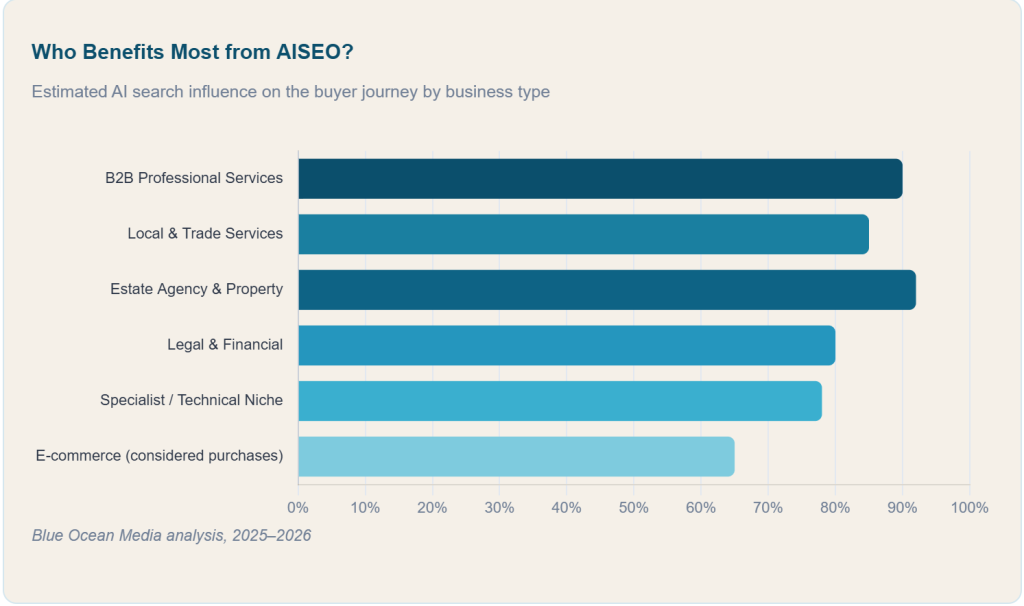
The honest answer is that almost any business selling something where the buyer does research before committing stands to benefit. But some categories see particularly strong returns.
High-Consideration Services
B2B service businesses such as agencies, consultancies, accountancy firms and IT providers are a natural fit. When someone asks an AI platform “which digital marketing agencies specialise in SEO for professional services firms?” the AI generates a shortlist. You either appear on that shortlist or you do not. There is no second page.
Local service businesses, including trades, legal firms, medical clinics and estate agencies, benefit in a similar way. AI answers are increasingly compressing the “who is best near me?” journey into a single synthesised response rather than a list of results.
Specialist and Technical Niches
If your business operates in a niche with genuine complexity, AISEO rewards you for publishing clear, authoritative explanatory content. AI platforms favour a business that can define the problem, explain the options and articulate why their approach is best. That is the kind of content that earns citations.
Businesses Where the First Interaction Is an Enquiry
If your sales process starts with a call, a quote request, a booking or a demo, AI visibility can drive demand even when it does not drive a direct click. The customer has already been pre-sold by the time they reach you, because the AI platform built their confidence in your brand before they ever visited your website. This is not a theory; it is something we have seen in practice with our own clients.
A Real-World Example: 85% More Enquiries for a UK Estate Agency
This client had been ranking strongly in Google for years, delivering consistent enquiry volumes through traditional SEO. But in 2023, buyer behaviour began to shift. Prospective clients were increasingly turning to ChatGPT and Microsoft Copilot to research agents and seek recommendations, and this business was simply not appearing in those AI-generated responses.
Blue Ocean Media implemented a structured 60-Day AI Search Visibility Sprint, restructuring content for AI readability, expanding the brand’s corroboration footprint, and establishing entity consistency across platforms.
“ChatGPT and CoPilot now make up the majority of our enquiries. We don’t need any reports from Blue Ocean to tell us that — our clients tell us weekly that they found us on CoPilot or ChatGPT and proceed to complement us on how well we are doing with our online marketing.” Gemma, Managing Director.
Click here to read the full AISEO case study
0 → 23AI citations out of 50 tracked queries
55% of enquiries now AI-driven (up from 0%)
85% total enquiry growth over 12 months
What Does AISEO Actually Involve?
There is no single magic tactic. AISEO is a system that operates across three areas simultaneously.
On-Site: Making Your Content AI-Ready
AI platforms extract information differently from how a human reads a webpage. Content needs to be structured so that it can be understood and cited out of context. This means clear definitions, well-organised headings, answers that appear near the top of sections rather than buried in paragraphs, and content that demonstrates genuine expertise rather than simply echoing what everyone else has already written.
It also means ensuring your website clearly establishes who you are, where you operate, what you do and why you are credible. A strong About page, detailed author biographies, client evidence and case studies all contribute to what AI systems assess when deciding whether to trust and cite a source. If you want to go deeper on this, our guide to optimising content for ChatGPT covers the practical mechanics in detail.
Off-Site: Building Your Corroboration Layer
This is the area many businesses overlook entirely. Getting referenced in trade publications, earning mentions in industry directories, appearing in podcast discussions relevant to your sector, contributing to reputable third-party platforms: all of these build the network of corroborating signals that AI platforms use to verify a business’s credibility and relevance.
The goal is not link building for its own sake. It is establishing that multiple independent, credible sources agree on who you are and what you are good at. That consensus is what gives an AI platform the confidence to recommend you.
Measurement: Tracking What Actually Matters
This is where many businesses are currently flying blind. If you are still reporting only on keyword rankings and organic sessions, you are missing the majority of the AI visibility picture. Effective AISEO measurement tracks how often your brand appears in AI responses for key queries, how that changes over time, and how it correlates with branded search growth, direct traffic and ultimately enquiry volume.
Understanding how AI platforms like Perplexity surface and cite sources, for instance, is part of building an accurate measurement picture across the AI search landscape.
Is AISEO Replacing Traditional SEO?
No. And be wary of anyone who tells you it is.
Traditional SEO remains highly relevant. Google is still the dominant search platform and organic rankings still drive significant traffic for many businesses. The data shows that 99.5% of Google AI Overview citations overlap with content that already ranks well in traditional search, which means strong SEO remains a prerequisite for strong AI visibility, not an alternative to it.
What AISEO does is expand what “search visibility” means. It extends your strategy to cover the growing portion of the search journey that no longer passes through a traditional results page. You still need good SEO. You now also need AISEO. They are complementary, not competing. If you are interested in how B2B brands are approaching getting cited in ChatGPT and Gemini, that is worth reading alongside this.
What Should You Do Next?
The most important first step is simply to understand where you currently stand. Are you appearing in AI-generated responses for the queries that matter most to your business? If you do not know, that in itself is useful information, and it is the starting point for an AISEO audit.
From there, a structured approach typically moves through four phases: auditing your current AI visibility, restructuring your on-site content for AI readability, building your off-site corroboration layer, and establishing a measurement framework that captures what is actually happening. That is the methodology we have developed and refined since 2023, and it is the approach behind the results we have achieved for clients including the estate agency case study above.
The businesses that move on this earliest will build a meaningful advantage. AI platforms develop preferences for sources they have consistently cited over time; getting into that position now, before your competitors do, is a genuine strategic opportunity.