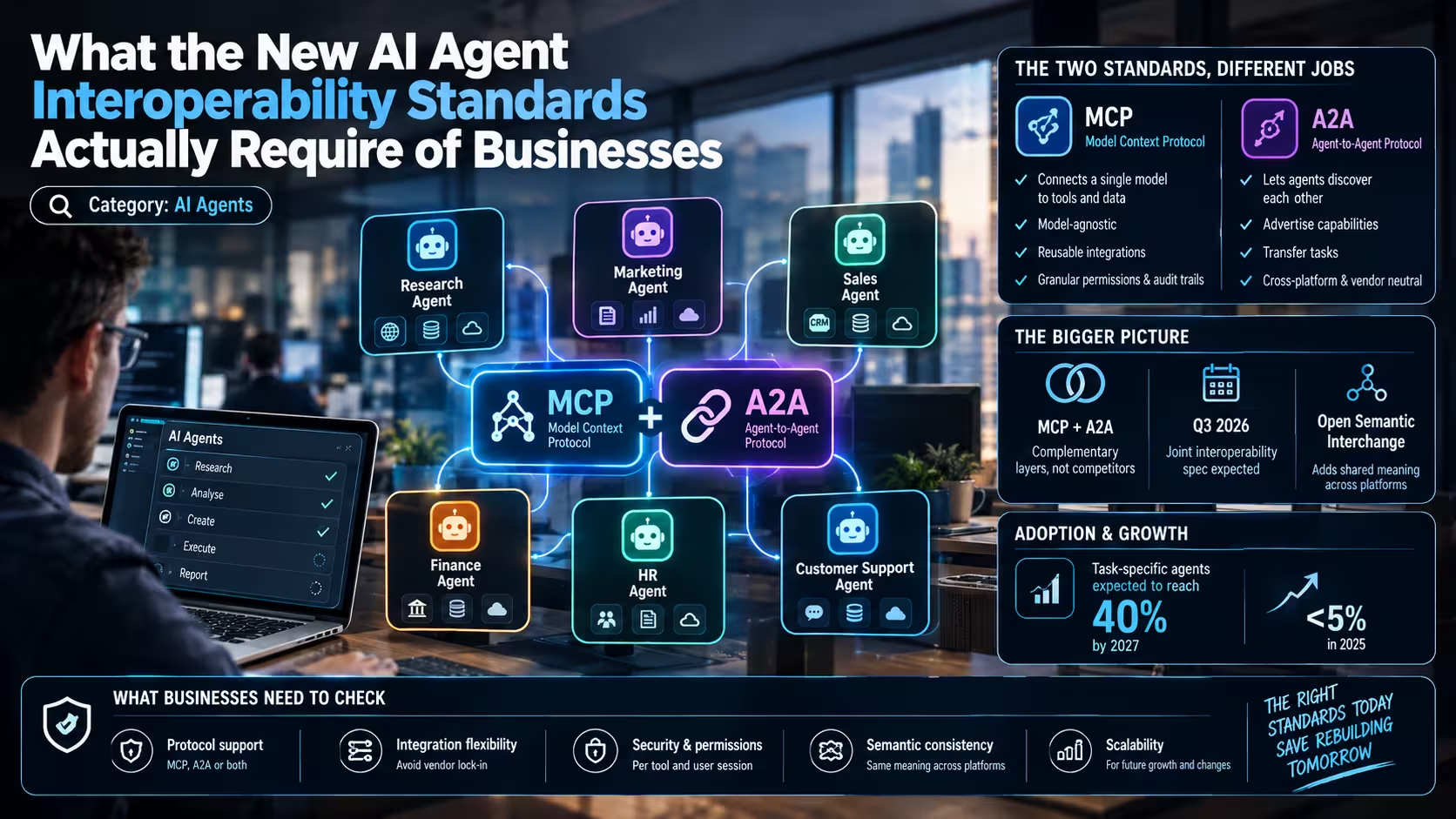

Gartner forecasts that nearly every business application will carry an AI assistant by the end of 2026, with 40% integrating task-specific agents within the following year, up from under 5% in 2025. That growth has made a previously obscure technical question, whether agents built on different platforms can actually talk to each other, into a live procurement issue for any business running more than one AI system.
This article sets out what the two protocols now shaping AI agents interoperability actually require, and what businesses adopting agentic systems need to check before assuming their tools will work together.
What MCP Actually Standardises
The Model Context Protocol, originated by Anthropic in 2024, standardises how a single AI model connects to external tools and data sources, the vertical relationship between a model and everything it needs to reach outside itself. It is model-agnostic by design, meaning integrations built against MCP are reusable assets rather than one-off connections that need rebuilding every time a business changes which model it runs.
In practice, MCP’s static, enumerable tool definitions also give businesses a genuine security advantage, since permissions can be applied per tool and per user session, producing an audit trail that many enterprise compliance teams need before approving any agent deployment at all.
What A2A Adds on Top
The Agent-to-Agent protocol, launched by Google in April 2025 and donated to the Linux Foundation two months later, standardises the horizontal relationship, how separate autonomous agents discover each other, advertise what they can do, and hand off tasks between them regardless of which vendor or framework built them. IBM’s competing Agent Communication Protocol merged into A2A in August 2025, consolidating what had briefly looked like a competing standards fight into a single dominant specification with more than 150 partner organisations.
Why Businesses Cannot Treat This as a One-Off Integration Decision
MCP and A2A operate at different layers and are increasingly treated as complementary rather than competing, MCP for how an agent reaches its own tools, A2A for how it collaborates with agents outside its own system. A joint interoperability specification bringing the two closer together is expected from major vendors including Google, Anthropic, Microsoft and Salesforce in the third quarter of 2026, meaning the standards themselves are still actively converging rather than settled.
A third emerging layer, sometimes called Open Semantic Interchange, standardises shared business meaning and definitions across platforms, addressing a problem protocol compliance alone does not solve, since two fully MCP and A2A compliant agents can still disagree on what a shared term actually means in a specific business context. Businesses evaluating agent platforms should treat protocol support and semantic consistency as two separate checks, not one, since passing the first does not guarantee the second.
What Is Being Said About Agent Standards Right Now
Enterprise teams already running both protocols in production report layering them deliberately, MCP for all tool interactions within a single agent, A2A only for the inter-agent orchestration where latency tolerance is higher. A recurring theme in practitioner discussion is treating protocol choice as a tactical decision rather than a permanent commitment, building abstraction layers that let a business swap the underlying protocol without rewriting the business logic sitting on top of it.
Adoption of Task-Specific Agents Is Set to Reach 40% by 2027
Geoff Parker of Blue Ocean Media says businesses evaluating agent platforms should be asking about protocol support before anything else. “The question we get most often is which agent platform to buy, but the more useful question is whether that platform speaks MCP, A2A, or both,” Parker says. “Businesses that pick a platform locked into a proprietary integration approach are going to find themselves rebuilding everything in twelve months, while the ones asking about protocol support now are buying something that will still work as the ecosystem consolidates.”
For businesses evaluating or already running multiple agent tools, checking protocol compatibility now, rather than after a costly integration project reveals the gap, is the more reliable route through a standards landscape that is still actively converging.