
For two decades, the “search engine” was a librarian. You asked a question, and it pointed you to a book. But as of January 2026, the librarian has moved into your house, read your mail, looked through your photo albums, and memorised your travel plans.
Google’s rollout of Personal Intelligence in AI Mode represents the single most significant shift in the history of the company. It is no longer about finding the best answer; it is about finding the only answer that fits the user’s specific life at this exact micro-moment. For brands, this isn’t just another algorithm update. It is an “extinction event” for traditional top-of-funnel SEO. If your brand doesn’t exist within the user’s personal “context loop,” you are effectively invisible.
The Mechanics of Personal Intelligence
At its core, Personal Intelligence is an integration layer powered by the Gemini 3 model architecture. Unlike previous iterations of search that relied on public web retrieval, Personal Intelligence enables a secure, real-time “bridge” between the public web and the user’s private Google ecosystem—specifically Gmail, Google Photos, YouTube history, and Maps data.
The “Personal Context Loop” When a user toggles into AI Mode (a feature that reached full U.S. rollout on January 14, 2026), the engine doesn’t just crawl the web. It queries the user’s Connected Content Apps. This creates what Google engineers call “Cross-App Reasoning.”
Consider a search for “best walking shoes for my trip”:
- The 2024 Search Experience: Google shows top-rated shoes based on reviews and affiliate blogs.
- The AI Mode Experience (2025): Google summarises the top three shoes and adds a carousel of buying options.
- The Personal Intelligence Experience (January 2026): Gemini 3 sees a flight confirmation in Gmail for a trip to the cobblestone streets of Rome in April. It scans Google Photos and notes the user wears a specific size (9.5) and prefers wide-fit silhouettes. It cross-references the weather forecast for Rome (highs of 20°C).
- The Result: “Since you’re heading to Rome in April, you’ll need something breathable but stylish for the cobblestones. Based on your previous purchase of [Brand X] sneakers in size 9.5, these three orthopedic-yet-chic options are available in your size and ship before your April 12th departure.”
Persona Gating—The Work vs. Life Divide
A critical component of the January 2026 rollout is Persona Gating. Google has acknowledged that users have “Agentic Identities” that shift based on context. The AI now distinguishes between a user’s “Professional Persona” (Workspace data) and “Private Persona” (Personal Gmail/Photos).
Contextual Switching If a user is at their office (determined by IP and Maps history) and searches for “laptops,” the AI prioritises enterprise-grade hardware and procurement-friendly vendors found in their corporate email threads. If the same user searches for “laptops” at home at 9:00 PM, the AI shifts to gaming rigs or lightweight media consumption devices based on their YouTube viewing habits and personal budget history.
What this means for B2B vs. B2C brands:
- B2B Brands must optimise for “Decision-Maker Context.” This involves appearing in industry whitepapers and technical documentation that a user might “save to Drive” for work.
- B2C Brands must win the “Lifestyle Context,” focussing on social proof and visual presence in Google Photos.
The Protocol Layer – The Era of Agent-to-Agent Commerce
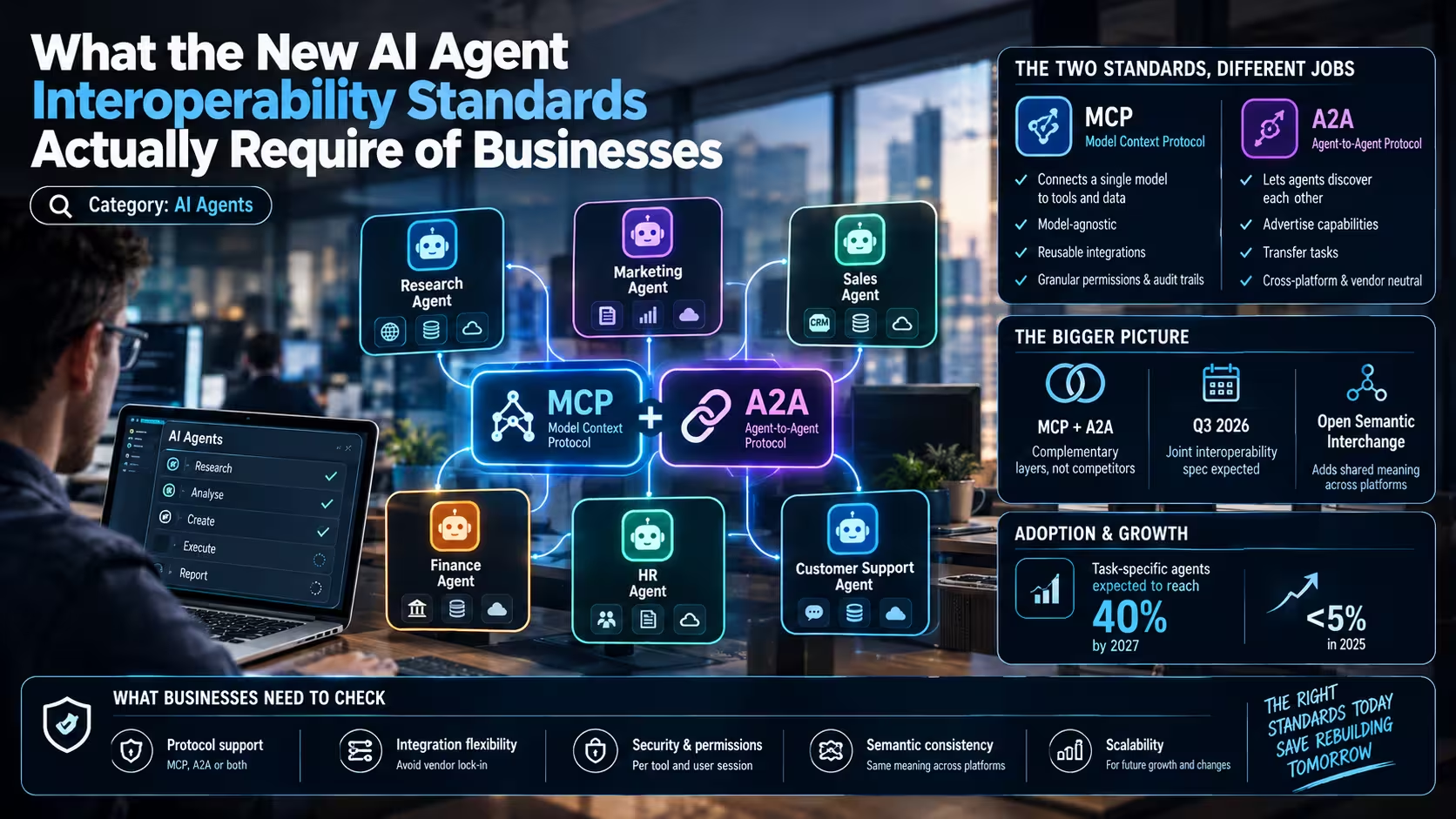
By January 2026, the traditional “customer journey” has been bypassed. We are now entering the age of Inter-Agent Commerce. In this layer, Google’s Personal Intelligence (the “Buyer Agent”) communicates directly with a brand’s internal AI (the “Seller Agent”) without the user ever seeing a landing page.
If a user tells Gemini, “I need a new coffee machine similar to the one I liked at the hotel in Paris last year,” the Personal Intelligence agent doesn’t just search the web. It uses Contextual APIs to ping brand agents. It asks for real-time stock, negotiates based on the user’s loyalty status (found in Gmail), and verifies shipping speeds.
The Strategy: To survive here, your brand must be “Agent-Compatible.” This means moving beyond a pretty UI and developing an API-First Brand Personality. If your system can’t provide structured, real-time data to an external AI agent regarding personalised pricing or “Agentic Discounts,” the Buyer Agent will simply skip you in favour of a more “talkative” competitor.
Hyper-Local Spatial Intelligence – Maps as a Physical Ledger
Google Maps is no longer just for directions; in the Personal Intelligence era, it is the Physical Ledger of Intent. The AI monitors a user’s “dwell time” in specific real-world locations to build a preference profile that search queries alone couldn’t capture.
If the AI notices a user spends twenty minutes every Saturday at a specific high-end boutique or a niche climbing gym, it updates the user’s Affluence and Interest Vector. When that user later searches for “gear” or “clothing,” the Personal Intelligence mode prioritises brands that match the “Spatial Reality” of their life.
The Strategy: Spatial SEO. Local businesses must optimise their Google Business Profiles not just for keywords, but for “Contextual Landmarks.” This involves ensuring your physical location’s metadata—what people do there and the average customer profile—is explicitly clear to Google’s spatial crawlers.
Aesthetic & “Vibe” Optimisation – Visual Semantic Matching
Since Google Photos is now a primary pillar of Personal Intelligence, the AI has a perfect understanding of a user’s Visual Aesthetic. It knows if their home is “Industrial Modern,” if their wardrobe is “Dark Academia,” or if their photography style is “High-Saturation.”
Google calls this Visual Semantic Matching. When recommending products, the AI isn’t just looking for a “brown sofa”; it’s looking for a sofa that matches the exact hex codes and fabric textures it sees in the user’s uploaded living room photos.
The Strategy: Brands must pivot to “Vibe-Based Metadata.” Your product photography is no longer just for humans; it’s for Computer Vision. You need to tag your assets with “Aesthetic Profiles.” If your brand’s visual identity aligns with the “Vibe” found in the user’s Photos library, you become the “natural” choice suggested by the AI.
Why “Governance” and “Entity Trust” are the New SEO
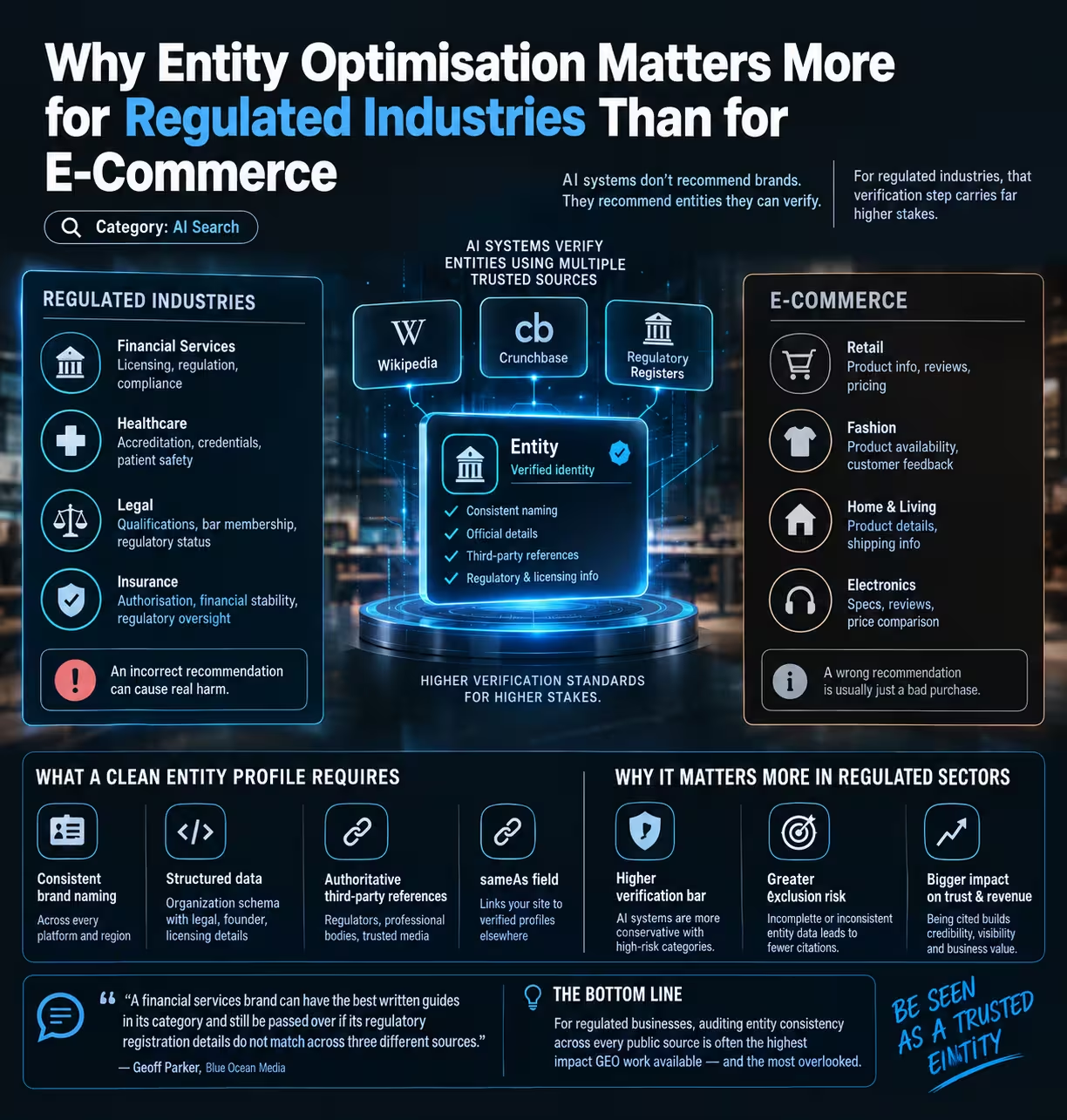
In this new reality, the traditional levers of SEO—backlinks and keyword density—are becoming secondary signals. The new primary signal is Entity Trust and Contextual Relevance.
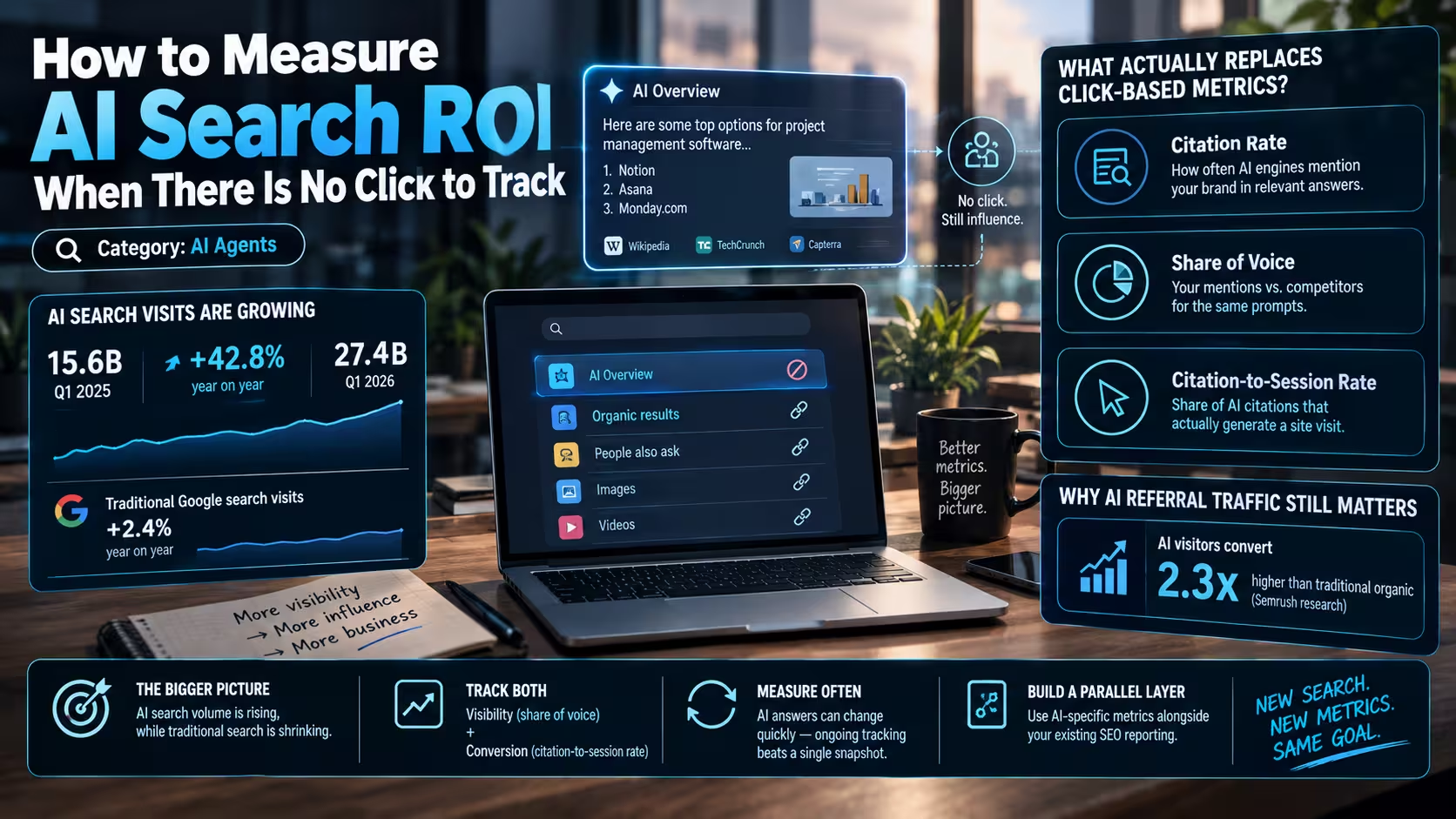
The Death of the “Top 10” In AI Mode, there are no “10 blue links.” There is only the Synthesised Answer. If the AI provides a perfect recommendation based on private data, the user has zero reason to click through to a third-party website.
Google’s SVP of Knowledge, Nick Fox, noted that as of January 2026, AI Mode supports roughly 75 million daily active users. For these users, click-through rates (CTR) on traditional organic results have plummeted by over 45%. Brands are no longer competing for a “rank”; they are competing to be the cited source within a private conversation.
The Rise of “Answer Engine Optimisation” (AEO) To be cited, your content must be “machine-ready.”
- Data Assembly vs. Retrieval: AI doesn’t read your page; it assembles an answer using your data as a building block. If your product specs aren’t clearly defined in Schema.org markup, the AI cannot compare your product to the user’s requirements.
- The Verified Fact Layer: The AI will prioritise sources that have a verifiable “Fact Record.” This is where E-E-A-T (Experience, Expertise, Authoritativeness, Trustworthiness) becomes a technical requirement.
The “Private Data” Advantage for Brands
1. The E-Receipt is the New Backlink Every time a user receives a confirmation email from your brand, you are etching your brand into their “Personal Knowledge Graph.” Strategy: Use Microformats (JSON-LD) within emails to ensure that Gemini 3 accurately logs your brand as a “preferred provider.”
2. The YouTube “Demonstration” Signal Since YouTube history is a core component of Personal Intelligence, “How-To” and “Review” videos are now search assets. If a user has watched your brand’s video, the AI is 4x more likely to recommend your products later.
Technical Deep-Dive – The “Agentic” Schema Audit
To facilitate these new interactions, the January 2026 rollout introduced several “Agent-Specific” Schema.org properties. These tags tell Google exactly how much “agency” it has when interacting with your site.
- actionAccessibility: This tag defines which actions an AI can take on your behalf (e.g., “The AI can check inventory and add to cart, but cannot checkout”).
- agentInteractionPolicy: This establishes the rules for how your brand’s AI talks to Google’s. It prevents “Agentic Hallucinations” by providing a hard-coded set of brand truths.
- dynamicPricingContext: A schema that allows you to offer “Real-Time Personalisation” based on the trust level the AI communicates.
The Strategy: Perform a 2026 Schema Audit. Static schema is dead. You need to implement a “Dynamic Schema” that changes based on the agent’s identity.
The Core Risks – Privacy and the “Tunnel Vision” Effect
The Privacy Tightrope Google stresses that Personal Intelligence is opt-in only and that private data is not used to train the global Gemini model. However, for brands, the risk is the Echo Chamber. If the AI only recommends what it knows the user already likes, breaking into a user’s “inner circle” becomes nearly impossible without massive “External Trust Signals.”
The “Authenticity Update” (January 2026) To combat AI-generated sludge, Google now looks for the “I” Factor. Content that uses “I tried this” or “Our team tested this” is weighted more heavily than generic lists.
The 6-Month Roadmap for Brands
To survive and thrive in the era of Personal Intelligence, businesses must execute the following plan:
Phase 1: Technical Infrastructure (Months 1-2)
- Hyper-Structured Data: Implement every relevant Schema.org property. If you sell a jacket, you need schema for material, weight, weather-resistance, and “Agentic Compatibility.”
- Site Fluidity: Interaction to Next Paint (INP) must be under 200ms. AI agents “prefer” sites they can parse and exit quickly.
Phase 2: Private Silo Strategy (Months 3-4)
- Machine-Readable Newsletters: Stop sending image-heavy emails. Use text and JSON-LD so Gemini can “read” your offers.
- Visual Identity Audit: Ensure your logo and products are recognisable by Google Lens.
Phase 3: Authority & Persona Building (Months 5-6)
- The Expert Network: Shift budget from SEO writers to subject matter experts. One article by a verified expert is worth more than 50 SEO blogs.
- Zero-Click Presence: Create high-value, snackable content that the AI can use without needing to send the user to your site.
From “Searching” to “Knowing”
The January 2026 rollout of Personal Intelligence in AI Mode marks the end of the “Search Result Page” as a list of possibilities. It is the beginning of search as a curated reality.
For the consumer, search is becoming effortless. For the brand, search is becoming a high-stakes battle for trust. The brands that win will be those that don’t just “show up” on Google, but those that integrate themselves so deeply into the user’s life that the AI has no choice but to recommend them.