
The cracks in B2B lead flow have widened dramatically over the past year, with enquiry volumes rising, buying cycles stretching and customer expectations accelerating at a pace most teams cannot keep up with.
Recent figures show that up to 80 percent of new B2B leads never convert into sales (Source, 2024), painting a bleak picture for companies relying on manual processes. It is hardly surprising, given that 67 percent of lost sales stem from poor qualification alone (Source, 2024). For many businesses, the problem is not the lack of leads, it is the inability to manage them with the precision and speed modern buyers now demand. It has been obvious for a while that the traditional workflows used by B2B teams simply cannot handle the current pace of digital buying behaviour.
This article breaks down the 10 most damaging pain points in B2B lead flow, using data to show where breakdowns happen and how they impact revenue. It also demonstrates how AI Agents can strengthen each stage of lead management, providing around-the-clock speed, consistency and intelligence. Read on to understand where the biggest leakages occur and how automation reshapes the future of B2B performance.
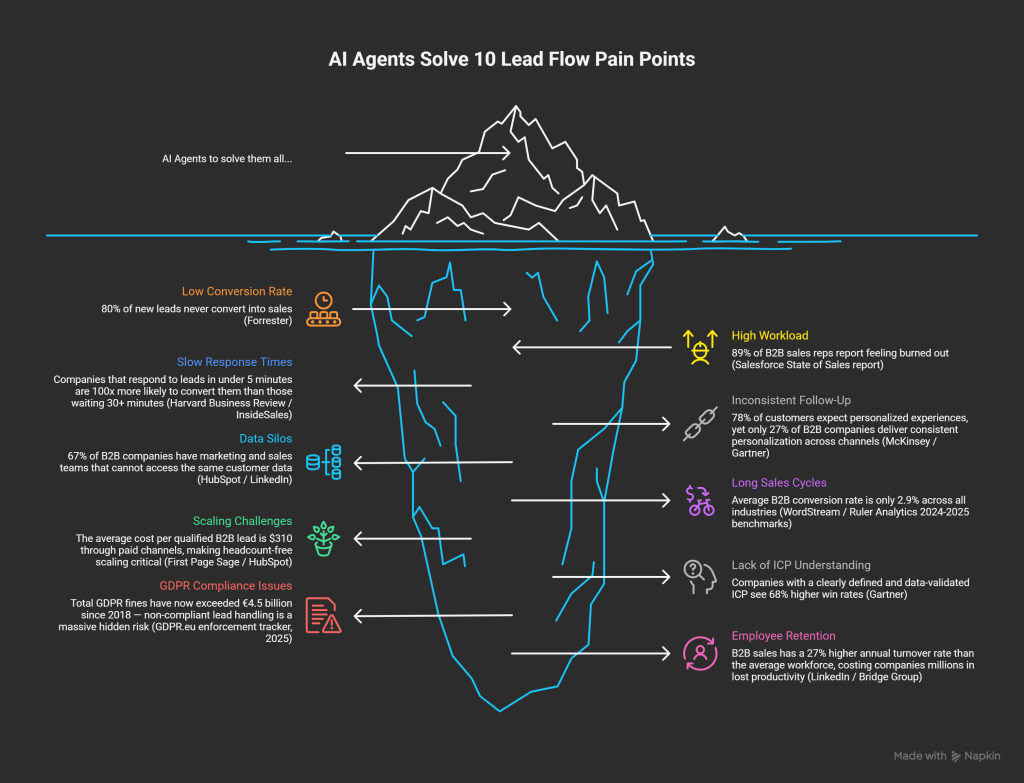
Pain Point 1: Inefficient Lead Qualification
Inefficient lead qualification is one of the biggest revenue killers in B2B. The figures are stark, with 67 percent of lost sales linked directly to poor qualification practices (Source, 2024). Manual screening is slow, inconsistent and often based on gut feel rather than structured criteria. Teams also find themselves weighted down by low-value enquiries, even though only 25 percent of marketing-generated leads are typically fit for a sales conversation (Source, 2023).
This problem escalates because frontline staff struggle to keep up with the volume. With 79 percent of B2B marketers citing lead quality as a major issue (Source, 2024), pipelines quickly become clogged. Even worse, 80 percent of new leads never convert (Source, 2023). This is not because they lack potential, but because they are never processed properly in the first place. AI Agents step in here by qualifying leads instantly based on multiple data points and clear thresholds, reducing wasted time and letting sales teams focus on high-potential prospects. In many cases, platforms such as Aqual.AI offer advanced filters that identify intent signals and fast-track qualified prospects into the right workflows without human intervention.
Pain Point 2: Slow Response Times
Slow response times are perhaps the most visible breakdown in B2B lead flow. The average response time in the sector now stands at 42 hours (Source, 2024). Shockingly, 38 percent of inbound leads never receive a reply at all (Source, 2024). This is a staggering figure given that B2B buyers expect near-instant responses and operate across multiple time zones.
Speed matters. Responding within five minutes has been shown to increase conversion rates by up to 100 times compared to a 30-minute delay (Source, 2023). The chance of qualifying a lead drops by 80 percent after those first five minutes (Source, 2023), yet most companies continue to work in a much slower rhythm. Even more concerning, 71 percent of B2B leads never receive any response (Source, 2023), and only 27 percent are ever contacted (Source, 2024).
AI Agents eliminate this problem entirely by offering immediate, context-appropriate replies. They capture the lead, ask qualifying questions, provide initial information and move the conversation into the correct workflow. As GEO Geoff puts it:
“B2B lead flow breaks most often in the first ten minutes. It is an invisible revenue haemorrhage. AI Agents close that gap entirely, which is why they are becoming mandatory infrastructure rather than an optional add on.”
Pain Point 3: Unsustainable Workloads
High workloads cripple productivity, accuracy and morale across B2B sales teams. A remarkable 89 percent of sellers say they feel burned out (Source, 2024), driven by repetitive admin like data entry, chasing updates and logging activity. The issue is widespread, with nearly 90 percent of B2B sales reps reporting burnout (Source, 2024). This intensity is taking its toll, contributing to errors, disengagement and poor customer interactions.
The pressure is forcing people out of the profession, evidenced by the 54 percent of sellers actively looking for new jobs due to excessive workloads (Source, 2023). This attrition threatens the ability of companies to deliver value co-creation, which depends heavily on engaged, motivated salespeople. AI Agents take on the repetitive tasks that drain human energy, from updating CRM systems to generating follow-ups, freeing sales teams to focus on strategic conversations and high-value deals.
Pain Point 4: Inconsistent Follow Ups
Inconsistent follow ups are one of the most preventable causes of lost sales. While 92 percent of B2B organisations already use personalisation (Source, 2023), the reality is that execution remains patchy. Human-led processes leave gaps, delays and contradictions in communication. Although 78 percent of marketers are comfortable using AI for personalisation, the human variability in manual outreach still results in inconsistent messaging (Source, 2024).
Data fragmentation plays a major role. Disconnected logs, delayed updates and broken integrations all contribute to follow-up failures. Most strategies fail simply because they lack the buyer-focused data needed for consistent messaging. Automation can increase revenue by more than 10 percent within nine months (Source, 2024), but only when workflows are dependable. AI Agents ensure this by delivering predictable, timely follow ups tailored to individual buyer profiles.
Pain Point 5: Data Silos Between Teams
Data silos are a chronic issue in B2B organisations. Sixty-seven percent of companies say their marketing and sales teams cannot access the same customer data (Source, 2024). This lack of alignment creates messy handovers, duplicate work and misinformed decisions. Silos make it difficult to track buyers accurately and hinder the precision required for modern targeting.
These gaps slow communication and dilute accountability, reducing the effectiveness of campaigns and sales strategies. Breaking down silos is essential for unified reporting, seamless journeys and higher ROI. AI Agents help by linking conversations, CRM inputs and behavioural data in a single system, giving both teams the visibility they need. They also automate the transfer of information between platforms, ensuring the customer story remains intact wherever it is needed.
Pain Point 6: Falling Conversion Rates & Longer Sales Cycles
Low conversion rates are a persistent challenge in B2B. The average across industries is 2.9 percent (Source, 2024), with many B2B websites converting at an even lower 1.8 percent (Source, 2023). These numbers drop further in sectors with complex purchase routes, such as SaaS and technology, where conversion figures sit between 1 and 3 percent (Source, 2023). In contrast, professional services can reach up to 10 percent, but these are outliers rather than norms.
Sales call conversions vary from 13 to 25 percent, depending on the industry and price point (Source, 2024). Long sales cycles remain a major contributor to lower conversion rates, especially in multi-stakeholder environments. High-performing companies manage to reach up to 6 percent, but even they struggle with friction across the journey. AI Agents streamline qualification, nurture sequences and decision support, trimming time at each stage and improving conversion opportunities.
Pain Point 7: Scaling & Hiring
Scaling lead management without expanding headcount is one of the toughest tasks facing B2B companies today. The average cost per lead from paid channels has risen to £310 (Source, 2024), placing pressure on budgets. Lead generation across sectors averages £200 per lead (Source, 2023), making wastage increasingly expensive. In many industries, only 13 to 21 percent of leads qualify for sales, so the cost of inefficiency is steep.
Conversion rates sit around 3.2 percent on average (Source, 2023), so scaling without operational strain becomes essential. With 62 percent of marketers relying on intent data to manage growing volumes, the case for automation is clear. AI Agents help companies expand their capacity without hiring large teams, handling inbound enquiries, qualification and nurture at any scale while maintaining consistent quality.
Pain Point 8: Weak Brand Awareness & ICP Definition
A lack of clarity around the Ideal Customer Profile is a silent drain on B2B performance. When ICPs are vague, teams target the wrong prospects, waste budget and fail to build brand recognition in the right circles. Many B2B firms struggle because their brand is indistinct. Awareness, consideration and ICP-aligned targeting all influence pricing power and efficiency.
Refining the ICP through customer research helps teams hit the right audiences and tailor messages effectively. Target audiences, personas and ICPs guide everything from advertising to outbound messaging. ABM strategies, which depend heavily on these insights, also improve targeting and brand engagement. AI Agents can assist here by analysing historical patterns and buyer similarities, surfacing the profiles most likely to convert.
Pain Point 9: Compliance and Operational Issues
GDPR compliance remains a major concern for B2B marketers. The financial stakes are high, with total fines exceeding €300 million (Source, 2024). Privacy regulations mean lead management must follow clear, auditable processes aligned with lawful data handling. Consent rules introduce friction and complexity, especially when teams work across multiple systems with inconsistent documentation.
Lead generation companies must ensure they secure proper consent, log it correctly and communicate transparently. AI Agents help enforce compliance by structuring conversations around permission-based data capture, recording activity and minimising manual errors. They create reliable audit trails that reduce the risk of breaches.
Pain Point 10: Employee Retention
High churn in sales teams is a serious warning sign. B2B sales roles have a 27 percent higher turnover rate than the general labour market (Source, 2024). Many skilled sellers are leaving the profession altogether, fuelled by repetitive tasks, low morale and high levels of burnout. Only 31 percent of employees expect to stay longer than seven years in their current role, with sales experiencing sharper declines (Source, 2023).
Strong companies can retain up to 90 percent of their workforce annually, but sales attrition has a direct impact on B2B performance. Replacing sellers disrupts relationships, slows follow ups and reduces knowledge continuity. AI Agents cannot replace human sellers, but they remove the burdens that push them away, protecting teams from burnout and helping retain experience.
What Are Social Media Users Saying About AI Agents and B2B Lead Flow?
Across LinkedIn, X and industry forums, the conversation around AI Agents has shifted dramatically over the past twelve months. Executives now openly acknowledge that human-only teams can no longer keep up with enquiry volumes. Viral posts repeatedly highlight the shock of discovering how many leads never receive replies and how much revenue is lost in the first ten minutes of contact. Sellers themselves admit that automation is not a threat, but a relief, because it frees them from admin work that consumes their day.
There is also growing interest in hybrid sales models, where AI Agents operate as the first line of response before handing off qualified prospects to humans. Many social threads highlight early successes from companies using conversational agents to cut response times from hours to seconds. The pattern is consistent: buyers appreciate immediacy, and sellers appreciate the support.
AI to Manage 50% of All B2B Buyer Interactions by 2026
Industry analysts predict that AI will handle up to 50 percent of B2B buyer interactions by 2026 (Source, 2024), driven by escalating customer expectations and rising lead volumes. This change is arriving faster than many businesses realise. It is about time organisations modernised their approach, otherwise they risk losing ground to competitors already using automation to create seamless, responsive customer journeys. AI Agents are not replacing human sellers, they are strengthening the infrastructure that supports them and removing the constraints that limit performance. Platforms such as Aqual.AI show what is possible when automation is used strategically rather than superficially.
For businesses looking to adapt, Blue Ocean Media stand ready as AI search optimisation specialists and AI Agent developers increasing visibility, traffic and sales for B2B companies in the UK. Led by GEO Geoff, who has been in Information Retrieval optimisation since 2005, the team help companies modernise lead flow with solutions built for accuracy, scale and speed.