
On 11 February 2026, Google published an Ads & Commerce update that, on the surface, read like a product enhancement announcement. AI Mode shopping would become more conversational. Direct Offers would close the “consideration gap.” A new Universal Commerce Protocol would allow merchants to enable checkout directly inside Search and Gemini. Integrations with Shopify, Etsy, and Wayfair signalled mainstream retail alignment.
The narrative was clear and optimistic. Consumers increasingly expect conversational discovery. They want to describe what they are looking for in natural language, receive curated options, compare in context, and complete a purchase without navigating across five tabs. AI Mode promises to compress that journey into a single, fluid interface. Fewer clicks. Less friction. Faster checkout.
From a user-experience standpoint, the shift appears inevitable. From an economic standpoint, it is destabilising.
What AI Mode represents is not simply a new search feature. It is the quiet internalisation of the referral layer that has sustained the open web for two decades. The answer appears inside Google. The comparison appears inside Google. Increasingly, the transaction also happens inside Google. The user journey that once flowed outward into publisher ecosystems now resolves at the source.
This is the traffic mirage of 2026. Engagement metrics remain visible. Impressions remain high. AI citations increase. Yet the monetisable click — the unit that powers affiliate models, ad-supported journalism, and independent publishing — declines steadily. Beneath the convenience narrative, structural consolidation accelerates.
To understand the magnitude of this shift, we need to examine how AI Mode changes search behaviour, how traffic compression is unfolding across commercial and informational queries, how Google’s commerce stack creates a closed-loop monopoly flywheel, and what adaptation looks like for publishers, brands, and digital strategists navigating the reset.
From Discovery Engine to Decision Engine
For most of its history, Google operated as an index. It crawled the web, ranked content, and directed users outward. The company monetised intent through paid placements and sponsored listings, but the underlying economic model depended on sending traffic to publishers. The symbiosis was imperfect but functional. Publishers created content. Google indexed it. Users clicked through. Advertisers funded the ecosystem.
AI Mode transforms Google from an index into a decision engine.
Instead of returning ranked links that require evaluation, AI Mode synthesises information and resolves intent within the interface itself. A query such as “best compact treadmill for small apartments under £800” no longer produces ten blue links competing for attention. It produces an AI-generated summary that evaluates categories, compares top models, integrates real-time pricing, and presents sponsored modules aligned with the user’s stated constraints. The interface encourages refinement through conversational follow-ups, narrowing the selection further until a purchase decision feels obvious.
The consideration phase, which once unfolded across multiple editorial articles, is compressed into a single AI-mediated answer. Where publishers once competed for the middle of the funnel — the product review, the buyer’s guide, the comparison chart — AI Mode now synthesises that comparative analysis internally. Direct Offers further reduce friction by layering promotions and incentives at the precise moment of decision.
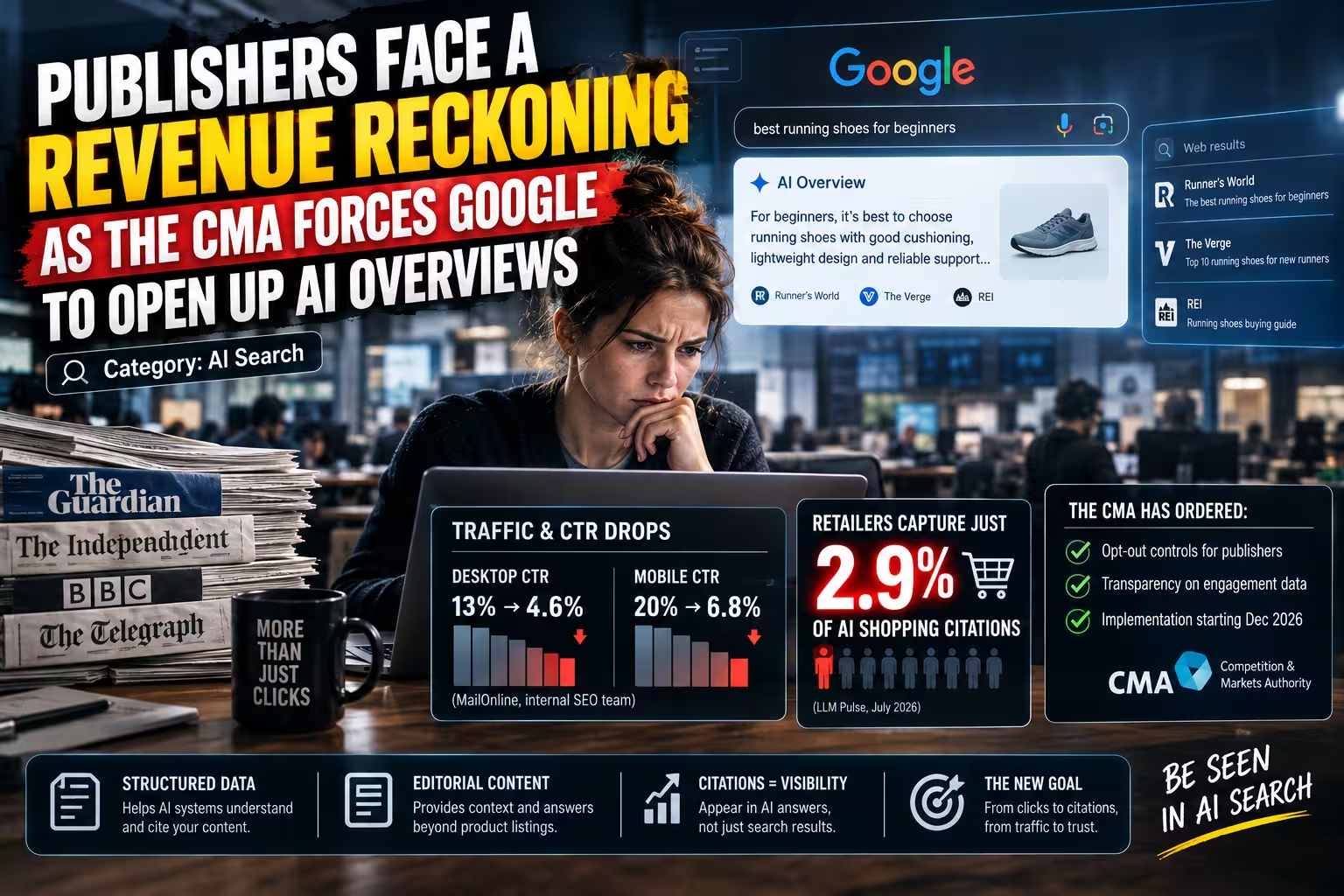
The introduction of Universal Commerce Protocol deepens the shift. UCP allows retailers to integrate inventory, pricing, and payment infrastructure directly into Google’s environment. A user can discover, compare, and purchase without leaving Search or Gemini. The referral step disappears entirely.
This reconfiguration matters because referral is the economic oxygen of publishing. When discovery becomes resolution, traffic becomes optional rather than structural.
The Measurable Decline in Click-Through Rates
Traffic compression is no longer anecdotal. Across multiple media groups and analytics providers, click-through rates on commercial queries have declined materially where AI Overviews or AI Mode dominate the results page. Desktop CTR for review-heavy queries that once hovered in the low double digits has fallen to mid-single digits in some verticals. Affiliate-focused sites in consumer electronics, home goods, and lifestyle categories report traffic declines ranging from 20 to 40 percent year over year.
The mechanics behind this decline are straightforward. AI Overviews provide multi-paragraph summaries drawn from indexed sources, often satisfying the informational component of a query. AI Mode adds transactional scaffolding, presenting products, prices, and promotions directly within the answer. When the system delivers a curated recommendation and a path to checkout, the incentive to click outward diminishes sharply.
Informational queries, once thought to be relatively insulated, are increasingly subject to the same pattern. Definitions, how-to guides, and step-by-step instructions are synthesised into coherent responses that reduce the need for further exploration. Even when sources are cited, citation rarely translates into traffic. Users consume the answer in situ.
The zero-click phenomenon, which began with featured snippets and knowledge panels, now scales across entire commercial categories. Instead of answering a single factual question, AI systems resolve complex product comparisons and transactional decisions.
Some publishers have pointed to rising referral traffic from large language model interfaces as a compensatory trend. While percentage growth in LLM-driven referrals appears impressive, the absolute volume remains small relative to losses in traditional organic search. A fivefold increase from a minimal baseline does not offset a one-third decline in primary search traffic. Moreover, many AI platforms summarise without driving meaningful outbound engagement, further limiting monetisation potential.
The arithmetic reveals a contraction in the referral economy that cannot be ignored.
The Economics of Containment
Beyond traffic metrics lies a deeper economic restructuring. AI Mode is not simply a feature; it is an infrastructure shift that concentrates discovery, consideration, transaction, and measurement within a single vertically integrated system.
When Google captures intent conversationally, it gathers richer, more granular data about user preferences and constraints. When it synthesises comparisons internally, it shapes the evaluative frame through which products are perceived. When checkout occurs inside its ecosystem, it acquires transaction-level insights into pricing sensitivity, conversion triggers, and creative performance.
This data feeds a feedback loop. More transactions generate better optimisation signals. Improved optimisation increases advertiser return on investment. Higher ROI attracts more retailers to integrate through UCP. Expanded integration generates more data, reinforcing the system’s advantage.
The result is a monopoly flywheel driven by data centralisation.
Retailers benefit from streamlined checkout and improved conversion efficiency. However, they also become increasingly dependent on a single gateway for high-intent traffic. Brand storytelling, which once unfolded across independent editorial environments, becomes secondary to structured data compliance and bid strategy inside AI-curated modules.
Publishers face the most immediate economic impact. Commercial-intent content often subsidises broader newsroom operations. Affiliate commissions and premium advertising impressions fund investigative reporting and specialised analysis. When that revenue declines, editorial breadth contracts.
The containment of transactions within a platform environment shifts economic leverage decisively toward the intermediary.
Brand Strategy in an AI-Mediated Marketplace
For brands, the transition to AI Mode presents both opportunity and risk. In the short term, frictionless discovery and integrated checkout can improve conversion rates. AI-generated creative assets enable rapid experimentation and personalisation at scale. Attribution within a closed loop appears cleaner and more comprehensive.
Yet dependency risk grows alongside efficiency.
As more commerce flows through AI Mode, brands relinquish some control over narrative differentiation. Product presentation becomes standardised within curated carousels and summarised comparisons. Visibility depends increasingly on integration, data structure, and advertising spend rather than on editorial partnerships or storytelling nuance.
If the AI decides which three products to surface in response to a query, the competitive field narrows dramatically. Brands not selected effectively vanish from consideration. The margin between inclusion and exclusion becomes thin, governed by opaque algorithmic criteria.
In this environment, diversification becomes a strategic imperative. Brands must avoid overreliance on a single commerce intermediary while still optimising for AI-mediated visibility.
The Publisher Response: Litigation, Consolidation, and Reinvention
Large media organisations have begun exploring legal and regulatory avenues, arguing that AI synthesis appropriates content value without proportionate compensation. Antitrust scrutiny may intensify as platform consolidation deepens. However, legal processes unfold slowly, and technological adoption moves quickly.
Smaller publishers lack the resources to pursue extended litigation. Many confront immediate revenue pressure that demands operational adjustment rather than courtroom strategy. Consolidation is already visible in affiliate-heavy verticals, where independent sites merge or pivot as referral volume declines.
Reinvention requires rethinking the relationship between content and distribution. Traditional SEO strategies that prioritise ranking position are insufficient when AI summaries intercept user intent. Visibility inside generative systems becomes as important as ranking itself.
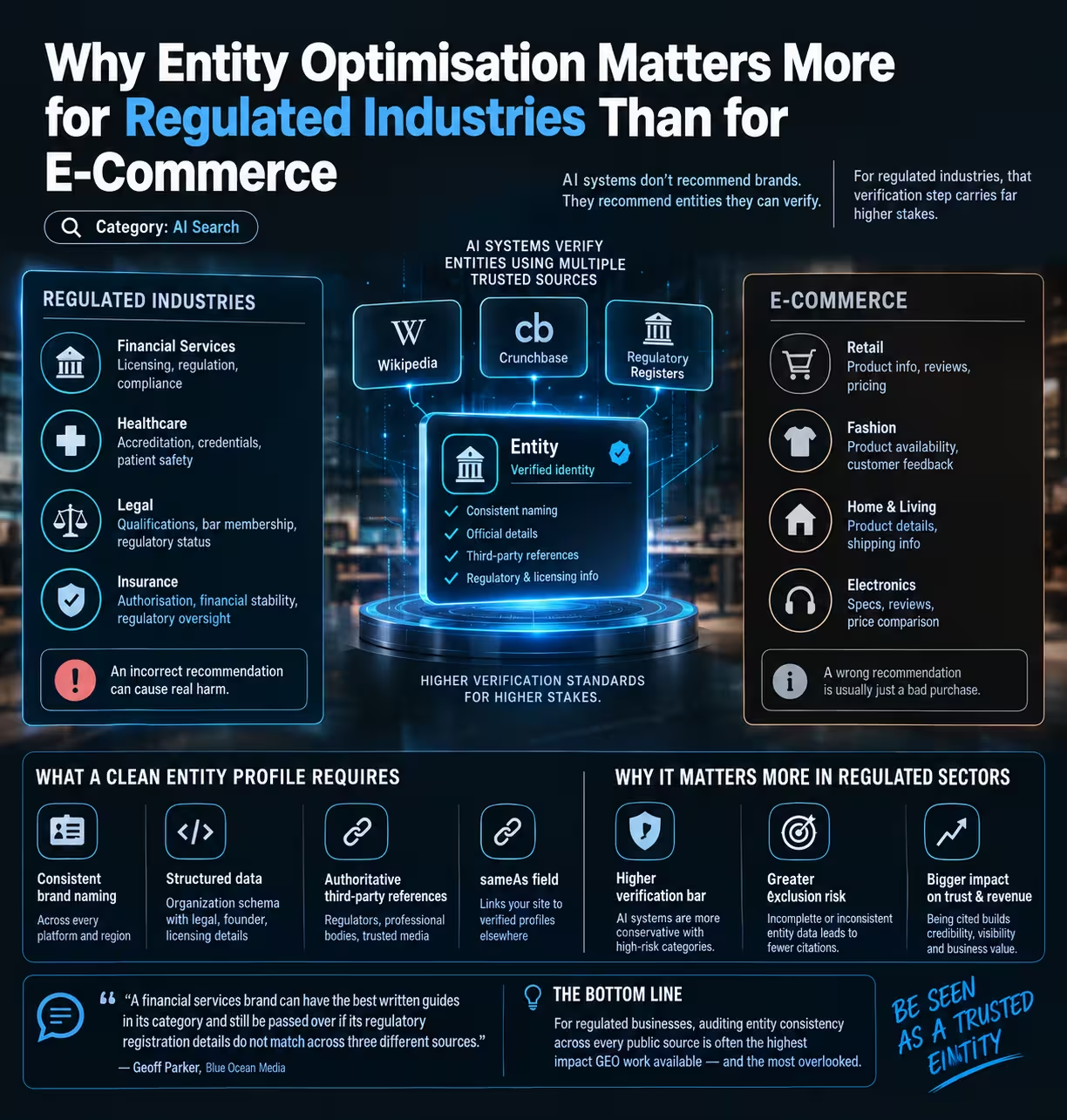
Generative Engine Optimisation extends beyond keyword placement. It demands structured clarity, authoritative sourcing, and machine-readable formatting that increases the likelihood of inclusion in AI-generated responses. Schema markup, entity consistency, and transparent author credentials influence whether content is synthesised or bypassed.
At the same time, revenue diversification becomes essential. Newsletter ecosystems, subscription communities, and direct sponsorship arrangements reduce exposure to volatile search flows. Social and community-driven platforms offer alternative pathways to audience engagement, though they carry their own risks.
The goal is resilience rather than restoration. The referral economy will not revert to its pre-AI structure.
The Illusion of Stability
One of the most deceptive aspects of the current transition is the persistence of surface-level metrics. Impressions remain high. AI citations may even increase brand visibility in theory. Paid revenue can temporarily offset organic declines.
Yet the underlying dynamic is consolidation. When answers resolve inside AI systems, referral-based monetisation weakens. When transactions close within platform environments, attribution centralises. When creative production scales at machine speed, paid inventory expands faster than organic reach.
The mirage lies in the appearance of continuity. Traffic dashboards may not collapse overnight. Revenue lines may decline gradually rather than precipitously. However, the structural direction is clear: economic power concentrates at the platform level.
The open web does not disappear instantly. It erodes incrementally.
The Road Ahead: 2026 to 2029
Looking forward, the trajectory suggests continued compression of commercial organic click-through rates. AI-mediated transactions are likely to represent an increasing share of online retail by the end of the decade. Mid-tier affiliate publishers will face consolidation or transformation. Large media brands will invest heavily in data infrastructure and AI-aligned content architecture.
Regulatory intervention may shape implementation details but is unlikely to reverse the broader shift toward conversational, agentic commerce. Consumer preference for frictionless experiences aligns with platform incentives.
The strategic challenge for publishers and brands is to operate effectively within AI-mediated systems while preserving independence and diversification. Structured data clarity, technical optimisation, and owned audience development become foundational rather than experimental.
Search no longer guarantees outbound traffic. It increasingly resolves intent internally.
Beyond the Mirage
The 2026 introduction of AI Mode shopping marks a turning point in digital commerce. What appears as user-centric innovation also represents economic consolidation. Discovery, consideration, transaction, and measurement converge within a single ecosystem.
Consumers gain efficiency. Retailers gain streamlined checkout. Google strengthens its centrality in the commerce value chain.
Publishers lose referral volume that once underwrote editorial investment. Brands confront growing dependence on a platform intermediary. The competitive field narrows as AI systems mediate visibility.
The traffic mirage is persuasive because it aligns with user expectations. Fewer clicks feel convenient. Faster answers feel intelligent. Seamless checkout feels modern.
But beneath that convenience, the economics of the open web are shifting. The monetisable click declines. The data moat deepens. Platform leverage expands.
Survival in this environment requires acknowledging the structural reset rather than resisting it rhetorically. Visibility inside AI systems, diversified revenue models, and technical resilience are no longer optional. They are prerequisites for participation in a commerce ecosystem increasingly defined by agentic interfaces and consolidated measurement.
“What we’re witnessing isn’t just a UX upgrade — it’s a redistribution of economic power. When search becomes the checkout, publishers lose oxygen and brands lose independence. The companies that survive this shift won’t be the ones chasing rankings, but the ones redesigning their visibility strategy for AI-controlled environments.” says Geoff Parker, Managing Director of Blue Ocean Media Ltd.
The future of digital publishing and retail will not be determined solely by ranking position. It will be determined by who adapts fastest to a world where the click is no longer the central currency of growth, and where the interface itself has become the marketplace.