
We are already past the point where AI in search can be described as experimental. Half of consumers now intentionally use AI-powered search engines as a primary source for buying decisions, overtaking traditional search behaviour in multiple sectors (McKinsey, Aug 2025). That change has happened quietly, without a defining platform launch or a single algorithm update to point at, which is why many businesses still underestimate its scale.
This article looks back at how AI reshaped search in 2025 and why AI SEO, or GEO, has emerged as a standalone industry. More importantly, it examines why this shift is not limited to discoverability alone. The evidence suggests a deeper behavioural change that will continue to reshape how people research, purchase, and interact with brands and artificial intelligence itself.
Why has AI-driven search moved faster than most marketers expected?
AI-driven search moved faster because it aligned with how people already wanted to ask questions. Conversational, intent-rich queries removed friction that keyword-based search never solved, particularly for complex or high-consideration decisions.
By 2025, the impact was measurable. Many publishers saw organic clicks fall by between 20 to 40% as AI-generated answers satisfied intent without requiring a site visit (Business Research Insights, 2025). At the same time, the commercial response accelerated. The global AI SEO market, effectively non-existent five years ago, is now projected to grow from $1.99 billion in 2024 to $4.97 billion by 2033, formalising optimisation for AI systems as its own discipline rather than an extension of traditional SEO.
How did AI search evolve from ranking pages to answering questions?
AI search evolved gradually, then suddenly. Early machine learning systems such as Google’s RankBrain in 2015 improved relevance, but the interface remained the same. Users still scanned links and made decisions themselves.
The inflection point arrived with generative interfaces. In 2025, Google AI Overviews alone appeared in 6.5% of queries in January, rising to 24.6% in July before stabilising at 15.7% by November (Semrush, Dec 2025). That volatility masked a deeper shift. Informational queries dominated early AI deployment, accounting for over 91% of AI Overview triggers, but by late 2025 this fell to 57% as commercial and navigational queries are now surging. This clearly shows that the time for businesses to act to improve their Generative Engine Optimisation is now. 2026 will be a big year.
Why are AI platforms now pulling users away from Google?
AI platforms are pulling users away from Google because they collapse research into a single interaction. Users no longer need to compare sources when the system synthesises it for them.
By mid-2025, ChatGPT had become the world’s fifth most visited website, handling nearly five billion visits per month (Mike Khorev, Jul 2025). Meanwhile, Google’s global search dominance dipped below 90 percent for the first time since 2015 (Exploding Topics, 2025). That decline was not driven by dissatisfaction with results, but by a preference for answers.
The commercial implications are significant. AI-influenced searches are now projected to affect $750 billion in US revenue by 2028, with up to 55% of consumers in sectors such as travel and consumer electronics relying on them during decision-making (McKinsey, Oct 2025).
How did AI SEO turn from a tactic into a standalone industry?
AI SEO became a standalone industry because optimisation targets changed. Traditional SEO focused on rankings and traffic. AI SEO focuses on citation, inclusion, and semantic trust within generated responses.
The market responded quickly. The global AI SEO software sector is forecast to reach $17.6 billion by 2033, growing at a compound annual rate of 25% (Market.us, 2025). Adoption followed utility. In 2025, 47% of marketers used AI SEO tools to improve efficiency, while 84% relied on them for trend identification (Entrepreneur, 2025).
Why AI Overviews are quietly killing traditional organic traffic
AI Overviews reduced organic traffic not through penalty but through displacement. When answers appear immediately, clicks become optional rather than necessary.
By late 2025, AI Overviews featured in roughly 15% of all Google searches, driving organic click reductions of between 20 to 60% depending on query type (Exploding Topics, 2025). Only 8% of users click through from AI summaries, while zero-click rates for AI-triggered keywords reached 30% (Semrush, Dec 2025).
The impact varied by sector but the pattern suggests not the death of websites, but a narrowing of visibility by the end user, allowing AI LLMs the laborious task of retrieving the right information for the query, saving a user time. We only see this trend likely to continue and we believe we are only in the very infancy of this revolution.
Why user-generated content is outperforming brand content in AI results
User-generated content outperforms brand content in AI results because it signals lived experience rather than intent to persuade. AI models consistently weight authenticity cues higher than polished messaging.
Interest in user-generated content has risen over 575% in the last five years, with platforms such as Reddit seeing traffic growth of over 600% to 1.23 billion visits (Exploding Topics, 2025). Quora experienced similar momentum. By 2030, UGC is projected to drive 80% of SEO-enhancing content, particularly in advisory and comparison-heavy categories.
How E-E-A-T and brand signals replaced backlinks in AI visibility
E-E-A-T replaced backlinks as a dominant visibility signal because AI systems assess credibility holistically rather than mechanically. EEAT stands for Experience, Expertise, Authoritativeness and Trust.
Search interest in E-E-A-T rose 344% as marketers responded to its growing influence (Exploding Topics, 2025). In AI-generated answers, traditional backlink volume plays a reduced role compared with consistent brand mentions, expert attribution, and corroboration across independent sources (Sam Varón, Concord USA, 2025).
Authority traditionally has been garnered through linking as the predominant source of citation, however AI is building upon the definition of citation by looking at the broader impact of EEAT and how citation indicators should be updated from our basic understanding of backlinks.
Why predictive and personalised search changes buying behaviour itself
Predictive search changes buying behaviour by intervening earlier in the decision cycle. Instead of responding to expressed intent, AI models anticipate what the user intent is to power results.
Predictive intent modelling has already increased customer lifetime value by between 5 and 25% for early adopters (Retisio via Mike Khorev, Jul 2025). Voice search adoption reached 27% on mobile devices, with 90% of users reporting it easier than typing (Keywords Everywhere, 2025). The consequence is subtle. Buyers increasingly encounter recommendations before they feel ready to buy.
How AI tools are restructuring marketing teams and workflows
AI tools are restructuring marketing teams by normalising high-volume, high-speed output. In 2025, 51% of marketers used AI to optimise content and 68% reported improved ROI (Mike Khorev, Jul 2025). Tools such as Semrush ContentShake enabled production at twelve times previous speeds, with 57% of AI-generated content ranking in Google’s top ten results (Exploding Topics, 2025).
The competitive edge now lies in direction rather than execution. Time will tell how users are able to discern between what is real or AI, or even if AI answer engines and Google, but more importantly does this content production add value to the end consumer. With signals such as EEAT affecting it’s ability to appear in AI answers then we trust that it will.
What marketers are currently debating on social media about AI SEO
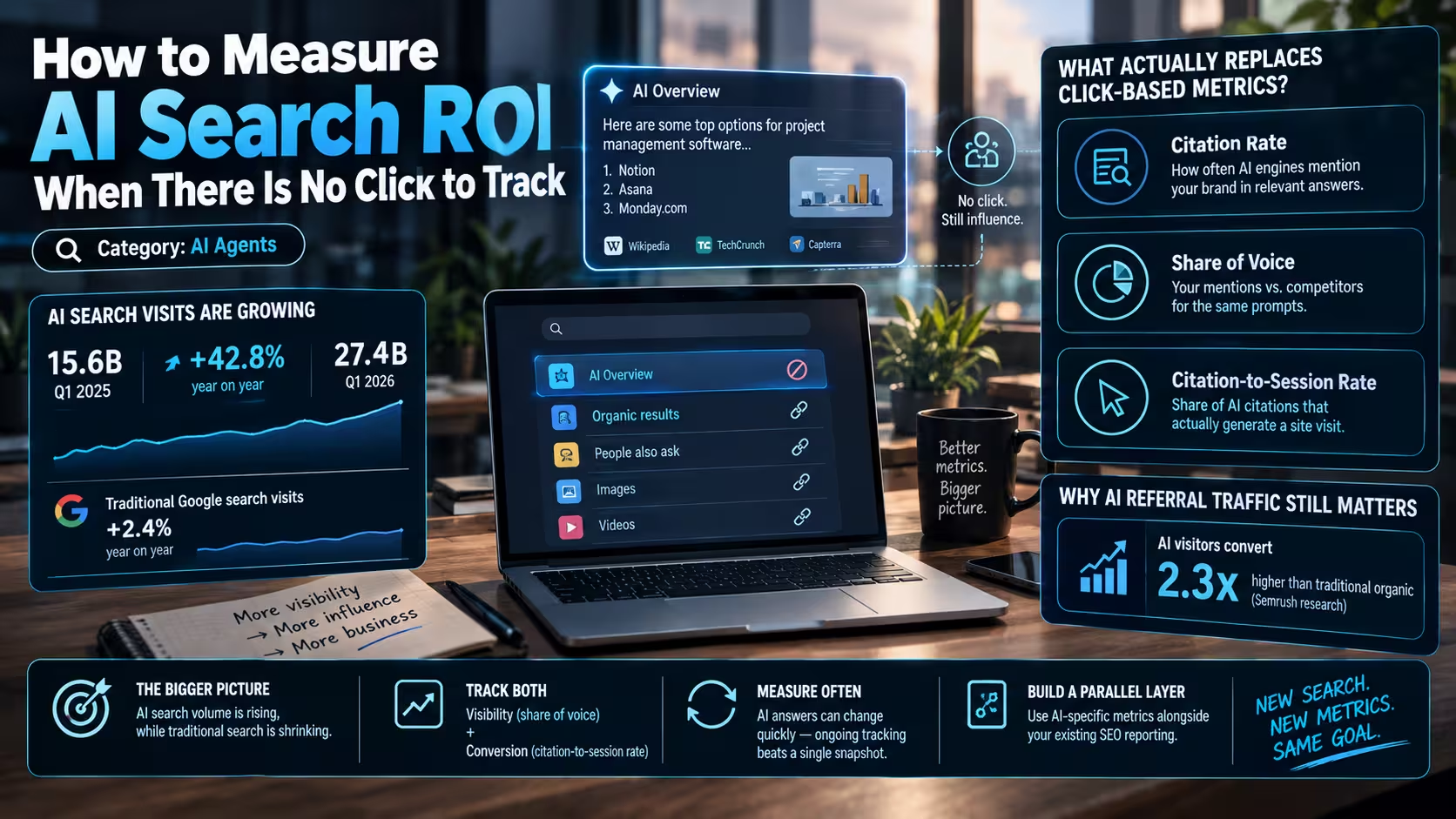
Social media discussion around AI SEO centres on uncertainty rather than opposition. Practitioners debate how to measure success when impressions and clicks no longer tell the full story. Concerns about declining traffic coexist with anecdotal evidence of higher-quality leads emerging from AI exposure. The tone is cautious rather than dismissive, reflecting an industry aware that behaviour has shifted faster than its tools. At Blue Ocean Media we have always been focused on the end numbers for clients – these are simply are lead numbers increasing, is the phone ringing more often and are sales increasing. If the answer is yes then we are doing our job. We do not get hooked up on clicks, impressions and tiny KPIs that can send us analysing the same set of data for months on end to try and argue why something is or isn’t working. We know that are work gets higher visibility in AI answers and our AI SEO service has been successful for over 2 years now.
The AI answers market is only 5% through the revolution
2026 will be a paradigm shift for businesses from traditional SEO to AI SEO or GEO services. However, we believe this is the very infancy of how we operate in businesses that we are only 5% of the way through where we ultimately see us in 5 to 10 years time.
By 2035 the world will be unrecognisable to what it is today. Going to Google or ChatGPT to ask a question, trawling through websites etc will be as archaic as flicking through the Yellow Pages, or visiting the Library to find a book. We are on the precipice of lifechanging societal change in how we require, search, retrieve and implement information for the purpose that we need.