
Brands are confronting a profound shift in online discovery as AI-powered search engines increasingly deliver complete answers without directing users to source websites. By late 2025, tools such as Google’s AI Overviews, Perplexity, and ChatGPT have accelerated zero-click experiences, synthesising information in ways that often omit or minimise brand references in favour of neutral, generic summaries. Unlike earlier search disruptions, this shift does not merely reorder results. It frequently removes brands from the user journey altogether.
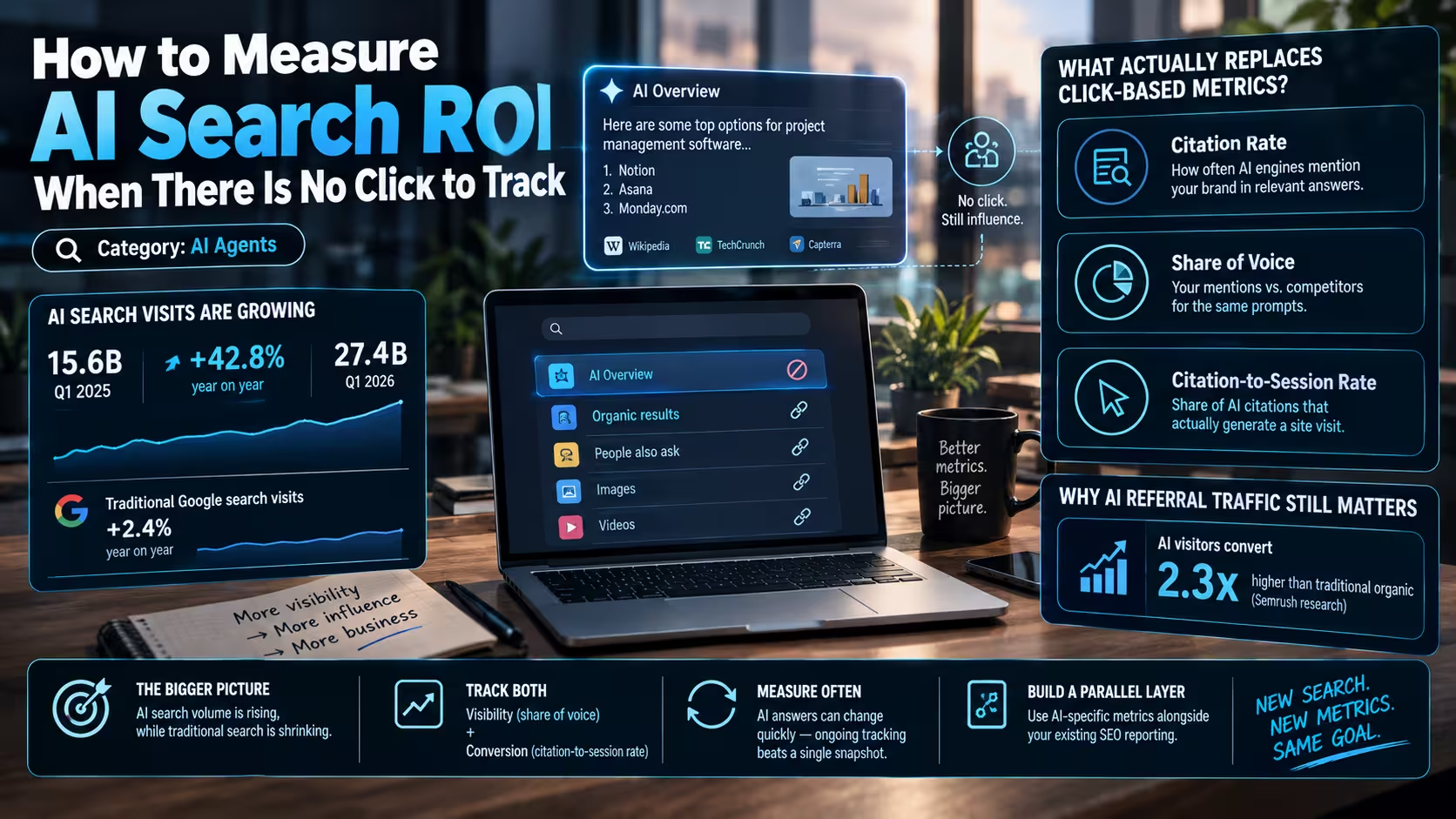
AI Overviews reduced traditional organic clicks by approximately 34.5% year over year, marking a steeper decline in direct traffic than many previous SEO disruptions caused (Digital Information World, 2025). While traffic loss is the most visible impact, it is not the most significant one. The deeper issue is that brands are increasingly absent at the moment answers are formed. In AI search, being ranked but unmentioned is functionally equivalent to being invisible.
This article explores how AI search, rather than democratising visibility, is actively rendering brands invisible within generated responses. It examines the mechanics behind brand omission, how zero-click answers accelerate erasure, persistent myths about AI neutrality, adaptive content strategies, disparities in citation patterns, impacts on traffic and perception, limitations within AI tools, key developments during 2025, the role of trust signals, real-world cases of invisibility, forward strategic implications, financial consequences, emerging optimisation techniques, international variation, and prevailing industry sentiment. As AI adoption accelerates into 2026, the evidence suggests a clear imperative: brands must prioritise presence inside answers themselves, because exclusion increasingly means irrelevance in user decision-making.
What Mechanics Drive Brand Invisibility in AI Responses?
AI search engines do not retrieve answers in the way traditional search engines retrieve links. They synthesise responses by extracting patterns, concepts, and consensus information from large volumes of data. In doing so, they often prioritise clarity, brevity, and perceived neutrality over attribution. Brand names, particularly those not universally dominant, are frequently stripped out during this synthesis process.
When users ask explanatory or comparative questions, models tend to generalise. They favour category-level descriptions, process summaries, or best-practice statements rather than naming specific providers. This is partly a design choice intended to reduce perceived bias and partly a technical artefact of training on aggregated datasets. The result is algorithmic invisibility: brands contribute informational value to the answer but receive no recognition within it.
This contradicts the assumption that AI simply aggregates existing visibility. In reality, AI actively filters brands out to streamline responses. Research indicates that AI answers often cite directories, aggregators, or third-party explainers instead of original brand sources, compounding exclusion for the very organisations producing the underlying expertise.
How Do Zero-Click Answers Exacerbate Brand Omission?
Zero-click experiences remove the incentive for exploration. When users receive full answers directly within search interfaces, there is no natural opportunity to encounter brand names through site visits, navigation, or contextual cues. AI Overviews and similar features do not just push organic results lower on the page. They redefine where the “answer” exists.
Queries that trigger AI Overviews consistently show significantly lower click-through rates, with brands absent from the generated response losing immediate recognition (Semrush, 2025). Even when brands technically rank, their visibility is functionally suppressed because the user’s informational need has already been satisfied.
This erosion extends beyond traffic metrics. It undermines brand recall and comparison behaviour. Users rarely question the completeness of AI-generated answers. When a brand is not named at the resolution stage, it is effectively removed from the consideration set. Over time, this compounds into diminished awareness, reduced branded search demand, and weakened competitive positioning.
What Misconceptions Persist About AI Search Preserving Brand Rankings?
A dominant misconception is that strong traditional SEO performance guarantees AI visibility. While SEO remains foundational, AI models operate on fundamentally different priorities. They optimise for synthesis, not navigation. Rankings influence training data and retrieval layers, but they do not ensure attribution.
Many brands assume that maintaining first-page positions protects them from AI disruption. This assumption overlooks how AI answers collapse the search funnel. When answers dominate interfaces, ranking position becomes secondary to mention inclusion. Visibility shifts from being “found” to being “named.”
This creates a visibility chasm. Brands may retain rankings yet lose relevance at the decisive moment. As one analyst observed, “If you’re not in the AI’s answer, you effectively don’t exist at the moment of customer decision-making” (Blissdrive, 2025). The compounding effect is severe: absence reduces awareness, which in turn reduces future mentions, reinforcing invisibility.
How Are Brands Adapting Content for AI Citation?
In response, brands are shifting from click-centric optimisation to citation-centric content design. The goal is no longer to attract visits but to become quotable within AI responses. This requires clearer entity signals, authoritative framing, and structured presentation.
Brands increasingly invest in comparative guides, definitional content, and original research that AI systems can extract cleanly. Expert quotes, explicit conclusions, and clearly labelled insights improve the likelihood of inclusion. Evidence-heavy formats outperform generic marketing pages because they offer verifiable anchors for AI synthesis.
Content that includes citations and statistics performs better in AI responses, driving a shift toward documentation-style publishing (MarketingProfs, 2025). However, adaptation requires balance. Over-optimisation or excessive branding can reduce neutrality signals and lead to exclusion. The emphasis shifts from persuasion to precision.
What Disparities Are Emerging in AI Brand Mentions?
AI citation patterns are uneven. Established entities with extensive historical mentions dominate inclusion, while newer or niche brands struggle for recognition regardless of expertise. Authority signals compound over time, favouring incumbents.
Only 31% of AI-generated brand mentions are positive, with smaller players often omitted entirely (Search Engine Journal, 2025). This imbalance consolidates visibility among organisations already embedded across the web. For emerging brands, invisibility becomes self-reinforcing: fewer mentions lead to less inclusion, which further reduces discovery.
This dynamic raises competitive barriers. AI search does not level the playing field. It amplifies existing authority hierarchies, making early visibility deficits harder to overcome.
How Does Invisibility Impact Traffic and Perception?
When brands are excluded from AI answers, discovery stops at the intent stage. Users never encounter the brand, never search for it directly, and never evaluate it as an option. This reduces branded query growth and long-term recall.
Perception also shifts. Users increasingly equate AI-mentioned entities with authority and reliability. Brands absent from summaries appear less credible by omission, even if their offerings are superior. Over time, this reshapes market perception in subtle but durable ways.
Brands not appearing in AI summaries face accelerating invisibility, with traffic erosion compounding as awareness declines (Digital Information World, 2025). The damage is not limited to immediate sessions; it affects brand equity.
What Limitations Do Current AI Tools Reveal in Brand Representation?
AI systems often omit brands to avoid hallucination or bias. Safer outputs rely on generalised language. Citation preferences lean toward aggregators and community platforms, which are perceived as neutral intermediaries.
Perplexity and similar tools disproportionately cite forums and directories, with variation by engine (TryProfound, 2025). This behaviour highlights a contradiction: AI promises precision but often delivers dilution, favouring breadth over specificity.
These limitations mean that high-quality brand content alone is insufficient. Without strong external validation and structured signals, omission remains likely.
What 2025 Developments Accelerated Brand Invisibility?
During 2025, AI Overviews fluctuated in prominence but stabilised as a persistent feature. Although volatility peaked mid-year, zero-click behaviour remained entrenched. Direct citations declined in favour of paraphrased summaries.
AI Overviews appeared for 15.69% of keywords by November 2025, down from summer highs yet sufficient to sustain omission trends (Semrush, 2025). The normalisation of answer-first interfaces cemented brand invisibility as a structural issue rather than a temporary experiment.
How Does Enforcement of Trust Signals Influence Inclusion?
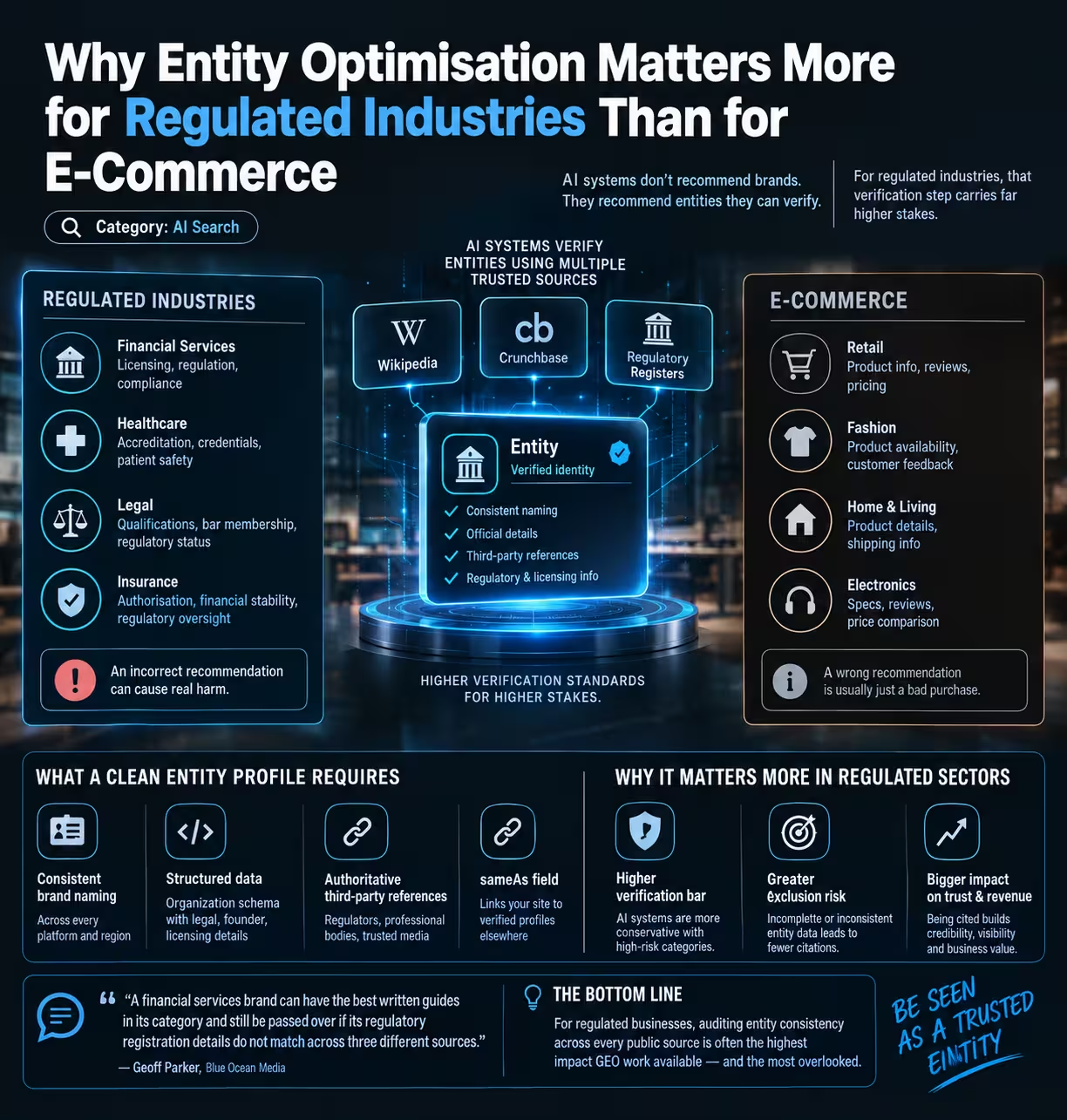
AI platforms increasingly prioritise verifiable authority. Structured data, schema, and consistent entity mentions improve citation probability. Without these signals, models default to safer, generic responses.
Structured data helps large language models interpret content reliably, according to Bing’s product manager (Digital Information World, 2025). Enforcement of trust signals rewards prepared brands while silently penalising others through exclusion rather than demotion.
What Case Studies From 2025 Illustrate Invisibility Risks?
Publishers reported sharp traffic declines following AI Overview expansion. Brands absent from summaries lost referral share even when rankings remained stable. Ecommerce sites observed recommendation queries favouring generic product categories over named brands, eroding conversion pathways.
These cases demonstrate how omission compounds. Recovery correlates strongly with subsequent citation inclusion rather than ranking recovery.
What Forward Implications Arise for Brand Strategies?
By 2026, multi-model optimisation will be essential as visibility fragments across multiple AI systems rather than consolidating around a single search engine. Brands will need to consider how they appear across different answer engines, each with its own citation behaviour, trust thresholds, and synthesis logic. This marks a shift away from channel-specific optimisation toward entity-level presence that travels across platforms.
Building durable authority will increasingly depend on consistent brand mentions, structured data, and third-party validation rather than on-page optimisation alone. Brands that are cited, referenced, and corroborated across the wider web will be better positioned to surface within AI-generated answers, even when direct attribution is limited.
Unprepared brands may experience 20–50% traffic decline, according to projections (McKinsey, 2025). More importantly, this decline reflects lost discovery rather than simple ranking volatility. The trajectory points toward a future where proactive presence-building, designed specifically for AI interpretation, replaces reactive SEO adjustments aimed at recovering clicks after visibility has already been lost.
How Do Supply Chain Data Gaps Worsen Invisibility?
Incomplete or unstructured product data significantly reduces the likelihood of inclusion in AI-driven comparison and recommendation queries. When models cannot easily parse specifications, attributes, or relationships, they default to sources that present information in consistent, standardised formats.
Aggregators and directories benefit from this structure advantage. Their listings are designed for comparison, making them easier for AI systems to synthesise and reuse. Direct brands, by contrast, often present information in marketing-led formats that prioritise persuasion over clarity, which limits machine interpretability.
The volatility seen throughout 2025 exposed these weaknesses. As AI Overviews expanded and contracted across query types, brands with fragmented or poorly structured data were more likely to disappear from answers altogether. These gaps amplify omission, particularly in high-intent queries where structured comparison is central to the response.
What Financial Metrics Underscore Invisibility Costs?
Revenue erosion typically follows discovery loss rather than ranking loss. When brands are excluded from AI-generated answers, they lose visibility at the earliest stage of decision-making, before users ever reach a shortlist. Competitors that are cited gain disproportionate share, even when underlying offerings are similar.
The financial impact mirrors patterns seen in other industries where exclusion from decision pathways leads to rapid loss of market relevance. Analogies drawn from global packaging recalls demonstrate similar outcomes, where removed brands suffer lasting commercial damage despite product parity (Aptean, 2025).
In the AI search context, invisibility compounds over time. Reduced exposure leads to weaker brand recall, fewer downstream searches, and diminished lifetime value. The cost is not limited to immediate traffic loss but extends to longer-term revenue stability.
What Emerging Optimisation Techniques Counter Invisibility?
To counter omission, brands are increasingly adopting optimisation techniques focused on being reference-worthy rather than clickable. Entity engineering helps clarify who the brand is, what it does, and how it relates to key topics, making it easier for AI systems to include it in generated responses.
Digital PR and mention-focused strategies play a growing role by increasing authoritative references across trusted sources. These external signals reinforce credibility in ways that on-site optimisation alone cannot achieve. Tools that track performance across multiple AI engines now help brands identify where they are included, omitted, or misrepresented.
Branded mentions correlate strongly with visibility in AI-generated answers (Exploding Topics, 2025). As a result, optimisation is no longer centred on rankings or even impressions. It is about earning inclusion as a credible reference within answers themselves, where discovery increasingly begins and ends.
What is the current sentiment online regarding AI visibility?
Industry discourse reflects urgency and frustration. Marketers share omission experiences and challenge assumptions about AI fairness. Optimism exists, but it is tied to adaptation rather than preservation. New metrics beyond clicks dominate conversation.
“The problem is not rankings disappearing, but brands becoming invisible in answers. Consumer journeys are getting shorter and brands are about to be left out of the conversation altogether if they aren’t doing AI SEO,” says Geoff Parker, Managing Director at Blue Ocean Media.
AI Overviews reduced clicks 34.5%. For brands responsible for visibility, the message is clear. Audit AI mentions, build citation signals, and redesign content for answer inclusion. Delay risks erasure at the decision stage. The single defining takeaway is this: in AI search, presence inside the answer defines discovery itself.