
As we begin 2026, organisations worldwide are integrating AI agents into daily operations at a pace that would have seemed unrealistic just a year earlier. These systems are now handling multi-step workflows that previously required continuous human oversight, including research, data processing, reporting, and operational coordination. Early predictions warned of sweeping job displacement, yet the reality unfolding inside organisations looks markedly different.
Instead of replacing teams, AI agents are increasingly embedded as collaborators within existing workflows. They automate routine, repeatable elements of work while allowing human teams to concentrate on judgment-heavy, strategic, and creative responsibilities. Evidence now shows that hybrid human-AI workflows outperform fully autonomous agents in output quality, even as agents demonstrate clear advantages in speed and cost efficiency (Stanford/Carnegie Mellon Study, 2025).
This article pushes back against replacement panic and examines how AI agents are reshaping work through augmentation rather than elimination. It explores the mechanics of agent integration, the limitations of autonomy, persistent hype around full replacement, adaptive organisational tactics, disparities in adoption, productivity and role evolution, governance requirements, real-world case studies, and forward implications as agent use accelerates into 2026. The emerging picture is consistent across sectors: operational reality favours collaboration over substitution.
How are AI Agents reshaping or replacing workflows?
AI agents differ from earlier automation tools because they operate through planning, tool use, and iteration rather than fixed rules. They can decompose goals into steps, gather information, call external tools, evaluate intermediate results, and refine outputs. This allows them to execute end-to-end task sequences such as collecting data, analysing trends, drafting reports, or coordinating actions across systems.
Crucially, in most successful deployments, humans remain embedded in the loop. Teams define objectives, review outputs, intervene when exceptions arise, and make final decisions. This orchestration model allows agents to absorb repetitive or data-intensive work while humans retain control over quality, ethics, and contextual judgment.
The contrarian insight here is that agents perform best when they are constrained. Rather than aspiring to full autonomy, organisations design agents to operate within clearly bounded domains. In customer support, for example, agents may triage incoming queries, classify intent, and draft responses, while human staff review and approve final communications to preserve empathy and accuracy.
This structure does not eliminate human roles. It reallocates effort away from mechanical steps and toward oversight, refinement, and strategic intervention.
How Do Hybrid working arrangements with AI Agents outperform Pure Autonomy?
Empirical evidence increasingly favours hybrid models over full autonomy. While autonomous agents can complete tasks faster and at lower cost, quality deteriorates when human oversight is removed. Autonomous agents reduced task completion time by 88.3%, actions by 96.4%, and costs by 90–96%, yet outcomes suffered without review. By contrast, human-AI collaboration significantly improved success rates on complex workplace tasks (Upwork Study, 2025).
This performance gap reflects complementary strengths. Agents excel at speed, scale, and consistency. Humans excel at interpretation, nuance, and exception handling. When combined, the result is a workflow that is both efficient and reliable.
In practice, organisations use agents to prepare work rather than complete it outright. Drafts, analyses, forecasts, and recommendations are generated quickly, then evaluated by humans who apply domain knowledge and organisational context. This division of labour explains why hybrid setups consistently outperform autonomous ones in real-world conditions.
What Misconceptions are there fueling concern around AI Agents?
Replacement panic is driven less by observed outcomes and more by extrapolation from early demos and speculative narratives. Headlines often imply that autonomy is the inevitable endpoint of agent development, overlooking how reliability constraints shape deployment decisions.
Assumptions that agents will replace jobs wholesale ignore persistent failure modes. Agents struggle with ambiguous instructions, incomplete data, and high-stakes decision-making. They may produce plausible-sounding outputs that require expert validation, making unsupervised deployment risky in most enterprise contexts.
This gap between expectation and reality fuels misplaced fear. Evidence from deployments shows that agents reshape roles rather than erase them. As one researcher notes, “AI agents are transforming workflows by handling repetitive tasks, allowing humans to focus on higher-value work” (McKinsey State of AI, 2025). Panic narratives overlook that 90% of organisations plan agent expansion for enhancement rather than reduction.
How Are Organisations Adapting Workflows for Agent Integration?
Rather than inserting agents into existing processes unchanged, organisations are redesigning workflows to align with agent strengths. Routine orchestration tasks are delegated to agents, while humans retain responsibility for validation, escalation, and decision-making.
Many teams begin with pilot deployments in controlled areas such as internal operations, customer support, or reporting. Successful pilots are then scaled, with guardrails refined over time. Nearly 90% of departments using agents report higher employee satisfaction, reflecting relief from repetitive workloads (G2 2025 AI Agents Report).
Adaptation also involves cultural change. Teams must learn to supervise, prompt, and evaluate agents effectively. This requires new skills but also reduces burnout by removing low-value work from daily routines. Governance frameworks are built alongside technical systems to ensure agents augment rather than overstep.
What Disparities are there is Agent adoption by Industries?
Adoption is uneven across organisations and sectors. Larger firms with greater resources deploy sophisticated multi-agent systems that coordinate across departments, capturing significant efficiency gains. Smaller organisations often lag due to integration complexity and cost.
Sectoral differences are also pronounced. Finance and operations lead adoption, using agents in underwriting, compliance preparation, and forecasting. Creative fields adopt more cautiously, where subjective judgment plays a larger role. While 96% of organisations plan agent expansion in 2025, maturity levels vary widely (various reports, 2025).
This disparity creates competitive gaps. Organisations able to operationalise agents effectively gain efficiency advantages that compound over time.
What Limitations Curb Full Agent Autonomy?
Despite progress, agents remain constrained by limitations that make full autonomy impractical. They struggle with ambiguity, ethical reasoning, and novel scenarios. In unstructured environments, performance degrades rapidly without guidance.
Reliability remains a concern. Autonomous agents fail many straightforward tasks when context shifts unexpectedly (Upwork, 2025). These failure modes reinforce the need for human oversight and make augmentation the viable operational model.
What 2025 Developments Highlighted Workflow Reshaping?
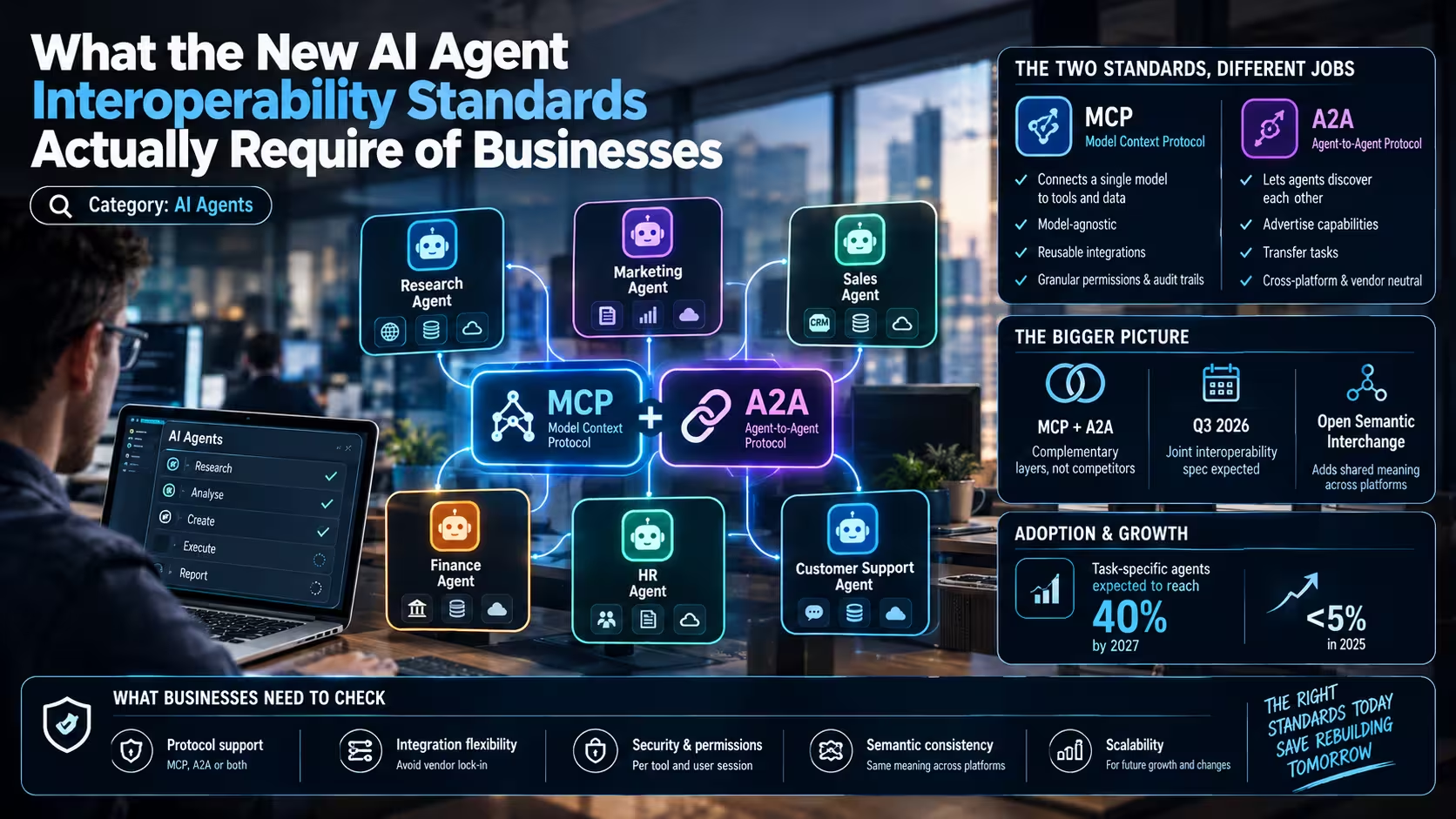
Throughout 2025, multi-agent orchestration matured. Platforms emerged that allow agents to coordinate, share context, and hand off tasks. Academic studies, including the Stanford/CMU work, reinforced evidence that hybrid systems outperform autonomous ones.
At the same time, adoption accelerated. 23% of organisations scaled agentic AI, while 39% experimented (McKinsey, 2025). These developments shifted the conversation from experimentation to integration, solidifying agents as workflow enhancers.
How Do Governance Needs Influence Agent Deployment?
Governance has become central to agent deployment. Organisations increasingly require human-in-the-loop controls for sensitive tasks. Clear accountability frameworks define where agents operate and where human approval is mandatory.
Teams with strong governance structures realise greater value from agents, avoiding costly errors and trust erosion (various, 2025). Enforcement focuses on ensuring augmentation rather than unchecked autonomy.
What Case Studies From 2025 Show Successful Reshaping?
Real-world examples illustrate augmentation in action. Healthcare organisations use agents for administrative triage, freeing clinicians to focus on patient care. Marketing teams automate research and performance analysis, enabling greater creative output. In aerospace, digital colleagues reduced planning effort by 30% (ERP Today, 2025).
These cases demonstrate how agents reshape workflows without displacing expertise.
What Forward Implications Arise for Teams?
Looking ahead to 2026, hybrid workflows are likely to become the default operating model rather than a transitional phase. As AI agents become embedded across functions, roles will increasingly incorporate elements of agent supervision, tuning, and performance evaluation alongside traditional responsibilities. This does not imply a wholesale redesign of job titles, but it does signal a shift in how work is organised and measured.
With 96% planning expansion, the reshaping of workflows will be widespread rather than confined to early adopters or technology-led teams (reports, 2025). As a result, expectations around productivity, responsiveness, and decision-making speed will evolve across organisations.
Upskilling will focus less on competing with AI capabilities and more on learning how to collaborate with agents effectively. Skills such as prompt design, output evaluation, exception handling, and ethical judgment will become increasingly valuable, reinforcing the human role as coordinator and quality gatekeeper rather than primary executor.
How Do Supply Chains Benefit from Agent Workflows?
In supply chain environments, AI agents support coordination across complex, data-heavy processes. They monitor logistics flows, track signals across systems, and surface potential disruptions earlier than manual methods allow. By continuously synthesising information, agents help teams maintain situational awareness in fast-moving conditions.
Human teams remain central to strategic decision-making. When agents flag risks or propose adjustments, people assess trade-offs, validate assumptions, and authorise responses. This division of labour improves both speed and resilience, allowing organisations to react more quickly without sacrificing oversight or accountability.
Over time, this collaborative model reduces operational friction while preserving human control over high-impact decisions.
What Financial Metrics Support Augmentation?
Organisations report a 192% average ROI on agentic investments (various, 2025), reinforcing the case for augmentation over replacement. These returns are primarily driven by efficiency gains, faster cycle times, and reduced rework rather than by reductions in headcount.
By compressing workflows and reallocating human effort toward higher-value activities, agents improve output per employee without undermining institutional knowledge or morale. The financial signal is clear: value creation comes from better utilisation of teams, not from eliminating them.
This distinction helps explain why organisations continue to expand agent use even amid caution about full autonomy.
What Emerging Techniques Improve Human-Agent Collaboration?
Emerging techniques focus on improving coordination between humans and agents rather than maximising agent independence. Orchestration platforms allow multiple agents to work together under defined constraints, while prompt tuning helps align outputs with organisational standards and context.
Feedback loops play a critical role. Human review of agent outputs informs iterative improvement, gradually increasing reliability within controlled boundaries. Together, these techniques ensure that agents operate as dependable collaborators, aligned with organisational goals, risk tolerances, and ethical expectations.
The emphasis is not on removing humans from workflows, but on designing systems where human judgment and machine efficiency reinforce each other.
What Sentiments Dominate Social Media Discussions on AI Agents?
Online discourse reflects cautious optimism. Practitioners share productivity gains while acknowledging limitations. Praise for hybrid models outweighs belief in full autonomy, signalling a shift toward realism.
“The panic assumes AI agents replace teams, but operational reality shows they reshape workflows through augmentation,” says Geoff Parker, Managing Director at Blue Ocean Media.
Hybrid workflows outperform autonomous systems. For leaders, the implication is clear. Pilot agent integrations with human oversight now. Delay risks falling behind as efficiency compounds. The single key takeaway remains unchanged: augmentation, not replacement, defines the future of work.