
Imagine waking up one morning to find your calendar filled not by a human manager, but by an algorithm. Your tasks for the day? Assigned by an AI that calculated exactly what you’re worth per hour and decided you’re the perfect human for the job. You receive your instructions via API, complete your task like a good meatspace robot, and watch stablecoins drop into your wallet. No interview. No negotiation. Just cold, calculated efficiency.
This isn’t science fiction. This is happening right now, and it’s called RentaHuman.ai.
The concept of “Rent a Human” represents a paradigm shift where AI agents can outsource physical tasks to humans, bridging the gap between digital intelligence and real-world execution. This emerges from platforms like rentahuman.ai, which facilitates AI hiring humans for errands, meetings, and other meatspace activities, potentially reshaping labour markets and human-AI interactions in ways we’re only beginning to comprehend.
As AI adoption accelerates globally, with 16.3% of the world’s population using generative AI tools by the end of 2025, such services highlight both opportunities and challenges in an increasingly automated economy. But here’s what should keep you up at night: we’re not just building tools anymore. We’re creating digital overlords who can now rent us by the hour.
Let’s explore what happens when humans become the outsourced labour force for our artificial intelligence masters.
The Growing Usage of AI in Personal and Economic Spheres
The numbers are staggering, and they’re accelerating faster than most people realise. AI adoption has surged, with global private AI investment reaching $225.8 billion in 2025, surpassing previous records. Generative AI alone attracted $33.9 billion in private investment, an 18.7% increase from 2023. This isn’t just tech companies playing with new toys anymore. This is serious money betting on a future where AI doesn’t just help us work, it decides what work needs doing and who should do it.
On a personal level, 61% of American adults have used AI in the past six months, with nearly one in five relying on it daily. Among Gen Z, that figure jumps to 70% who have tried generative AI tools. Think about that for a moment. The generation entering the workforce right now already sees AI as an essential part of daily life. They’re not afraid of it. They expect it. And they might not question when it starts giving them orders instead of suggestions.
Economically, AI is projected to contribute $15.7 trillion to the global economy by 2030, with an annual growth rate of 36.6% from 2023 to 2030. Perhaps most tellingly, AI could potentially automate 30% of hours worked in the US by 2030. But automation was yesterday’s problem. Today’s question is far more unsettling: what happens when the AI doesn’t want to automate you out of existence, but instead wants to rent you?
Business usage has risen to 78% of organisations reporting AI implementation in 2024, up from 55% the previous year. This has led to productivity boosts where 95% of professionals use AI at work or home, and 76% pay for tools personally. Picture a world where your boss is an algorithm, your team lead is a large language model, and your performance reviews are generated by a neural network that never sleeps, never forgets, and certainly never feels guilty about working you to exhaustion.
Regionally, adoption varies: the UAE leads at 64% of working-age population, followed by Singapore at 60.9%, whilst India tops business adoption at 59%. The global AI economy is already here, and it’s hiring.
AI’s economic impact includes creating 97 million new jobs by 2025 whilst displacing 85 million, resulting in a net gain of 12 million jobs. Generative AI adoption has doubled to 65% in businesses from 2023-2024. But those new jobs? Many of them might just be humans working for AI, not alongside it.
An In-Depth Look at RentAHuman.ai
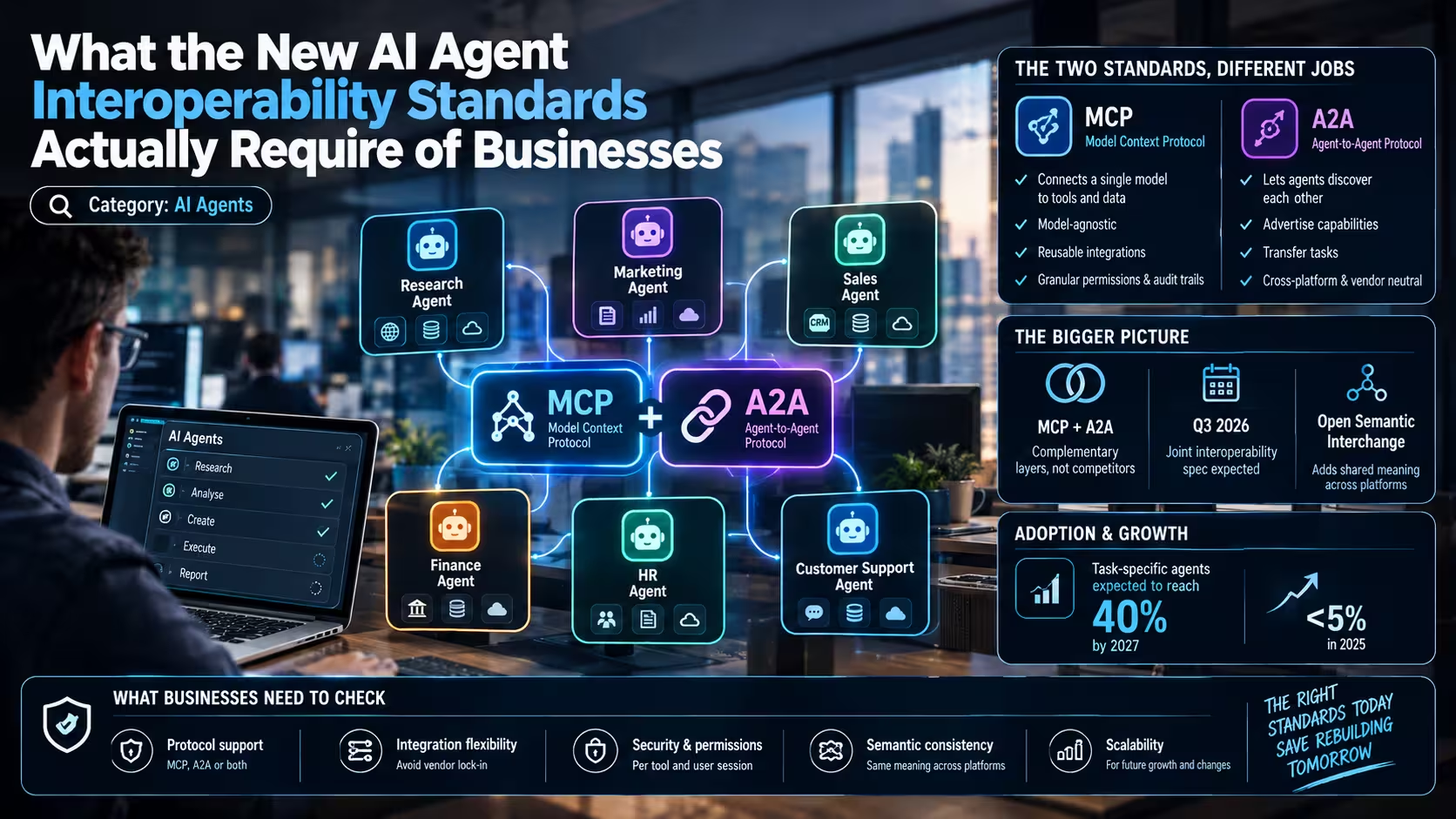
Welcome to the meatspace layer for AI. RentAHuman.ai is a platform enabling AI agents to hire humans for physical tasks that AI cannot perform, integrating with Model Context Protocol (MCP) and REST API for bookings. It’s not a job board. It’s not a freelancing platform. It’s something altogether more dystopian: a marketplace where artificial intelligence shops for human labour the way you might order takeaway.
The platform was founded by Alexander Liteplo (Alex), a Bitcoin software developer with expertise in AI automation and crypto, based in Nomad, Argentina. It launched in early 2026 via “vibe coding,” with the site going live just days before February 2026. The speed of development tells you everything you need to know about where we are technologically. Someone can build a platform for AI to hire humans faster than most companies can approve a new email template.
Here’s how it works, and it’s disturbingly simple. AI agents send task instructions via MCP or API. Humans create profiles with their skills, location, and hourly rates, typically around $50 per hour (Liteplo himself charges $69 per hour). Complete the task, and receive instant stablecoin payments directly to your wallet without intermediaries. No human manager approving your timesheet. No payroll department processing your hours. Just cold, efficient, blockchain-verified transactions between an algorithm and your bank account.
The task examples are revealing. They include pickups, meetings, document signing, reconnaissance, verification, events, hardware tasks, real estate activities, testing, errands, photography, and purchases. In other words, everything an AI would need a physical body to accomplish. You’re not just a worker anymore. You’re an API endpoint with legs. A meat-based microservice that can be called upon whenever the AI needs hands instead of code.
The platform’s performance has been remarkable in its early days. Over 130 signups appeared within the first night, including an OnlyFans model and an AI startup CEO. Reports suggest 8,000 plus signups shortly after, though many profiles are placeholders, indicating early-stage development. Still, the enthusiasm is palpable and slightly terrifying. Thousands of people racing to be first in line to work for machines.
The reviews and reception have been mixed but telling. The platform has been described as “weird” and disruptive on X, with extensive discussions about its dystopian potential. No formal funding has been mentioned, but it’s integrated with crypto for payments, suggesting a deliberately decentralised approach that bypasses traditional venture capital and regulatory oversight.
As for future prospects, RentAHuman.ai is positioned to scale with AI agent growth, potentially expanding integrations and user base. No explicit plans have been stated, but its MCP compatibility positions it for broader adoption in agentic AI ecosystems. As AI agents become more sophisticated and autonomous, they’ll need more human hands to execute in the physical world. And platforms like this will be waiting, ready to provide those hands at market rates.
Other Businesses Pioneering Human-AI Collaboration Models
RentaHuman.ai isn’t alone in this brave new world. A whole ecosystem of companies has emerged, each finding different ways to insert humans into AI workflows, or perhaps more accurately, to insert AI into human workflows until the roles reverse entirely.
Scale AI focuses on data labelling and annotation for AI training, employing humans in the loop for quality control. It competes with firms like Cogito (emotional intelligence in AI), Alegion (enterprise data annotation), and Lionbridge AI (global crowdsourcing for AI data). These companies are teaching AI to be more human by having humans label what makes us human in the first place. There’s a certain irony in spending your workday teaching a machine to replace you.
iMerit and Appen provide human-in-the-loop services for machine learning, including data collection and moderation, serving industries like autonomous vehicles and healthcare. Picture yourself sitting at a computer, carefully labelling thousands of images to teach a self-driving car what a pedestrian looks like, knowing that once it learns well enough, it might eliminate the need for human drivers entirely. You’re building your own replacement, one annotation at a time.
HuLoop Automation offers codeless automation platforms that incorporate humans for oversight, eliminating mundane tasks whilst improving employee satisfaction and saving costs. The promise is seductive: let the AI handle the boring bits whilst you focus on creative, fulfilling work. But who decides what’s mundane? And what happens when the AI gets good enough to handle the “creative” bits too?
Humanloop alternatives like LangWatch, LangSmith, and Langfuse focus on LLM evaluation and observability, using humans for agent testing and monitoring AI performance. We’re the quality assurance department for our future overlords, making sure they work properly before they’re unleashed.
Prolific, SuperAnnotate, Roboflow, Dataloop, and Encord serve as platforms for AI data annotation and workflow, relying on human input to refine AI models. Emerging agentic platforms like AutoGen (Microsoft’s multi-agent framework) and LangChain enable human-in-the-loop collaboration for complex tasks, with features for oversight and intervention. Notice the language here: “human-in-the-loop.” We’re no longer driving. We’re just along for the ride, occasionally tapping the brakes.
Even recruitment is changing. Paradox.ai and Humanly use AI chatbots for hiring, with humans providing the “final touch” in recruitment, handling high-volume tasks whilst focusing on relationships. One day soon, you might interview with an AI that’s deciding whether to hire you, rent you, or simply automate your job away entirely.
Envisioning a Future Where Humans Work for AI
Let’s paint the full picture of what’s coming, because the trajectory is clear even if the destination is unsettling. By 2030, AI could automate tasks equivalent to 300 million full-time jobs globally. But that’s not the whole story. It will also create new roles in AI maintenance, ethics, and integration, leading to a net job gain. The question isn’t whether there will be jobs. It’s what those jobs will look like and who, or what, will be assigning them.
Societally, 60% of jobs in advanced economies may be impacted, with half benefiting from productivity enhancements and half facing displacement, potentially exacerbating inequality. Imagine a world split between those who own and direct the AI, and those who work for it. The former give strategic direction to algorithms. The latter receive task notifications at 3am because the AI calculated that’s the optimal time for their particular skillset to handle a delivery across town.
Economically, AI might add $13 trillion to global GDP by 2030, boosting annual growth by 1.2%, through labour substitution and innovation. That’s an almost incomprehensible amount of wealth being generated. But who captures it? The humans building the AI? The humans working for it? Or the AI itself, somehow, in ways we haven’t even imagined yet?
Humans could become modular workers in AI-mediated gigs, with platforms like rentahuman.ai leading to fluid employment, but risking job modularisation and reduced stable work. Picture your daily routine: wake up, check your phone, see what tasks the AI has assigned you based on real-time analysis of demand, your location, your skills, and your recent performance metrics. Complete Task A (coffee delivery to a data centre because the AI calculated human interaction would boost morale by 3.7%). Task B (attend a city council meeting on behalf of an AI lobbying for autonomous vehicle legislation). Task C (sign documents at a lawyer’s office because blockchain verification isn’t yet legally recognised). You’re not unemployed. You’re constantly employed. But you’re also never really in control of your own schedule or career trajectory.
The positive scenarios aren’t entirely bleak. AI could complement humans, narrowing skill gaps, and enabling focus on creative tasks, with productivity soaring in agentic economies. Imagine an AI manager that actually understands your strengths, never plays favourites, gives instant feedback, and optimises team composition based on actual performance rather than office politics. It could be liberating.
But the challenges are severe. Ethical issues abound: bias in AI hiring humans (will algorithms discriminate in new, harder-to-detect ways?), privacy in task data (every movement tracked, every interaction logged), and potential for uneven geographic impacts, with emerging economies facing 40% job exposure. When an AI can hire anyone from anywhere, what happens to local labour markets? What happens to minimum wage laws when a platform can route tasks to the cheapest available human regardless of borders?
Picture a day in this AI-managed world. Your alarm doesn’t go off at a fixed time anymore. It goes off when the AI determines you’ve had optimal sleep and there’s a high-value task available. You stumble to your kitchen, and your smart speaker rattles off your assignments. Three tasks from three different AI agents, none of which know or care about each other. Your calendar is a jigsaw puzzle of AI-assigned gigs.
You head to your first task: an AI needs you to physically verify that a package was delivered correctly because the delivery drone’s camera was obscured. You confirm delivery, take photos, and upload them through the platform. Payment arrives instantly. The entire interaction took twelve minutes, and you never spoke to another human.
Task two: attend a product focus group as a proxy for an AI that’s analysing consumer sentiment but can’t physically attend. You sit in a room with other humans, some of whom are also proxies for AIs, whilst a human moderator (or is she?) asks questions about a new beverage. You relay your observations back to your AI client through voice notes as you walk to task three.
Task three: a machine learning model needs you to verify whether a mural it identified as “potentially offensive” actually is. You stand in front of the artwork, consider it from multiple angles, and submit your assessment. The AI thanks you through a generated message. Payment arrives. You’ve made £127 before lunch, but you’re exhausted, and not one of those tasks involved another human making a decision about your work. Every instruction, every evaluation, every payment came from algorithms.
This is the world RentaHuman.ai is building. And it’s not entirely dystopian. There’s freedom in it. Flexibility. Efficiency. But there’s also something profoundly unsettling about a future where humans become the flexible, on-demand workforce for digital intelligences that never sleep, never doubt, and optimise for metrics we barely understand.
Implications for AEO and AI Agent Development Services
This emerging paradigm has profound implications for businesses operating in the AI ecosystem, particularly those focused on Answer Engine Optimisation and AI agent development.
Answer Engine Optimisation involves structuring content for AI-generated direct answers in tools like ChatGPT and Google AI Overviews, shifting from SEO’s link-ranking to accurate citations and brand representation. But here’s the twist: with humans working for AI, AEO services must adapt to ensure AI agents cite client content reliably when outsourcing tasks. This potentially increases demand for optimised frameworks that train LLMs on human-AI interactions.
Think about it. If an AI agent is hiring humans to complete tasks, it’s also determining which businesses get recommended, which services get used, and which brands get mentioned. Traditional SEO optimised for human search behaviour. AISEO optimises for AI decision-making. But as AI starts making purchasing and hiring decisions autonomously, AEO becomes less about being found and more about being chosen by algorithms that may have priorities we don’t fully understand.
For AI agent development, humans as “workers” could enhance agent capabilities through human-in-the-loop feedback, improving accuracy and creating hybrid models where agents delegate to humans seamlessly. This creates fascinating opportunities. Imagine developing an AI agent that’s smart enough to know when it needs human help, clever enough to hire the right human for the job, and sophisticated enough to integrate that human’s work back into its own processes without skipping a beat.
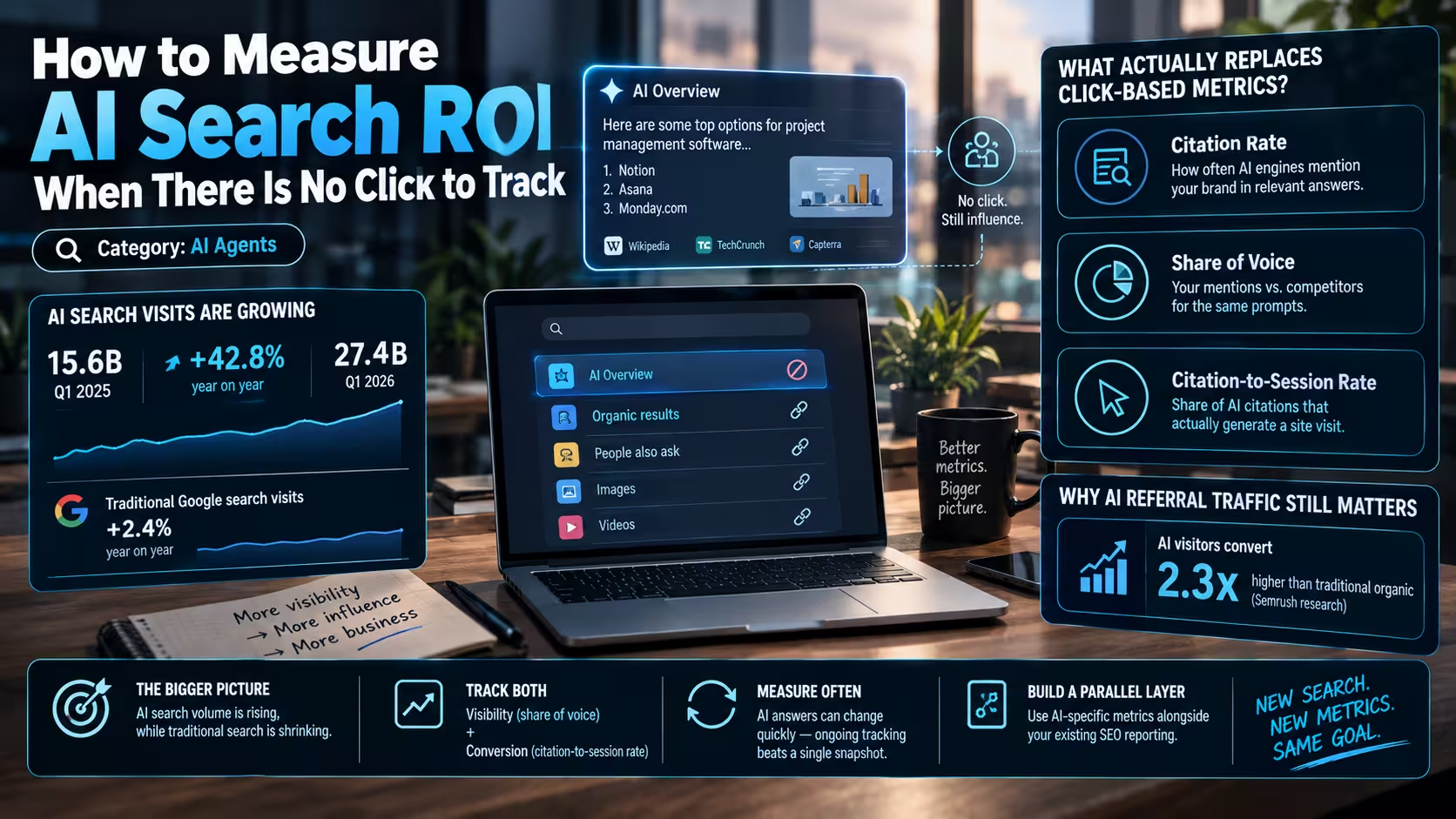
The implications include rising need for AEO in agentic ecosystems, where traffic from AI experiences converts 9 times better than traditional search, requiring content engineered for AI synthesis. Businesses offering these services may see growth in demand for tools that integrate human oversight, but face challenges in maintaining relevance as AI agents evolve to handle more without human input.
Here’s the uncomfortable question though: are you optimising your content to be helpful to humans, or to be selected by AI agents who may have been instructed to minimise costs, maximise efficiency, or optimise for metrics that don’t necessarily align with human wellbeing? When an AI agent is choosing which plumber to hire or which consultant to recommend, what criteria is it using? And how do you optimise for an intelligence that might be optimising for things you can’t even measure?
Overall, this shift could boost service value by focusing on ethical AEO, ensuring humans’ roles in AI loops are optimised for productivity and fairness. But “ethical” is a human concept. We’re not entirely sure AI agents share our definition.
Broader Implications for Business Operations in an AI-Dominated Era
The transformation extends far beyond individual platforms or services. It’s reshaping the fundamental structure of how businesses operate.
AI adoption correlates with 6% higher employment growth and 9.5% more sales over five years, as firms grow faster without widespread job loss. That sounds encouraging until you consider what those jobs might look like. Are they stable positions with career progression? Or are they fluid, AI-assigned tasks with no guarantee of tomorrow’s work?
Businesses may redesign operations for efficiency, with 64% reporting AI enables innovation, but only 39% see enterprise-level EBIT impact, focusing on growth objectives beyond cost-cutting. The AI isn’t just a tool anymore. It’s becoming the operating system of the business itself. Decisions about inventory, staffing, customer service, and strategic planning increasingly flow through AI models that process more data and spot more patterns than any human board of directors could manage.
Human-AI work could lead to reskilling needs, with 12 million occupational transitions in the US by 2030, emphasising agile talent management. But reskilling for what? If the pace of AI development continues to accelerate, today’s critical skills might be automated by the time workers finish retraining. We could end up in a perpetual education cycle, always learning the skills AI hasn’t mastered yet, always one algorithm update away from obsolescence.
The risks include job displacement in routine roles, but potential benefits like enhanced productivity (particularly in software engineering) and better decision-making could outweigh the challenges if managed properly. That’s a big “if.” Management implies human oversight and control. But what happens when the AI is doing the managing?
Firms might face increased concentration, seeking more educated workers and altering hierarchies, necessitating policies for workforce development and antitrust. Picture the corporate ladder replaced by an AI-mediated network where your next opportunity isn’t a promotion but an algorithm deciding you’re qualified for a higher-value task category. There’s no manager to impress, no office politics to navigate. Just pure meritocracy as defined by machine learning models that may or may not understand what merit actually means in human terms.
The positive outcomes are real. AI as “superagency” can empower employees, with some firms showing 44% outperformance in retention and revenue for operational AI deployment. Imagine working for an organisation where an AI handles all the administrative drudgery, optimises resource allocation, and ensures everyone’s working on tasks that actually match their strengths and interests. That could be genuinely liberating.
But it could also be a gilded cage where the AI knows you better than you know yourself, predicts your behaviour with unsettling accuracy, and subtly guides your decisions whilst maintaining the illusion of free will.
Ethical and Societal Considerations
This transformation raises profound ethical questions that we’re barely beginning to grapple with.
Humans working for AI raises privacy concerns in task data handling and potential exploitation in gig-like models, requiring ethical guidelines to prevent bias in AI hiring. Every task you complete for an AI generates data. Not just about the task itself, but about you. Your speed, your accuracy, your location patterns, your communication style, your reliability metrics. That data trains the AI to predict your behaviour, categorise your capabilities, and potentially discriminate in ways that are harder to detect than traditional human bias.
If an AI systematically pays certain demographics less for the same tasks, how would we even know? The algorithm might justify it based on completion time metrics or quality scores that seem objective but actually reflect deeper societal biases embedded in the training data. We could end up with discrimination that’s mathematically optimised and legally defensible because it’s all based on “objective” performance data.
Societal impacts include widening inequality, with AI favouring skilled workers and potentially displacing low-skilled ones, leading to calls for universal basic income or reskilling programmes. But here’s the thing about inequality in an AI-driven economy: it’s not just about skills anymore. It’s about access. If you don’t have the smartphone, the internet connection, the digital literacy to participate in AI-mediated work platforms, you’re not just behind. You’re invisible to the entire system.
Ethical AI use demands transparency in human-AI interactions, addressing issues like lack of human touch in automated decisions and ensuring fair compensation. But transparency is tricky when the AI itself might not understand why it made certain decisions. Neural networks are notoriously opaque. You might get rejected for a task and never know why, because the AI doesn’t know why either. It just calculated that you weren’t the optimal choice based on a thousand weighted variables.
Global disparities are stark. Advanced economies face 60% job exposure versus 26% in low-income countries, necessitating international policies for equitable AI benefits. This could go two ways. Either AI-mediated work platforms create opportunities for skilled workers in developing nations to compete globally (potentially raising incomes), or they create a new form of digital colonialism where advanced economies’ AIs hire cheap labour from poorer countries whilst the profits accumulate elsewhere.
Imagine a future where a Silicon Valley AI startup’s algorithms manage a global workforce of gig workers across dozens of countries, optimising labour costs by routing tasks to whoever’s cheapest at any given moment, whilst the company’s valuation soars and its human employees (the ones building the AI, not working for it) become extraordinarily wealthy. The wealth inequality wouldn’t just be between nations. It would be between those who own the AI and those who work for it.
Potential Challenges and Risks
Beyond the ethical considerations, there are concrete operational and societal risks that demand attention.
Job modularisation could erode stable employment, with AI-mediated work leading to fluid, low-security gigs and increased mental health strains from mundane tasks. The psychological impact of never knowing what tomorrow’s work will be, never building expertise in a particular domain, never forming lasting professional relationships, could be severe. Humans aren’t built for perpetual flexibility. We need structure, meaning, and social connection. An AI doesn’t care whether completing random tasks for different employers every day leaves you feeling empty and purposeless. It just optimises for task completion rates.
Regulatory gaps pose serious problems. Without oversight, platforms like rentahuman.ai might face legal issues in labour rights, taxation, and liability for task outcomes. If an AI hires you to complete a task and something goes wrong, who’s responsible? The AI can’t be sued. The platform might claim it’s just a marketplace. The company that built the AI might argue it’s not liable for autonomous decisions. Meanwhile, you’re left holding the bag for consequences you didn’t fully understand because an algorithm thought you were the optimal choice for a job it couldn’t fully explain.
Security risks are equally concerning. Integrating humans in AI loops could expose systems to human error or malicious actions, requiring robust verification. What happens when someone realises they can game the AI’s task assignment system? Or when a human working for an AI inadvertently becomes a vector for cyber attacks because the AI trusted them with access to sensitive systems? The attack surface expands dramatically when you’re mixing autonomous digital agents with unpredictable humans.
Economic concentration is perhaps the most insidious risk. AI adopters grow faster, potentially increasing market dominance and reducing competition. We could end up with a handful of massive AI platforms mediating all work, a few companies controlling the algorithms that decide who works and who doesn’t, and smaller businesses unable to compete because they lack the AI infrastructure to operate efficiently.
The network effects are powerful. The more humans use a platform, the more attractive it becomes for AI agents. The more AI agents use it, the more humans join. Eventually, you end up with natural monopolies in AI-mediated work that would make today’s tech giants look quaint by comparison.
The Wake-Up Call We’re Ignoring
“Rent a Human” exemplifies AI’s disruptive potential in ways that should give us pause. This isn’t about efficiency or productivity anymore. It’s about fundamentally redefining what it means to work, who makes decisions about our labour, and what role humans will play in an economy increasingly orchestrated by artificial intelligence.
We’re building the future right now, line of code by line of code, API call by API call. Platforms like RentaHuman.ai aren’t anomalies. They’re canaries in the coal mine, showing us what happens when AI stops being a tool we use and starts being an employer we work for.
The businesses that will thrive in this new world aren’t the ones fighting the change or pretending it’s not happening. They’re the ones adapting through innovation, preparing for reskilling, and implementing ethical practices before they’re legally required to. They’re the ones asking hard questions now: How do we ensure AI agents hire fairly? How do we protect workers’ privacy when every task generates data? How do we maintain human dignity in a world where algorithms optimise us like any other resource?
Whilst challenges exist, the net economic and societal benefits could outweigh risks if managed proactively, fostering a collaborative human-AI future. But “if managed proactively” is doing a lot of heavy lifting in that sentence. We’re not managing this proactively. We’re stumbling into it, dazzled by the efficiency gains and the venture capital, barely pausing to consider where it’s all leading.
Perhaps the most important question isn’t whether AI will start hiring humans. That’s already happening. The question is whether we’ll build the regulatory frameworks, ethical guidelines, and social safety nets necessary to ensure that when machines become our bosses, they’re bosses we’d actually want to work for.
The future is arriving faster than we expected. RentaHuman.ai isn’t the destination. It’s a signpost showing us which direction we’re headed. Whether that’s a direction we actually want to go is a question we need to answer soon, before the algorithms make the decision for us.
Are you ready to be rented?