
The rise of agentic commerce has reached a scale that even seasoned analysts did not anticipate. According to Adobe, traffic to US retail sites from generative AI browsers and chat interfaces surged 4,700 per cent year on year in July 2025, a spike that marks a structural realignment in how people discover and purchase online (Adobe, 2025). What once felt experimental is rapidly becoming the default behaviour, with consumers moving from search to purchase inside conversational interfaces. PayPal and Perplexity’s partnership, announced in May 2025 and launched fully in November, is the clearest example yet of this shift, embedding Instant Buy capabilities directly into AI search flows. It is a moment that feels even more dramatic than the early smartphone wave.
Expectations are rising in parallel. McKinsey forecasts that agentic commerce could generate one trillion dollars in US retail revenue by 2030 and three to five trillion globally, powered by AI systems that anticipate needs and automate decision making. Crucially, 15 to 20 per cent of all US commerce in 2026 is expected to be executed by AI agents (McKinsey, 2025). This article examines how this transformation is unfolding, why PayPal and Perplexity are positioned at the centre of it, and what B2B companies must do to remain visible in an economy where AI, not humans, makes most buying decisions.
What Is Agentic Commerce
Agentic commerce is the automation of the full buying journey by AI agents that search, compare, evaluate and execute purchases on behalf of users. It replaces the traditional multi step journey of searches, clicks and form fields with a single expression of intent. The agent handles the task end to end. The user simply approves or refines the outcome.
This shift is driven by AI now capable of reasoning, planning and acting with autonomy. It is no longer a matter of suggestions or recommendations. Instead, agents can complete full journeys, from researching a flight to booking it or from comparing outfits to paying for them. McKinsey estimates that these agent driven flows will unlock one trillion dollars in US retail value by 2030 and between three and five trillion globally, a figure that underscores how central agents will be in commerce ecosystems (McKinsey, 2025).
The steps that agents increasingly manage end to end include
• Searching and evaluating the entire web
• Comparing options using grounded and verified data
• Optimising choices around user constraints such as budget or ethics
• Executing payments and handling tracking and returns
With Adobe reporting that early AI shoppers experience 30 per cent higher conversion and 81 per cent improved satisfaction, the experience gap is becoming impossible for retailers to ignore (Adobe, 2025).
How Fast Is Agentic Shopping Growing
Agentic AI has evolved beyond simple assistants. It has become a decision maker. More than half of consumers expect to use AI assistants for shopping by 2025, a notable rise from the 24 per cent of US online adults who used tools like ChatGPT in earlier studies (Forrester, 2025). Perplexity, one of the category leaders, has seen 66 per cent year on year user growth and now drives 780 million monthly queries, up from 230 million a year earlier.
Visa has accelerated this shift through agent to agent pilots with Anthropic and OpenAI that allow AI agents to negotiate purchases within preset budgets. In parallel, McKinsey suggests that 15 to 50 per cent of ecommerce tasks will be automated by 2027, with AI driven supply chains reducing costs by 10 per cent and trimming 20 per cent of inventory.
Adoption varies by sector. Tech leads with 41 per cent daily usage, finance follows at 28 per cent, and retail has reached 31 per cent integration. Importantly, 93 per cent of ecommerce leaders already believe that AI agents provide a competitive advantage. Yet the friction remains high. The global cart abandonment rate sits at 70 per cent, rising to 85.2 per cent on mobile. Agentic flows cut abandonment by 20 to 30 per cent, largely because they remove manual form fields and anticipate user hesitation.
The message is clear. AI agents are not assisting the shopper. They are becoming the shopper.
Why PayPal Is Building Agent Ready Commerce Rails
PayPal’s pivot towards agentic commerce marks one of the most important strategic shifts in fintech. The October 2025 launch of its Agentic Commerce Services package, including Agent Ready for AI initiated payments and Store Sync for catalogue ingestion, signals a move away from being a checkout button. PayPal is positioning itself as the payment identity for autonomous agents.
The company’s ecosystem gives it a distinctive advantage. Its 400 million plus active accounts, multi decade investment in fraud detection and buyer protection, and its global merchant footprint make it one of the most trusted transactional infrastructures available. Partners including Wix, Cymbio, Commerce, Shopware and Newegg allow merchants to become instantly discoverable inside AI environments while retaining merchant of record status.
PayPal’s EPS grew 11.7 per cent year on year in Q3 2025, supported by value added services and 1.5 billion dollars in share buybacks, giving the business financial scope to accelerate this shift. Its integration with Mastercard’s Agent Pay further embeds it within universal agentic payment protocols.
The early impact is strong. Travel and fashion pilots have seen traffic spikes exceeding 200 per cent, and PayPal’s support for protocols such as MCP and AP2 position it for widespread agentic adoption.
GEO Geoff, MD of Blue Ocean Media and in Information Retrieval optimisation since 2005, captures the significance. He notes, “In an era where AI agents decide who gets the sale, having a trusted payment identity is becoming as important as being visible in the first place. PayPal is building the rails that autonomous commerce will run on.”
How Perplexity Turned From Answer Engine To Shopping Powerhouse
Perplexity’s expansion into shopping represents a natural evolution of its role as a high trust research engine. Valued at 18 billion dollars after its 500 million dollar raise in May 2025, the platform has grown from 520 million dollars in 2024 to one of the most well funded AI search challengers.
The usage numbers are striking. Perplexity processed 780 million queries in May 2025, tripling its volume from a year earlier. It now supports 22 million monthly active users, with 50 per cent year on year growth, and its mobile app has been downloaded 13.9 million times. More than 63 per cent of all activity happens on mobile. The core demographic is skewed towards men aged 25 to 34, who are heavy users of research categories such as tech and finance.
The launch of Perplexity’s free agentic shopping tool in November 2025 allows users to buy from more than 5,000 PayPal connected merchants, including Abercrombie and Fitch and Newegg. Using chat history, the model personalises results based on preferences, for example recommending eco friendly options if the user previously indicated sustainability priorities.
Performance is a major differentiator. Users conduct nine searches per day, compared with six on traditional engines. The service maintains 95 per cent grounding accuracy and responds in 1.2 to 2.5 seconds. Revenue reached 100 million dollars ARR in 2025, driven by Pro subscriptions and merchant programmes. The launch of the Comet browser in October 2025 added autonomous task execution for educational and ecommerce contexts, achieving 62 per cent retention.
This is a platform that has evolved from answering questions to completing actions.
What The PayPal And Perplexity Partnership Changes For Ecommerce
The synergy between PayPal and Perplexity is a blueprint for how agentic commerce will work at scale. Announced in May 2025 and launched on 25 November, the integration enables users to move from search intent to purchase without leaving the conversation. A query such as “eco friendly jacket under 100 dollars” becomes an Instant Buy journey completed with PayPal or Venmo. The backend handles identity verification, order tracking and returns.
The launch promotion offered 50 per cent cashback up to 50 dollars for first purchases between 25 November and 1 December, accelerating early adoption. Merchants such as Adorama have improved LLM grounding for visibility, and Newegg has introduced AI guided PC building directly in chat.
Black Friday integration included up to 50 per cent off Perplexity Pro when purchased via PayPal. With Perplexity’s traffic hitting 120 million monthly visitors and peaking at 153 million in June 2025, the scale of exposure is considerable.
Adobe reported an 830 per cent year on year increase in agentic traffic during the 2025 holiday period. For B2B procurement, this signals a wholesale transformation. Agents can manage supplier sourcing, quote comparison, approvals and purchase execution in a single flow, bypassing traditional forms and multi step purchasing systems.
The outcome is simpler procurement and fewer abandoned journeys.
How Agentic Commerce Is Disrupting Traditional Ecommerce Metrics
Traditional ecommerce continues to struggle with friction. The average cart abandonment rate has risen to 70.22 per cent, up from around 68 per cent a decade ago, costing retailers 18 billion dollars annually. Mobile abandonment is even higher at 85.2 per cent, compared with 68.55 per cent on desktop.
Agentic commerce compresses these points of failure. One click checkouts, passkey authentication and predictive interventions lift conversion by 20 to 30 per cent. The AI enabled ecommerce market now stands at 8.65 billion dollars in 2025, projected to reach 64 billion dollars by 2034, growing at 24.34 per cent CAGR.
Retailers adopting AI report purchases happening 47 per cent faster, higher personalisation driving 25 per cent larger average order value for repeat users and rising customer expectations. 71 per cent of shoppers list convenience as their priority, and forecasts suggest AI will handle 95 per cent of customer interactions by 2025.
Email retargeting continues to deliver reasonable performance, with abandoned cart campaigns achieving 10.7 per cent conversion and 41.8 per cent open rates. However, AI analytics now predict abandonment before it happens and recover 10 per cent of lost revenue automatically.
At the macro level, global ecommerce has reached 5.92 trillion dollars, and AI is reducing logistics costs by 15 per cent while improving inventory accuracy by 35 per cent. 80 per cent of retailers plan further AI investments.
Agentic commerce is removing the inefficiencies that retailers once had to accept as normal.
Which Signals AI Agents Use To Pick Winners
AI agents select which merchants to surface using a strict hierarchy of signals. Traditional ranking factors matter far less. What matters is how easily the agent can interpret, verify and act on the information a business provides.
Key decision signals include
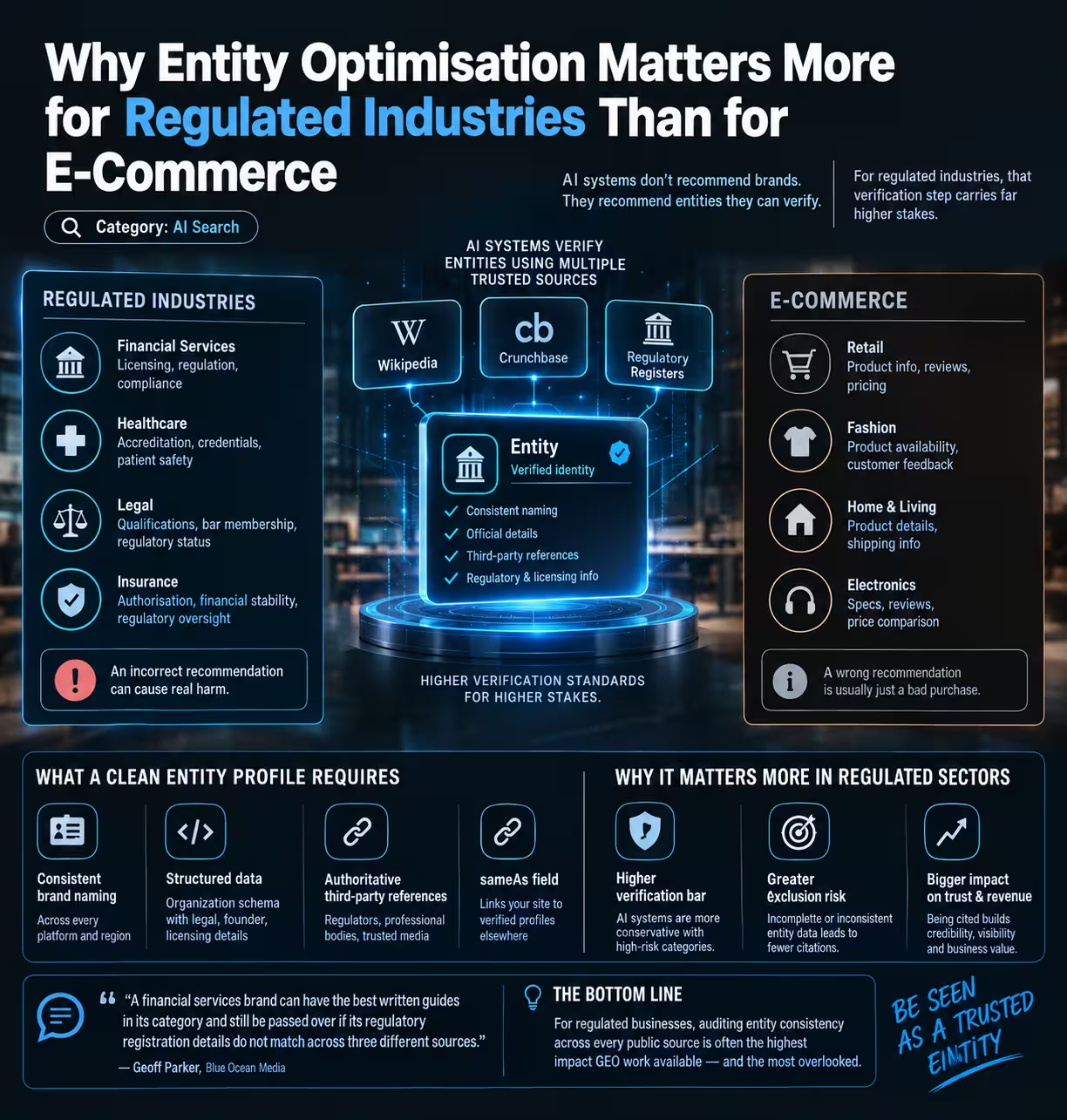
• Entity clarity and consistent naming across the web
• High quality structured product and pricing data optimised for grounding
• Verified expertise and trust signals such as reviews and guarantees
• Payment trust, including recognisable wallets such as PayPal and BNPL options
• Performance indicators from agentic flows such as conversion success and satisfaction
Your internal research shows clear patterns. Brands with strong entities, structured information and authoritative content dominate retrieval in agentic environments. B2B companies are particularly at risk because many rely on unstructured information that AI systems cannot parse reliably.
Agent readiness is becoming the new SEO.
How Social Media Is Reacting To Agentic Commerce
Social sentiment reveals both enthusiasm and anxiety. On X, tech commentators increasingly describe agentic commerce as the moment the website becomes a secondary asset for many journeys. “The era of agentic commerce has begun,” as one user put it, capturing growing belief that autonomous purchasing will overtake tab based browsing.
LinkedIn discussions are more strategic. CMOs examine the need for agent ready funnels, entity centric optimisation and procurement automation. Ecommerce heads debate whether search budgets should shift from keyword targeting to structured data pipelines that feed AI retrieval.
Retail investors speculate on PayPal’s upside as the transactional layer for agentic commerce, with PYPL trending around earnings updates linked to AI. In Reddit communities, users express concerns about privacy, consent and over reliance on AI agents, although many acknowledge the convenience benefits.
Social media is not just commentary. It is accelerating adoption.
What The New Agentic Commerce Stack Looks Like
A new stack is emerging that replaces standard ecommerce flows with agent orchestrated ones. The layers work together to compress intent, research and transaction into a single step.
| Traditional Ecommerce Journey | Agentic Commerce Journey |
| Search on browser | User expresses intent |
| Compare across tabs | Agent evaluates options |
| Add to basket | Agent selects best match |
| Checkout form fill | One tap PayPal identity |
| Email confirmations | Automated tracking |
| Customer support tickets | AI driven resolution |
The surrounding architecture includes
• The intent layer populated by chat interfaces such as Perplexity and the Comet browser
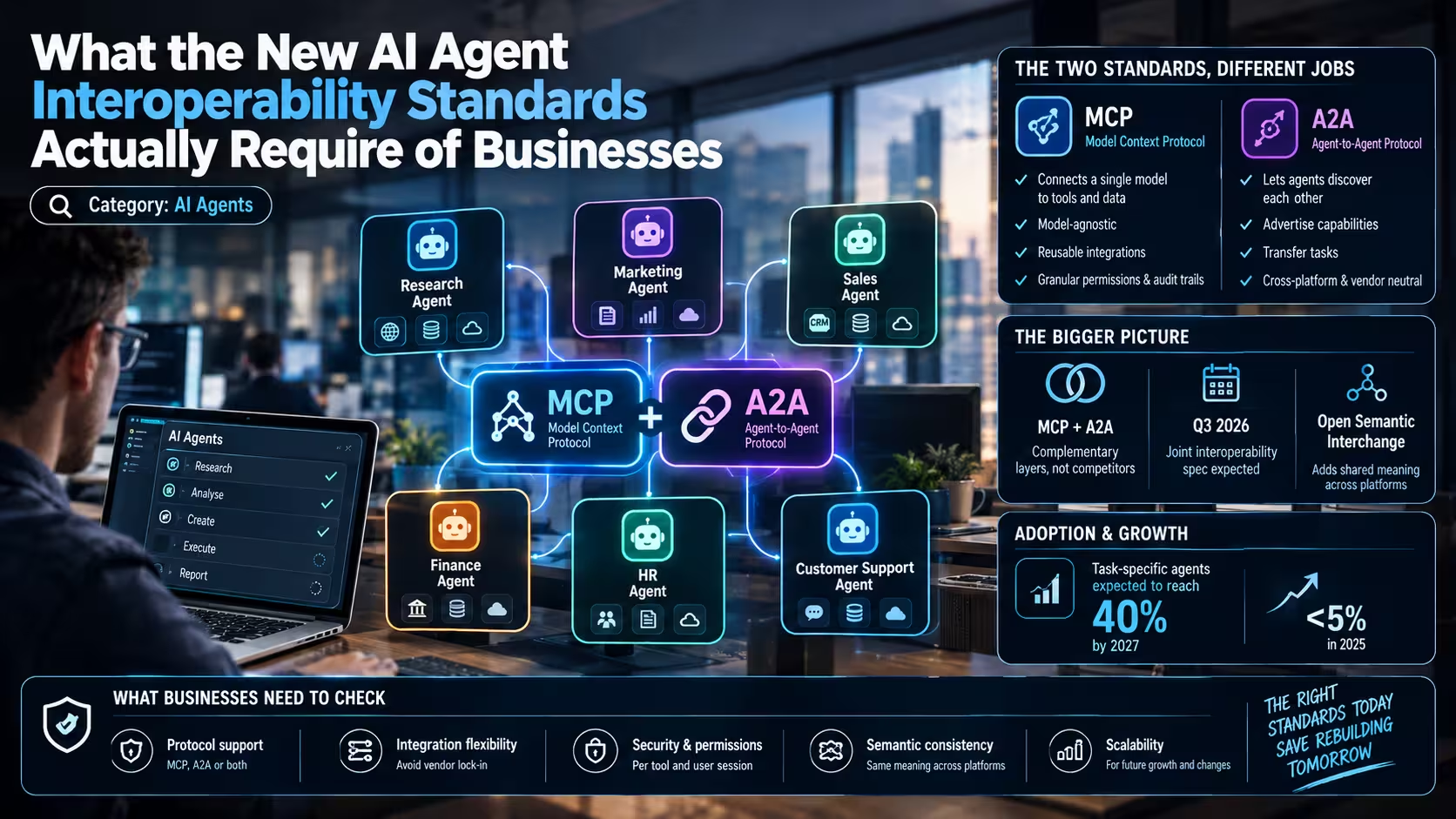
• The orchestration layer where agents reason, plan and act via protocols such as AP2 and MCP
• The commerce layer where PayPal’s Agentic Commerce Services and Mastercard’s Agent Pay execute transactions
• The data and optimisation layer where structured feeds, entity optimisation and AI search optimisation determine visibility
This stack is built for speed, accuracy and automation. For B2B procurement, it promises fewer steps, fewer errors and fewer abandoned decisions.
AI To Drive 20% Of Commerce By 2026
The forecast that AI agents will drive 15 to 20 per cent of US ecommerce by 2026 represents a turning point for the global market (McKinsey, 2025). This share equates to more than one trillion dollars in economic activity, and it arrives alongside broader projections that the AI retail market will reach 85 billion dollars by 2032 at 32 per cent CAGR. Around 33 per cent of B2B firms are expected to implement agentic AI by 2028.
The challenges are real. Privacy concerns, consent management, interoperability standards such as AP2 and MCP, and legacy systems all create friction. Sixty per cent of AI leaders cite outdated infrastructure as a barrier. Yet the opportunity is larger. Voice commerce, autonomous procurement and Perplexity’s projected three billion queries in 2025 all point towards an ecosystem where agents drive most commercial discovery.
The shift feels similar to the early smartphone era, but faster. The days of “Pay Per Clips” in PPC are now as distant as paper catalogues. Agentic commerce is the next evolution of digital buying.
For companies preparing for this shift, Blue Ocean Media supports growth as AI search optimisation specialists and AI Agent developers increasing visibility, traffic and sales for B2B companies in the UK. With GEO Geoff, in Information Retrieval optimisation since 2005, guiding clients through this transition, the path into the agentic era is becoming clearer. The businesses that adapt early will be the ones agents choose next.