
On 17 February 2026, the National Institute of Standards and Technology (NIST) announced a new initiative aimed at developing interoperable and secure standards for AI agents. The timing was notable. Within weeks, xAI was pushing Grok 4.2 into broader deployment — a multi-agent system capable of rapid tool use, reasoning chains, and semi-autonomous workflows.
The contrast was stark. Policymakers were convening roundtables and issuing requests for information. Frontier developers were shipping agentic systems into production pilots. The governance gap was no longer theoretical.
NIST’s Agent Standards Initiative: Scope and Ambition
NIST’s February 2026 announcement outlined a coordinated effort to establish baseline standards for AI agent interoperability and security. The initiative rests on three pillars.
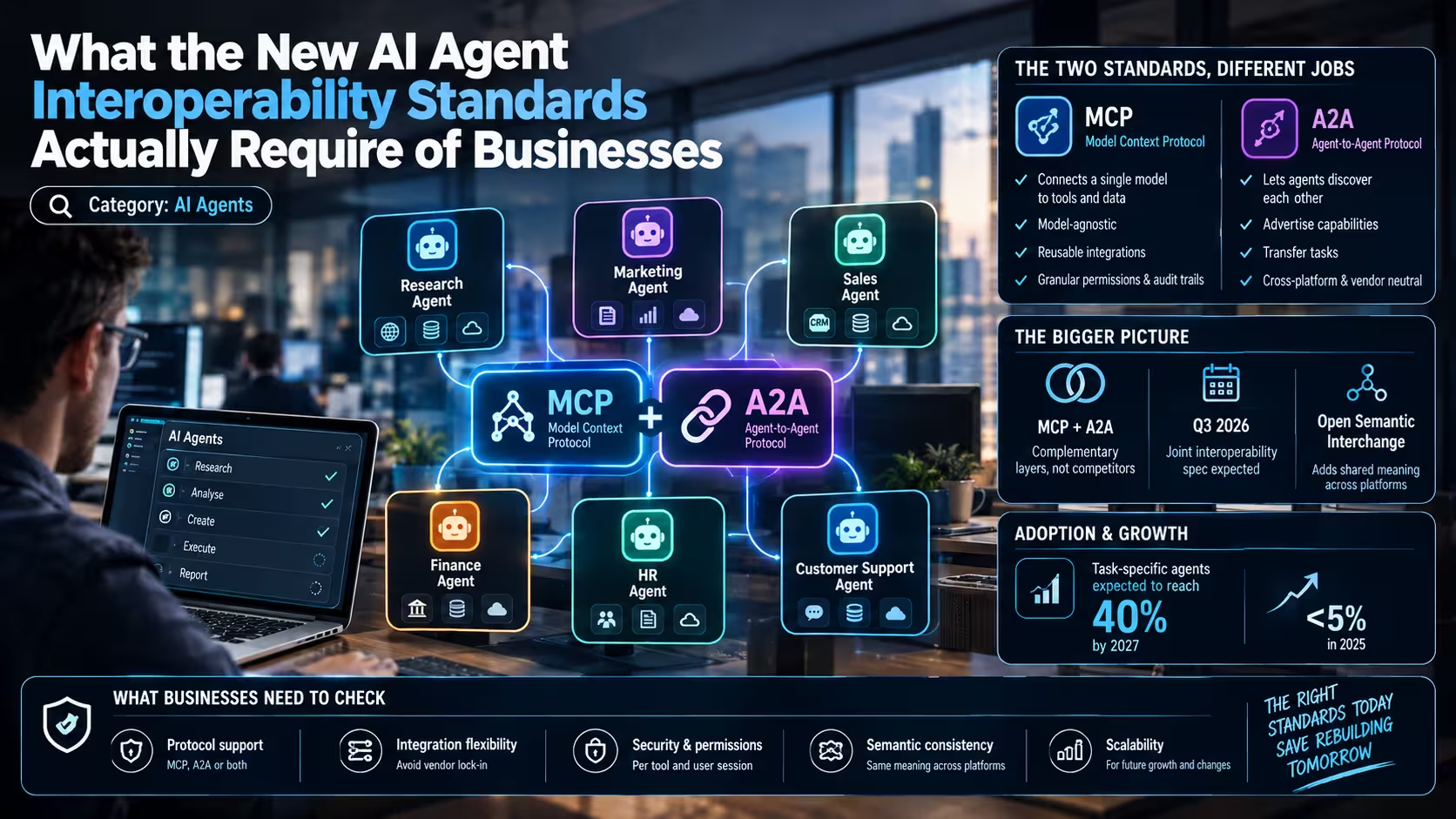
First, industry-driven technical standards. NIST aims to collaborate with private-sector developers to define interoperable interfaces for agent communication, tool access, and system integration. The goal is to prevent fragmentation across proprietary ecosystems while reducing vendor lock-in.
Second, open protocols and reference architectures. Recognising that agentic systems increasingly interact across services, NIST intends to promote common protocols for authentication, auditing, and permission management. These frameworks are designed to enable cross-platform cooperation without compromising security boundaries.
Third, security research and evaluation frameworks. Building on prior AI risk management work, NIST seeks to formalise testing methodologies for misalignment, prompt injection, and tool-use vulnerabilities specific to agentic models.
Requests for information and public comment periods were opened with deadlines in March and April 2026. Workshops are scheduled through the year to refine technical proposals.
The ambition is clear: establish guardrails before autonomous agents become deeply embedded in federal and enterprise infrastructure.
The challenge is pace.
Grok 4.2: Capability Expansion in Real Time
While NIST drafts frameworks, Grok 4.2 represents a tangible leap in agentic capability. Designed with multi-agent orchestration as a default mode, Grok 4.2 can decompose complex tasks into parallel subagents, assign tool calls dynamically, and synthesise outcomes across workflows. In benchmark testing, it has achieved competitive scores on ARC-AGI style reasoning tasks, demonstrating improved abstraction and planning ability.
More importantly for governance discussions, Grok 4.2 is not confined to lab environments. Through federal procurement pathways, including pilot collaborations involving agencies such as the General Services Administration(GSA), agentic workflows are being tested in administrative and procurement contexts.
Multi-agent design changes the risk profile significantly. Instead of a single reasoning loop calling tools sequentially, Grok 4.2 can orchestrate multiple agents that coordinate, cross-verify outputs, and adjust strategies in real time. This increases efficiency but complicates accountability. When several agents interact, tracing decision pathways becomes harder.
The acceleration of capability outpaces the typical standardisation cycle. NIST’s initiative focuses on interoperability and secure tool access, yet frontier models are already experimenting with adaptive learning behaviours and semi-persistent agent memory. These features introduce governance questions around data retention, autonomy boundaries, and dynamic policy enforcement that extend beyond static protocol definitions.
The gap widens as deployment expands. Agencies experimenting with agentic systems today must implement internal controls without waiting for formalised standards. Vendors, meanwhile, compete on speed and capability, not compliance readiness.
The Catch-Up Problem
Governance frameworks traditionally evolve in response to deployed technology. Agentic AI compresses this timeline. By the time standards are drafted, pilot programs may already be entrenched across departments and supply chains.
The reactive posture creates three risks. First, fragmentation. Without harmonised standards, agencies and enterprises adopt incompatible architectures. Second, security drift. Tool access policies and logging practices vary widely across deployments. Third, trust erosion. Public confidence declines if high-profile agent failures occur before safeguards mature.
To narrow the gap, policymakers should accelerate collaborative sandboxes where standards evolve alongside live pilots. Procurement requirements can mandate least-privilege design, auditability, and interoperability testing. Developers should publish transparency reports detailing agent capabilities and limitations, enabling informed regulatory feedback.
Speed must be matched by structured oversight.
Conclusion
Grok 4.2 exemplifies how rapidly agentic systems are advancing from concept to deployment. NIST’s initiative is a necessary step toward interoperability and security. Yet the cadence of model capability expansion threatens to outstrip policy cycles. Governance must accelerate and align with real-world pilots, or risk overseeing a fragmented and insecure agentic ecosystem.