
The experimental phase is over. AI is now changing the real world, and it’s happening faster than most people realise.
Whilst 2025 was characterised by a proliferation of AI applications and tools; with ChatGPT integrations, image generators, coding assistants, 2026 marks a fundamentally different inflection point. This is the year where artificial intelligence transitions from a novelty to a tangible economic force. To kick off 2026, we believe this is a very important year for humanity so what better to do than to deep dive into how we think AI will shape the future this year. The developments outlined below aren’t speculative forecasts; they’re transformations already underway that will fundamentally alter how businesses operate, how products reach consumers, and how scientific knowledge advances.
For UK business and workers across every sector the time for passive observation has passed. So lets present 7 developments that we feel business owners and execs should be aware of as they shape their marketing and business plans for 2026 and beyond.
1. The Rise of AI Agents: Automation Moves from Back Office to Customer-Facing
The concept of AI “agents”—autonomous systems that can complete complex, multi-step tasks without human intervention—has moved from research labs to retail floors with remarkable speed. Microsoft’s announcement on 8th January 2026, ahead of the National Retail Federation conference in New York, signals that one of the world’s largest technology companies is betting heavily on agentic AI as the next frontier of enterprise automation.
What makes this development particularly significant isn’t the technology itself, but rather the scope of what these agents can now accomplish. Microsoft’s retail-focused AI Agent solution encompasses “intelligent automation” across merchandising, marketing, store operations, and fulfilment—essentially, the entire retail value chain. The potential 20-30% reduction in operational costs through automation of inventory management and personalised recommendations represents a competitive advantage that retailers simply cannot ignore.
Three features stand out as particularly transformative:
Copilot Checkout enables purchases directly within AI chat interfaces, eliminating the friction that leads to the retail industry’s persistent 70% cart abandonment rate. Rather than redirecting customers to external sites mid-conversation, transactions occur seamlessly within the AI dialogue itself. So basically, shoppers will be able to, shortly, complete transactions within CoPilot but it depends on the payment gateway you are using. If you are using Shopify it will automatically feed into CoPilot. But for PayPal or Stripe you will need to apply.
Brand Agents function as AI-powered shopping assistants that embody a brand’s voice, guiding customers from discovery through to purchase. Early data showing 15-20% higher engagement and conversion rates compared to unassisted sessions suggests this isn’t marginal improvement—it’s a fundamental enhancement to the customer journey. You know when you walk into a shop and a customer service agent asks you “how can I help you today, is there anything in particular you are looking for?”. Well these brand agents will act like a customer service agent on the site, saving the customer time browsing through all the content to find out what there is.
Agent Templates available through Copilot Studio allow retailers to customise agents for specific scenarios using low-code or no-code environments, democratising access to sophisticated AI capabilities beyond firms with extensive technical resources.
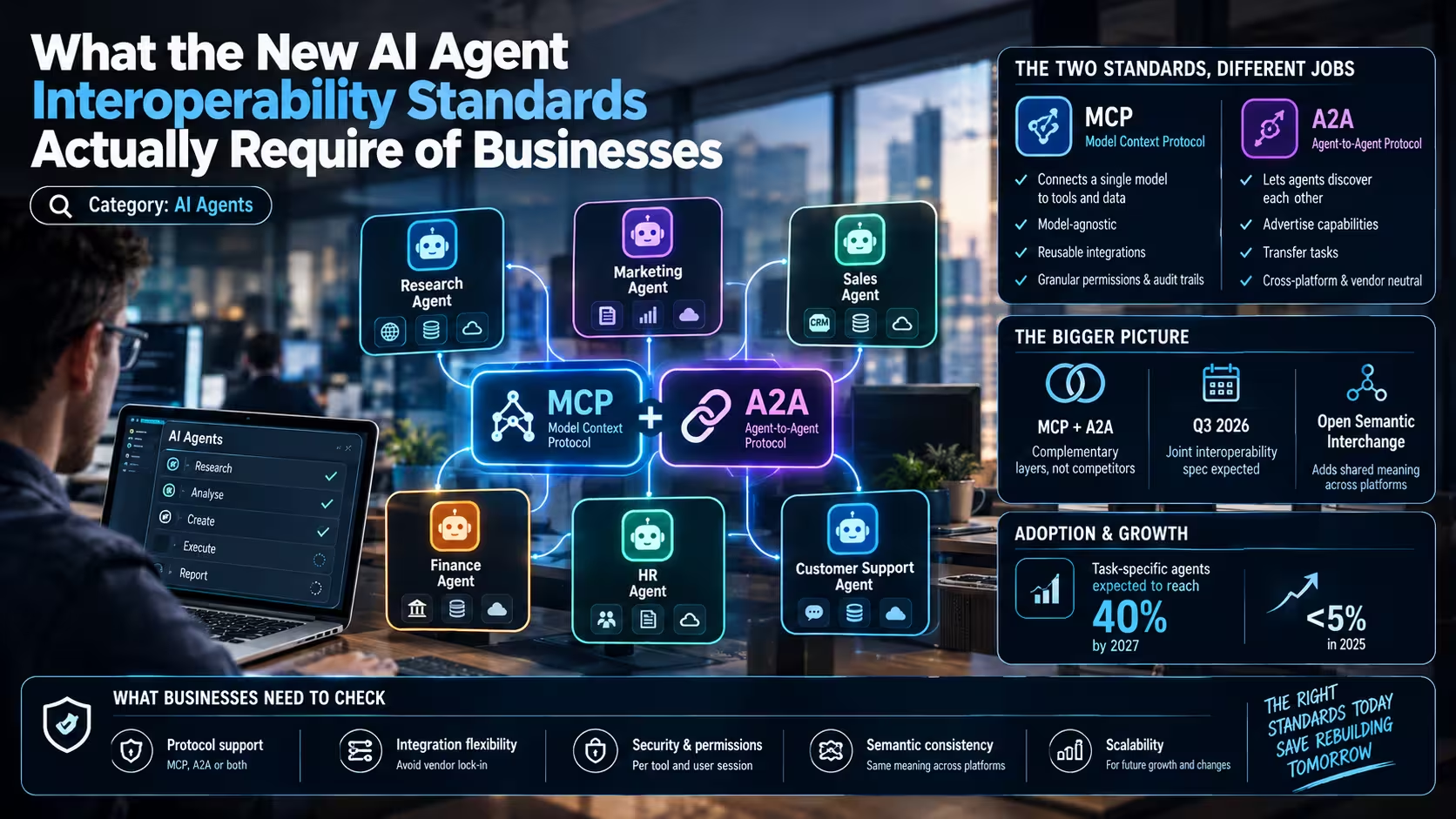
The broader industry context validates Microsoft’s strategic direction. Gartner projects that 40% of enterprise applications will include task-specific AI agents by the end of 2026—a staggering adoption rate for technology that was largely theoretical just two years ago. Microsoft’s Corporate VP of Industry Marketing, Kathleen Mitford, emphasised a crucial aspect of their approach: “We’ve designed it in such a way that retailers own those relationships with the customers. It is their data, it is their relationship.” This data sovereignty addresses perhaps the primary concern preventing widespread AI adoption in customer-facing applications.
The competitive dynamics of retail are shifting with unprecedented speed. Firms that integrate agentic AI into their operations over the next 12-18 months may establish significant advantages in customer acquisition costs, conversion rates, and operational efficiency. Time will tell though if consumers will prefer the non humanistic approach (knowing they are dealing with AI and not a human) or whether that’s not a concern if they find what they are looking for more quickly. Those who delay risk finding themselves structurally disadvantaged against more agile competitors.
2. NVIDIA’s $500 Billion Demand Forecast: The Infrastructure Boom Continues
When NVIDIA’s CFO Colette Kress stated at a JPMorgan event in January 2026 that the company’s forecast of over $500 billion in AI product demand “has definitely gotten larger,” she confirmed what many industry observers suspected: we’re witnessing an infrastructure build-out of historic proportions, and it’s accelerating rather than plateauing. Sceptics may again question the validity of these figures, as they did when Nvidia released their earnings last quarter, but what is clear is that this is different to the dotcom bubble in that despite the questionable nature of these figures, it is clear there are real world products that are making a difference in society and in the workplace.
To contextualise this figure, NVIDIA had already shipped approximately $150 billion worth of AI infrastructure by late 2025, leaving a $350 billion backlog extending through 2026-2027. Wall Street analysts estimate NVIDIA’s 2026 revenue at $321.2 billion—representing 57% year-on-year growth—with projections exceeding $400 billion for 2027. These aren’t the growth figures of a maturing technology; they’re indicative of an industry still in its explosive expansion phase.
What’s driving this extraordinary demand? CEO Jensen Huang pointed to “many new developments” that should increase expectations, including AI’s expansion into enterprise data processing and robotics. Crucially, approximately 90% of NVIDIA’s customers rely on the company’s networking stack to control data flow in AI data centres, creating a deeply integrated ecosystem that’s difficult to displace.
The geographical dimension is equally noteworthy. Despite ongoing US licensing uncertainties, demand from China remains robust, suggesting that AI infrastructure investment has become a strategic imperative that transcends geopolitical tensions. Meanwhile, global AI chip sales are projected to hit $500-550 billion in 2026 alone, with cumulative AI investments potentially reaching trillions by decade’s end.
The scale of infrastructure investment reveals two critical insights. First, the world’s largest technology companies and governments view AI capabilities as existential competitive assets, not optional enhancements. Second, this level of capital deployment creates powerful lock-in effects and economies of scale that will determine which platforms dominate for the next decade.
3. Small Language Models (SLMs)
Whilst much attention has focused on ever-larger language models, 2026 is witnessing the ascendance of Small Language Models (SLMs)—typically containing fewer than one billion parameters—as efficient alternatives for domain-specific tasks and edge deployment. These models deliver approximately 90% of large language model utility at just 1% of the computational cost, representing a fundamental shift in the economics of AI deployment.
AT&T’s Andy Markus captured the industry sentiment: “Fine-tuned SLMs will be the big trend… as the cost and performance advantages will drive usage over out-of-the-box LLMs.” The data supports this prediction. Models like Mistral 7B match GPT-4 accuracy after fine-tuning whilst reducing latency by 5-10x and costs by 80-90%. In finance and healthcare applications, SLMs cut power consumption by 50-70% compared to large language models—a critical advantage in resource-constrained environments and an increasingly important consideration as energy costs and environmental concerns mount.
Enterprise adoption of SLMs is rising 40% year-on-year, with models like Google’s Gemini Nano enabling on-device inference for over one billion users. This on-device capability addresses privacy concerns that have hindered AI adoption in sensitive applications, as data processing occurs locally rather than being transmitted to cloud servers.
NVIDIA, despite its significant investments in large-scale infrastructure, argues that SLMs represent the future for agentic AI precisely because of their deployability advantages. Open-source initiatives like IBM’s Granite models are democratising access to sophisticated AI capabilities, allowing organisations to customise models for their specific requirements without the prohibitive costs associated with large model training.
The rise of SLMs fundamentally alters the competitive landscape. Organisations no longer require hyperscale infrastructure or partnerships with the largest AI providers to deploy sophisticated language capabilities. By 2026, SLMs are projected to capture 30-40% of enterprise AI spending, with edge computing markets growing to $250 billion. This democratisation means that AI advantages will increasingly accrue to organisations that deploy intelligently rather than those that simply deploy at the largest scale.
4. Physical and Embodied AI: From Screens to the Real World
The most visceral evidence that AI is transitioning from digital abstraction to tangible reality came from the Consumer Electronics Show in early 2026, where robotics innovations surged 32% year-on-year with over 3,600 new products demonstrated. NVIDIA’s announcement of its Cosmos and GR00T models for robot training, alongside projections showing 50,000+ bipedal humanoid robots shipping globally in 2026 (representing 700% year-on-year growth), signals that embodied AI has moved from research curiosity to commercial deployment.
The capabilities on display represent genuine breakthroughs rather than incremental improvements. LG’s CLOiD robot handles complex household tasks including laundry sorting and cooking. The X-Humanoid robot performs bimanual object sorting with 90% accuracy—a level of dexterity that enables deployment in logistics, manufacturing, and eventually domestic environments. Electric vertical take-off and landing (eVTOL) aircraft and autonomous vehicles demonstrated practical city missions rather than controlled test scenarios.
NVIDIA’s comprehensive ecosystem now powers over 15 partners including Boston Dynamics, whilst edge computing capabilities via Intel’s Panther Lake processors enable real-time inference without cloud connectivity—essential for robots operating in unpredictable real-world environments.
The shift toward “embodied intelligence” leverages advances in world models and reinforcement learning, solving challenges in full self-driving capabilities and enabling robots to complete multi-day tasks with minimal supervision. Brett Adcock of Figure AI predicts that humanoid robots will be able to perform unsupervised home task completion by late 2026—a milestone that would mark the beginning of genuine domestic robot utility.
Physical AI represents perhaps the most disruptive development to society and how we live and work across these trends. Whilst software can be deployed instantaneously and scaled infinitely, the deployment of tens of thousands of capable humanoid robots in 2026 will trigger regulatory discussions, labour market adjustments, and infrastructure adaptations that have been largely theoretical to this point. McKinsey estimates this transition could add over $1 trillion in productivity whilst displacing millions of jobs—a duality that demands constructive policy decisions to avoid mass unemployment. But the question will be, will this empower the human race or make working obselete? We will see.
5. The Inference Wars: Where AI’s Economic Battle Is Really Being Fought
To understand why “inference” has become the central battleground in AI hardware, one must first grasp what the term means. In AI systems, “training” refers to the computationally intensive process of teaching a model by exposing it to vast datasets. This occurs once, or periodically when updating models. “Inference,” by contrast, is what happens every time that trained model is actually used to process a query, generate text, analyse an image, or make a recommendation. It’s the real-time deployment of AI that end-users experience.
As AI applications proliferate across enterprise and consumer contexts, inference operations are growing exponentially whilst training requirements remain relatively stable. Inference spending is now growing three times faster than training expenditure, fundamentally altering the economics and technical requirements of AI infrastructure.
Specialised chips designed specifically for inference—such as Groq’s Language Processing Units (LPUs) and Graphcore’s Intelligence Processing Units (IPUs)—are challenging NVIDIA’s GPU dominance by offering lower latency and improved cost efficiency for these high-volume, real-time operations. NVIDIA’s reported $20 billion acquisition interest in Groq signals the strategic importance of this shift, as inference becomes high-volume but lower-margin business compared to the premium pricing training infrastructure commands.
The technical innovations are substantial. Qualcomm’s AI200 chip offers 768GB of memory—four times NVIDIA’s B200—whilst optimisations like key-value cache offloading reduce GPU requirements by 50%. Hybrid architectures combining different processor types are reducing latency by 5-10x compared to general-purpose solutions. Meanwhile, AMD’s Ryzen AI 400 series and Intel’s 18A process target edge inference applications, and hyperscalers’ custom silicon development threatens NVIDIA’s 70-80% margins in high-end compute.
As Nilanjan Raychaudhuri observed: “Inference is cheap, but ‘thinking’ is slow”—highlighting that the battle isn’t merely about cost but about achieving the responsiveness that real-time AI LLMs need.
In 2026, inference is projected to dominate 60-70% of AI computational spending. Organisations making infrastructure decisions must now optimise for deployment characteristics rather than training capabilities. The companies that win the inference wars will control the on-ramps to AI capabilities for billions of daily user interactions.
6. AI-Accelerated Science: Compressing Discovery Timelines by Orders of Magnitude
Perhaps no domain demonstrates AI’s transformative potential more vividly than scientific research, where generative models and agentic systems are compressing discovery timelines in biology, medicine, and materials science by factors of 10-100x. Mass General Brigham in Boston predicts AI will interpret genomics data to extract complex biology insights with 40% productivity gains—and this appears conservative given developments already underway.
In biology and medicine, Google DeepMind’s AlphaGenome is decoding non-coding DNA sequences that comprise 98% of the human genome but whose functions have remained largely mysterious. AI systems are now proposing drug candidates that validate successfully in laboratory settings, cutting development timelines from years to mere days in some cases. The SAGA AI agent improved enhancer design—genetic sequences that regulate gene expression—by 176%, a breakthrough that accelerates both basic research and therapeutic development.
Materials science is experiencing similar acceleration. MatterGen generates novel inorganic materials with properties 20-30% superior to existing compounds, whilst BioEmu-1 simulates protein behaviour 1,000 times faster than previous methods—enabling researchers to explore vastly larger possibility spaces in equivalent time.
The adoption statistics are remarkable: AI tool usage is boosting academic paper output by 40-80%, with approximately 90% of scientists adopting AI assistance by mid-2026. Boston Consulting Group forecasts that agentic AI systems will compress drug development timelines from over a decade to mere months, whilst the World Economic Forum projects that biology-computation convergence will add $4 trillion in value creation.
Beyond multimodal AI applications, quantum-AI hybrid systems are emerging that leverage quantum computing for specific optimisation problems within AI-guided research workflows. Open-source diversification is democratising access to these capabilities, with initiatives like BioNeMo and OpenFold enabling researchers globally to contribute to and benefit from AI-accelerated discovery.
Real-World Breakthroughs: From Laboratory to Clinical Application
The abstract promise of AI-accelerated science becomes tangible when examining specific developments moving toward clinical deployment in 2026. These aren’t distant possibilities—they’re interventions entering trials and transforming patient care within months.
Early Cancer Detection via AI-Designed Sensors: Researchers at MIT and Microsoft have developed CleaveNet, an AI model that designs peptides—short protein sequences—specifically targeted by proteases, enzymes that become overactive in the presence of tumours. These AI-designed peptides coat nanoparticles that function as body-wide sensors: when cancer-associated proteases are present, they cleave the peptides, releasing detectable signals that appear in urine or blood samples. The clinical implication is profound—non-invasive, at-home tests for early-stage cancers including lung and pancreatic varieties, which are notoriously difficult to detect before advanced progression. Early detection could increase survival rates by 20-30% by identifying malignancies before symptoms manifest. The technology is moving toward clinical trials in 2026, with initial applications targeting routine screenings for high-risk patient populations.
Predicting Immunotherapy Responses: AstraZeneca and Tempus AI’s Predictive Biomarker Modelling Framework (PBMF) addresses one of oncology’s most vexing challenges—determining which patients will respond to immunotherapy treatments that cost upwards of £80,000 per patient and carry significant side effects. The AI system identifies biomarkers such as specific proteins or genetic markers that forecast patient response to immuno-oncology treatments. In retrospective trials, the framework improved patient selection sufficiently to deliver a 15% survival benefit compared to traditional selection methods. For practising oncologists, this means the ability to personalise immunotherapy for cancers including melanoma and lung cancer, avoiding ineffective treatments that impose financial and physical burdens on patients unlikely to benefit. By mid-2026, this technology is expected to be deployed in 20-30% of U.S. cancer centres, with the potential to reduce clinical trial failure rates from 90% to below 70%—a shift that could accelerate the availability of effective treatments by years.
Targeted Alpha Therapy for Advanced Cancers: NVIDIA and Los Alamos National Laboratory’s AI co-scientist platform combines large language models including Llama Nemotron with generative chemistry models like GenMol to discover chelator molecules—compounds that bind radioactive Actinium for precise tumour targeting. The AI has already identified molecules with improved binding energetics, enabling radiation delivery directly to cancer cells whilst sparing surrounding healthy tissue. For patients with metastatic prostate or breast cancers who have exhausted conventional treatment options, this represents a meaningful extension of both life expectancy and quality of life. Phase I clinical trials are commencing in 2026, with the potential to extend survival by months to years for patient populations with few remaining therapeutic options.
Applications Beyond Oncology: The acceleration isn’t confined to cancer treatment. AI platforms like POLYGON design multi-target drugs for complex diseases including Alzheimer’s and autoimmune disorders, simulating molecular interactions to identify compounds that achieve therapeutic effects whilst avoiding side effects that have historically terminated promising drug candidates. Startups such as Orakl Oncology are extending precision medicine approaches to rare genetic diseases, compressing development timelines by factors of 2-3x—a compression that, for patients with conditions affecting small populations, can mean the difference between a treatment arriving within their lifetime or remaining perpetually in development.
The compression of scientific discovery timelines represents perhaps the most profound long-term impact across these seven developments. Technologies that might have required decades to develop could emerge within years; therapies for currently untreatable conditions could reach patients within this decade; materials enabling clean energy transitions could be identified and scaled before climate tipping points are reached.
The Speed of AI Development Is the Real Story
Across these developments, a common thread emerges: the pace of change itself is the most significant factor demanding attention. Each trend represents not merely incremental progress but rather step-function improvements in capability, scale, or efficiency. AI agents are achieving 15-20% conversion improvements. Infrastructure demand has exceeded $500 billion. SLMs deliver 90% of capability at 1% of cost. Humanoid robot shipments are growing 700% year-on-year. Inference is growing three times faster than training. Scientific discovery is compressing by 10-100x.
These aren’t gradual evolutions—they’re discontinuous shifts that create advantages for early movers and disadvantages for those who delay. The organisations, institutions, and individuals who recognise that 2026 represents a fundamentally different phase from 2025’s experimental period will be positioned to capture value and manage disruption. Those who continue to treat AI as emerging rather than arrived technology will find themselves responding to changes they should have anticipated.
The test year is now over. The practice has stopped and we are now ready for the real game. The question is, are businesses and society ready for what comes next.