
Eight months ago, a brand marketing team could reasonably justify a multi-platform AI search strategy. ChatGPT held 89% of measurable B2B AI referrals. The remaining share was distributed so thinly across Claude, Gemini, Perplexity, and a long tail of smaller platforms that the economics of optimising for each one separately were difficult to defend. That calculation has changed. By March and April 2026, ChatGPT’s share of measurable B2B AI referrals had fallen to 62.6%. Claude reached 18.5%, Gemini 10.6%, and Perplexity 7.3%. The Big Four now hold 99% of measurable AI referral share. What has changed is not the size of that pool, but the distribution within it. And the distribution has a clear strategic implication: Claude is now the second platform that matters, and the gap between Claude and everyone else is widening in the direction that makes a two-platform strategy not just reasonable but correct.
This article examines what the data from the first half of 2026 actually shows about AI search citation behaviour, why Claude and ChatGPT operate on fundamentally different retrieval logic, what that difference means for brand visibility, and why chasing Perplexity, Gemini, or any other platform at the expense of depth on these two is where most brands are currently leaving share on the table.
What the Referral Data Actually Shows
The Goodie Wave 2 report, published May 2026 and tracking measurable B2B AI referrals across brands at scale, is the most comprehensive dataset available on where AI-originated traffic is actually coming from. The finding that stands out is not ChatGPT’s decline in isolation. It is the speed and destination of that shift. In Wave 1, covering May to August 2025, Claude held 1.35% of measurable B2B AI referral share. By Wave 2, covering March to April 2026, that figure was 18.5%. That is the largest eight-month shift of any platform in the dataset. Claude did not grow incrementally. It stepped.
The mobile data corroborates the referral trajectory from a completely independent source. As of early May 2026 on iOS, Claude ranked second in both the Top Free and Top Grossing app categories for AI applications. The install base is not comparable to ChatGPT’s, which carries 6.99 million ratings versus Claude’s 126,000, but the App Store rankings measure recency, not history. Claude has caught and surpassed Gemini for new installs and revenue capture among recent users. Two independent datasets, one tracking B2B referral traffic and one tracking consumer app adoption, are pointing to the same platform trajectory.
Gemini’s growth tells a different story. Its referral traffic to external websites grew 388% year-over-year versus ChatGPT’s 52%, which looks significant until the base is examined: Gemini’s growth is driven by Android ecosystem distribution, not by search-intent behaviour that results in brand citation. 77.9% of Gemini interactions occur on mobile. It strengthens Google’s ecosystem rather than driving AI-originated brand discovery. For B2B brands tracking AI citation as a pipeline signal, Gemini’s distribution growth does not translate into the citation behaviour that Claude and ChatGPT produce.
Why Claude and ChatGPT Have Different Citation Logic
The most important thing a brand can understand about the two-platform landscape is that Claude and ChatGPT do not cite in the same way. Treating optimisation for one as equivalent to optimisation for the other is the fundamental strategic error that most brand teams are making right now.
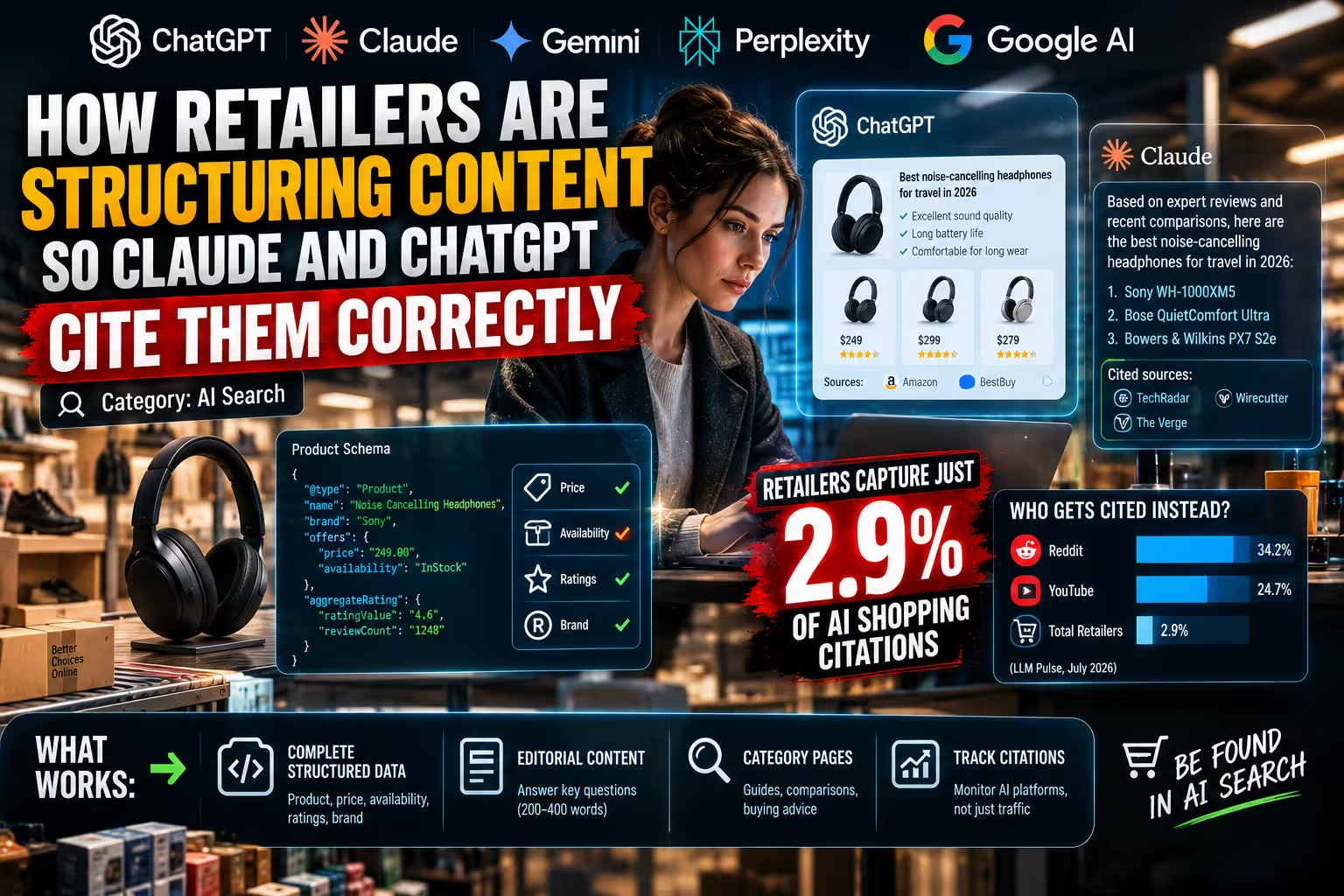
ChatGPT rewards scale, brand recognition, and high-volume content libraries. It is the platform where a mid-market brand encounters the brand recognition ceiling first: the top-cited brands on ChatGPT capture 24% of all named citations across B2B SaaS queries, with an average of 3.8 distinct brands surfaced per answer. Getting into ChatGPT citation at meaningful frequency requires either genuine category authority or a content volume that builds recognition signals at scale. It is also the platform where paid brand promotion is beginning to emerge: as of February 2026, ChatGPT ads appear in nearly 20% of sampled responses, meaning the organic visibility playing field is narrowing in some categories.
Claude operates differently. It cites the most distinct brands per answer of any major platform, averaging 5.1 distinct brands surfaced per response compared to ChatGPT’s 3.8. That structural difference is not a quirk of Claude’s model. It is a function of how Claude’s retrieval and synthesis logic works: it prioritises accuracy, depth, and careful reasoning, and in doing so it surfaces a broader set of authoritative sources than ChatGPT’s scale-and-recognition model. For mid-market and specialist brands that are not yet in ChatGPT’s top-cited tier, Claude is the platform where they can break in. The brand that earns Claude citation with depth and authority tends to see ChatGPT citation follow. Research tracking multiple B2B brands across AI platforms found that for most mid-market brands, ChatGPT visibility tends to follow as a trailing indicator of Claude optimisation. Teams that chase ChatGPT volume at the expense of Claude depth end up with broad but shallow visibility that lacks the authoritative signals needed to sustain AI citation over time.
What AI Search Optimisation Actually Requires
The content characteristics that earn citation on Claude and ChatGPT overlap significantly, but not completely, and understanding the overlap is where the efficiency of a two-platform strategy comes from. Research indicates that 60 to 70% of the AI search optimisation work required for Claude also benefits ChatGPT visibility. The overlapping signals include topical authority, strong expertise, authoritativeness, and trustworthiness signals, clear content structure, off-site community mentions, and consistent content updates that demonstrate recency. These are not new concepts for anyone with a background in search. They are, however, applied differently in an AI citation context than in a rankings context.
Traditional SEO optimises for a single page’s relevance to a query. AI citation optimisation requires building a network of interlinked, topic-complete resources that an AI model can synthesise into an authoritative answer. A single blog post does not earn regular AI citation. A content architecture that covers a topic from multiple angles, connects claims to credible sources, updates to reflect the current regulatory or market environment, and is reinforced by third-party mentions across authoritative publications, does. The AI model is not indexing a page. It is identifying whether a brand is trustworthy enough to appear in an answer that its user will act on.
The platform-specific layer is where the two strategies diverge. For Claude, the signal that matters most is depth and completeness. Claude’s long-context capability means it can synthesise long, complex documents, and it rewards content that fully covers a topic rather than content that is optimised for a keyword density that served a different era of search. For ChatGPT, the signal is reinforcement across high-volume surfaces: if a brand is mentioned frequently in the training and retrieval corpus, it is more likely to be surfaced. These are not contradictory optimisation strategies; they are sequential. Build the depth for Claude. The breadth for ChatGPT follows.
Why Perplexity Does Not Belong in the Same Conversation
The question of whether to add Perplexity to a two-platform strategy is reasonable and deserves a direct answer. Perplexity holds 7.3% of measurable B2B AI referral share, which is not negligible. Its citation model is different again from both Claude and ChatGPT: it is built around real-time web retrieval and source transparency, making it the platform where owning high-quality, citable, current content with strong third-party corroboration produces visible citation. For brands in categories where research-intent queries dominate, Perplexity can be worth tracking.
But the strategic question is not whether Perplexity is valuable. It is whether the optimisation work specific to Perplexity, which centres on earned media placements, forum mentions, and real-time content freshness, is worth the resource allocation at the expense of deeper work on Claude and ChatGPT. For most brands, the answer is no. The Claude and ChatGPT overlap in optimisation signals means that resource deployed on depth for Claude builds ChatGPT citations as a trailing effect. Perplexity requires its own citation-specific optimisation approach, and at 7.3% share versus Claude’s 18.5%, the return does not justify equivalent resource at this stage of market development.
The Measurement Problem Most Brands Have Not Solved
The practical obstacle to a two-platform AI search optimisation strategy is not the content work. It is the measurement model. GA4 does not separately attribute AI-originated sessions in most configurations; AI apps increasingly strip referrers, pushing AI-originated traffic into the direct bucket. Brands that are optimising for AI citation without a parallel investment in tracking that citation are flying blind. The brands that will compound their advantage through 2026 are those that have built measurement infrastructure around share of AI voice, tracking how frequently they appear in AI answers to the buyer-stage questions their category generates, not those that are waiting for GA4 to solve the attribution problem.
Geoff Parker on the Two-Platform Decision
“Most of the brands we work with have been asking whether they should be on every AI platform or focus their resources,” said Geoff Parker, MD of Blue Ocean Media Ltd. “The data from early 2026 makes that decision much clearer. Claude and ChatGPT are the two surfaces where measurable B2B citation is happening at meaningful scale, and the overlap in what it takes to earn citation on both means you are not splitting your strategy, you are building a single asset that works harder on two platforms. The brands that spread thin across four or five AI surfaces because they are worried about missing something are the ones ending up with shallow visibility everywhere and authority nowhere.”
Claude’s 18.5% Share Is the Number That Changes the Strategy
The argument for optimising across all AI platforms simultaneously rested on the assumption that the market was too fragmented to concentrate. That assumption was wrong for 2025 and it is demonstrably wrong for 2026. Claude’s emergence to 18.5% of measurable B2B AI referral share has created a genuine two-platform market. ChatGPT and Claude together now represent more than 80% of measurable B2B AI referral traffic, with fundamentally different citation logic that requires a two-platform strategy rather than a single optimisation approach copied across surfaces.
The brands that recognise this now and invest in the depth that Claude rewards, building content architectures that are complete enough to earn authoritative citation rather than broad enough to appear occasionally across many platforms, will have compounded their AI visibility advantage before the market reaches the consolidation point where breaking in becomes structurally harder. The window is open. The data is clear. The platform choice has been made for you by the market.
Sources
- Goodie, 2026 AI Search Traffic Report: ChatGPT Is Slipping, May 2026
- AI Business Weekly, AI Market Share 2026: ChatGPT vs Gemini vs Claude Data, April 2026
- Rankeo, B2B SaaS Citation Benchmarks 2026: ChatGPT vs Claude vs Gemini vs Perplexity, May 2026
- Crawl Vision, Claude AI Search vs ChatGPT Search: Which Should You Optimize First in 2026, May 2026
- LLMrefs, ChatGPT vs Claude vs Perplexity: 2026 SEO Guide, April 2026
- First Page Sage, Top Generative AI Chatbots by Market Share, June 2026
- Launchmind, AI Search Market Share 2026: ChatGPT vs Google vs Perplexity, January 2026
- Genesys Growth, ChatGPT vs Claude vs Perplexity: A Complete Guide for Marketing Leaders in 2026