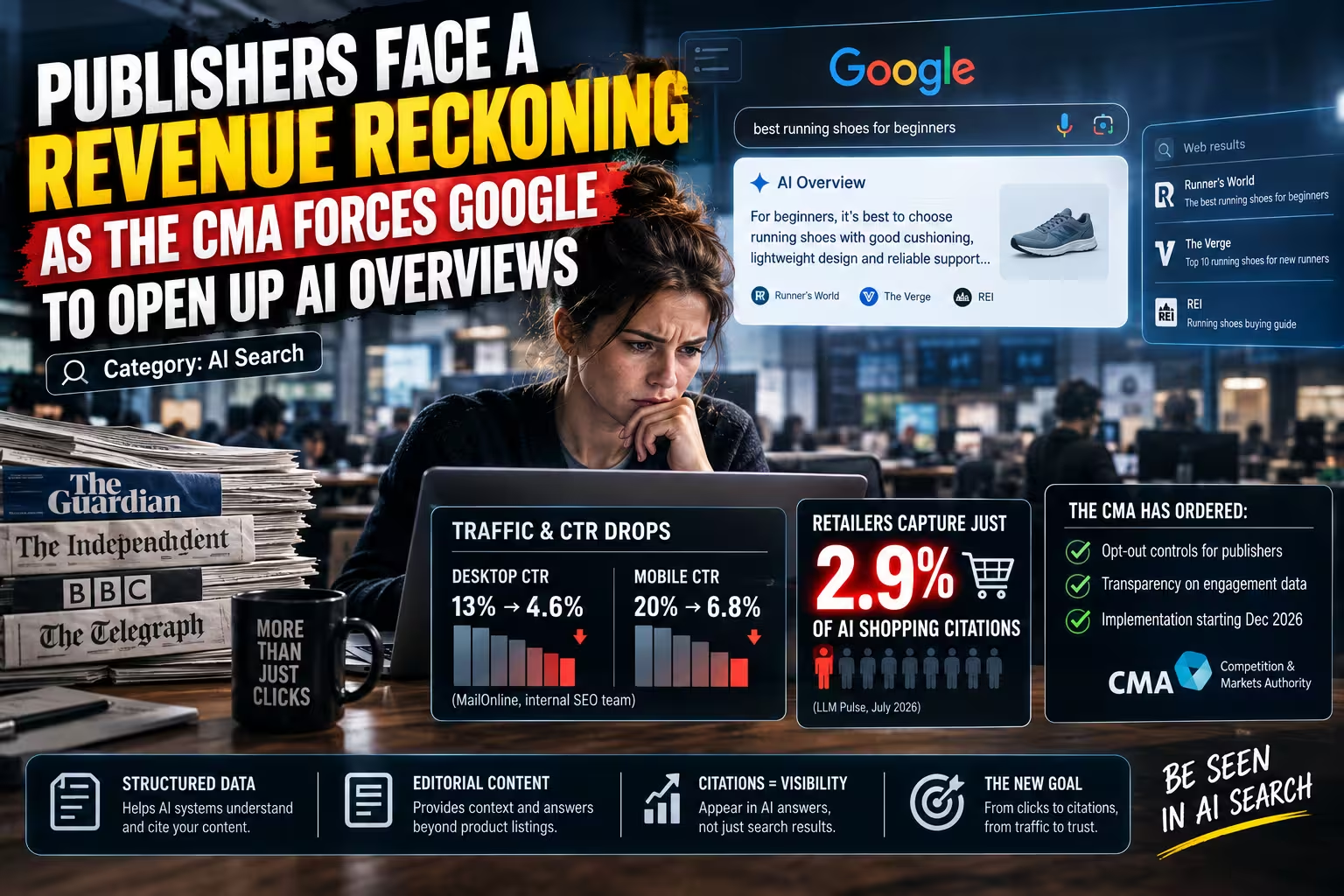

Desktop click through rates on MailOnline fell from 13% to 4.6%, and mobile from 20% to 6.8%, whenever an AI Overview appeared above its results, according to figures shared by the publisher’s own SEO team. Multiply that pattern across a UK news industry that leans on Google for a large share of its referral traffic, and the numbers behind the phrase “traffic apocalypse” start to look less like hyperbole and more like an accounting problem. On 3 June 2026, the UK’s Competition and Markets Authority moved to do something about it, imposing the first binding legal requirement anywhere in the world forcing Google to let publishers opt their content out of AI Overviews entirely.
This article sets out what the CMA actually ordered, how large the traffic and revenue losses already look before any opt-out takes effect, and why the ruling hands publishers a genuine negotiating position for the first time since AI Overviews launched. That is the real story here for anyone working in AI search, not whether individual publishers should flip the opt-out switch, but what the money at stake actually looks like now that Google has been forced to show its numbers.
What the CMA Actually Ordered on 3 June 2026
The conduct requirement follows directly from the CMA’s designation of Google with Strategic Market Status in general search, a 156-page final decision issued on 10 October 2025 after assessing evidence from Google, more than 80 market participants and 34 consultation responses. AI Overviews and AI Mode sit explicitly inside that designation, on the basis that both form part of Google’s general search infrastructure rather than a separate product.
The requirement itself splits into two independent opt-out controls, one for content being used to ground AI Overviews and AI Mode responses, and one for content being used to fine-tune Google’s underlying AI models, each operable separately at domain or individual page level. Google also has to publish disaggregated engagement metrics through Search Console, including impressions and click-through rates, giving publishers an evidence base that has simply not existed until now.
How Big Is the Traffic Loss Publishers Are Already Reporting
Research from UK AI search platform Authoritas, submitted as part of a legal complaint to the CMA, found publishers see a 47.5% clickthrough rate drop on desktop and 37.7% on mobile whenever an AI Overview appears for a given query. That data was gathered specifically to quantify the harm the CMA has now acted on, and it lines up closely with individual publisher figures shared separately, including MailOnline’s own reported CTR collapse.
“If AI Mode becomes the default experience, I don’t think anyone is going to be clicking on those links,” Carly Steven, MailOnline’s director of SEO and editorial e-commerce, told an industry conference. “Referral traffic from Google is definitely in trouble” (Carly Steven, MailOnline, 2025). Her own case study data showed a single news story ranking first in Google, drawing close to 6,000 clicks before an AI Overview was added to the results, then dropping to around 100 clicks afterwards on the same query.
Why Affiliate Revenue Is the Hidden Casualty
Traffic loss on news content gets most of the attention, but affiliate and review revenue may be where the financial damage is sharpest. Paul Cunliffe, an affiliate marketing specialist who works with UK publishers, told Press Gazette’s Future of Media Trends event that AI Overviews are cutting review and buyer’s guide traffic by up to 50%, translating into an affiliate revenue drop of 20% to 40% at some publishers (Paul Cunliffe, Press Gazette event, October 2025). Affiliate revenue depends entirely on a reader clicking through to make a purchase, so a summarised answer that removes the click removes the commission along with it, a more direct financial hit than the slower erosion of display advertising revenue from lost pageviews.
What Data Transparency Actually Changes for Negotiations
Until this ruling, publishers negotiating with Google over AI content deals were arguing from estimates, since Google controlled the only dataset that could confirm or deny the scale of traffic diverted into AI Overviews. Google has maintained that click volumes are broadly stable even as individual publishers reported steep declines, a disagreement that was, until now, impossible to independently verify.
Requiring Google to publish disaggregated impressions and click-through data through Search Console removes that information asymmetry. Publishers entering licensing or compensation negotiations with Google can now point to a CMA-mandated, auditable baseline rather than their own analytics alone, a materially stronger negotiating position than goodwill and estimated traffic loss provided before.
Why the Opt-Out Choice Is Not a Simple Binary
Having the option to opt out does not mean every publisher benefits from using it. If only a minority of publishers opt their content out of AI Overviews, those who remain opted in may see disproportionate representation in AI-generated answers relative to their opted-out competitors, since Google’s AI features still need source material to draw from. A publisher opting out purely on principle, without checking what competitors in its specific vertical are doing, risks ceding visibility rather than protecting revenue.
That collective action dynamic means the opt-out decision increasingly depends on competitive intelligence as much as on a publisher’s own traffic data, tracking what direct competitors signal about their AI Overview strategy before committing to a position that could look very different depending on how the rest of the market responds.
What the Phased Timeline Means for Budgeting This Year
The conduct requirement does not take effect immediately across the board. Main publisher opt-out controls are due by December 2026, with page-level grounding controls following in March 2027, giving Google roughly six to nine months to build the required infrastructure. For publishers, that phased timeline is a planning window rather than an emergency, but it is a narrower one than it looks, since the underlying traffic losses documented by Authoritas and individual publishers are happening now, well ahead of any opt-out mechanism actually existing.
Revenue planning for the remainder of this financial year needs to assume the current traffic and affiliate losses continue unmitigated until the opt-out tools arrive, rather than pricing in relief that will not materially change publisher economics until deep into the next reporting cycle.
What About Display Advertising Revenue
Affiliate commissions are the most direct casualty, but display advertising revenue is exposed in a slower, less visible way. Every pageview lost to a summarised AI answer is a pageview that never generates an ad impression, and industry-wide zero-click search rates have climbed sharply since AI Overviews expanded, meaning fewer visits are converting into the page loads that display advertising revenue depends on. Unlike affiliate revenue, where the loss shows up immediately in a single transaction, the display advertising impact accumulates gradually across a publisher’s entire traffic base, making it easy to underestimate until a full reporting quarter has passed.
That slower, cumulative nature is part of why the CMA’s new Search Console data matters beyond the headline CTR figures. A publisher able to see disaggregated impressions data can start attributing specific revenue lines, display, affiliate, subscription conversion, to AI Overview exposure at the query level, rather than only noticing the effect once total advertising revenue for a quarter comes in lower than forecast.
Why Other Regulators Are Watching This Ruling Closely
The CMA’s conduct requirement is being treated as an operational template well beyond the UK. Submissions to the CMA’s own consultation, including from the Center for Data Innovation, framed the decision as a live test case for how competition law, rather than copyright litigation, can be used to address AI search’s impact on publishers. Regulators in the EU, Australia and Canada have been tracking publisher-platform disputes over AI content use, and a working, enforceable UK model gives those bodies a concrete reference point rather than a theoretical one.
For UK publishers and brands, that international attention matters less for its own sake than for what it signals about durability. A conduct requirement built to withstand scrutiny from multiple international regulators watching how it performs is less likely to be quietly diluted in implementation than one operating without that level of outside interest.
Why This Matters Beyond News Publishing
The CMA’s ruling is framed around news publishers, but the underlying traffic and revenue mechanics apply to any business relying on organic search visibility, retailers, service providers, and B2B brands alike. A company whose product pages or guides get summarised inside an AI Overview faces the same CTR erosion a news publisher does, without the same trade body representation currently pushing for compensation on its behalf.
For brands outside news media, the practical takeaway is not a seat at the CMA’s negotiating table, since the conduct requirement is specifically about publisher content rights, but the newly available Search Console data still applies broadly. Any business can now see disaggregated impressions and click-through data for its own content, giving marketing teams the same kind of evidence base publishers have been fighting to access, just without the collective bargaining position that comes with organised news industry representation.
What Is Being Said About the Ruling Right Now
Trade body response has been broadly supportive but cautious about enforcement. News Media Europe has backed the conduct requirement in principle while pressing for stronger safeguards against circumvention and a design flexible enough to keep pace with how AI systems evolve. A parallel thread of commentary has focused on whether AI search competitors without Google’s Strategic Market Status designation, including OpenAI and Perplexity, will face any equivalent transparency obligation, since the current ruling applies specifically to Google’s general search activity rather than to AI search as a category.
Publishers See CTR Drop by Up to 47.5% When AI Overviews Appear
Geoff Parker of Blue Ocean Media says the CMA ruling changes the calculation for any brand relying on organic search traffic, not just news publishers. “This is the first time a regulator has forced a platform to show its working on AI search impact, and that data is going to reshape licensing conversations well beyond news publishing,” Parker says. “Brands and agencies watching this need to treat the opt-out decision as a live commercial question this year, not a policy debate to revisit once the tools are built.”
For any business dependent on organic search visibility, the CMA’s ruling is less about whether to opt out and more about understanding, for the first time with auditable data, exactly how much AI Overviews are already costing in clicks and revenue. Working through what that data means for a specific content strategy, rather than waiting for the December 2026 deadline to force the question, is the more useful place to start. Anyone assessing their exposure should be reviewing AI search performance now, while the current traffic losses are still the baseline any future negotiation will be measured against.