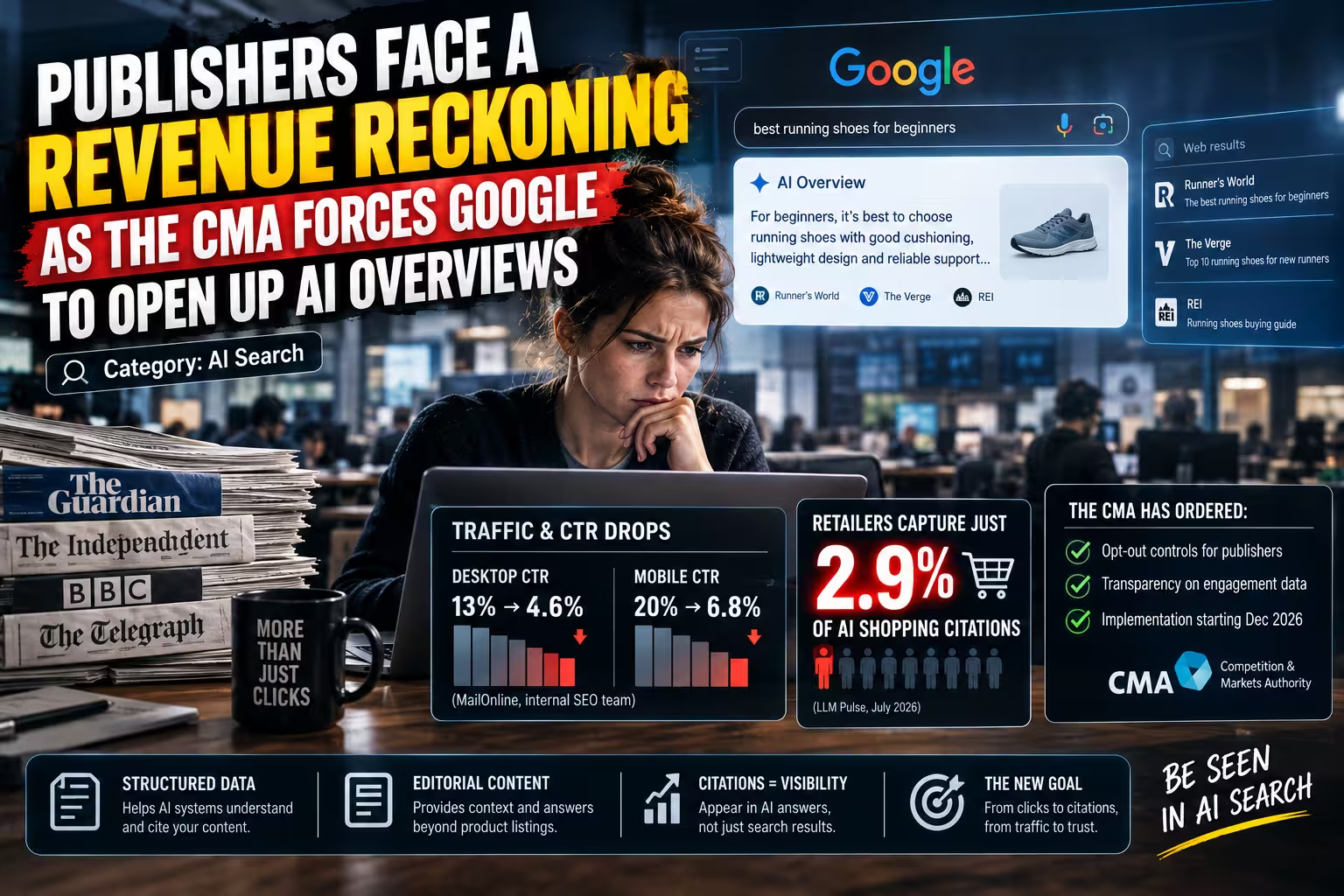

On 3 June 2026, the UK’s Competition and Markets Authority imposed a legally binding requirement forcing Google to let publishers opt their content out of AI Overviews, AI Mode and AI-powered Discover features, without losing visibility in ordinary search results. The CMA describes it as a world first, the first time any regulator has directly forced a dominant search engine to separate how content powers conventional search from how it powers generative AI summaries.
Google did not choose to make this change. It was designated as holding strategic market status in October 2025, a status that let the CMA impose the requirement without needing to prove Google had acted unlawfully at all.
This article sets out what the CMA has actually ordered, why publishers spent more than a year pushing for exactly this outcome, and why the obvious next question, whether publishers should now opt out, has a far less obvious answer than the ruling itself suggests. The mechanics matter less here than the strategic dilemma sitting underneath them.
What The CMA Has Actually Ordered
The publisher conduct requirement gives website owners two separate opt-out controls, one covering whether their content can be used to ground AI Overviews and AI Mode responses, the other covering whether it can be used to fine-tune Google’s underlying AI models. Both controls operate independently at domain and page level, meaning a publisher can block content from training Google’s models while still allowing it to appear as a grounded source in AI Overviews, or the reverse.
Google must also attribute publisher content clearly with direct links wherever it appears in an AI generated response, and must publish detailed engagement metrics, including impressions, click throughs and click through rate, through Search Console, giving publishers the data baseline needed to negotiate compensation rather than guessing at their own exposure.
The requirement is being phased in rather than switched on overnight. Main publisher controls take effect from December 2026, with page level grounding controls following in March 2027. A separate fair ranking and data portability requirement, covering how Google’s algorithm treats AI features in its rankings and how easily businesses can access their own search data, was imposed on 17 June 2026, two weeks after the publisher requirement itself. Together, the two rulings represent the most detailed regulatory intervention any search engine has faced over how it deploys generative AI against third party content.
The route to this point began well before June. The CMA published a roadmap of potential interventions in mid-2025, then launched a formal consultation on proposed conduct requirements in January 2026, drawing more than sixty published responses from publishers, trade associations, academics and Google itself.
The CMA held roundtable sessions with dozens of affected businesses that February to work through the practical detail of how opt-out controls should function, evidence of a regulator building the requirement through sustained engagement with the industry rather than issuing an untested rule from outside. That process matters for how durable the requirement is likely to prove, since a conduct requirement built on this much direct stakeholder input is harder for either side to credibly claim was rushed or poorly calibrated once implementation begins.
Why Publishers Fought for This
The commercial pressure behind the ruling is not abstract. Sistrix data published in Press Gazette in May 2026 found a 59% drop in click through rate at the top organic search position once an AI Overview appears above it, a collapse in referral traffic publishers had been reporting anecdotally since Google expanded AI Overviews to the UK in July 2025. Publishers had been operating under what industry lawyers describe as compelled consent, since allowing Google to crawl a site is a practical requirement for appearing in search at all, while that same crawled content was simultaneously powering AI features that were quietly cutting the traffic search had always delivered.
Dan Conway, chief executive of the Publishers Association, called the ruling a significant step in the right direction, noting that investments publishers make in accurate, trusted content had been undermined for too long by an arrangement they had no real ability to negotiate. The News Media Association struck a similar note, framing the requirement as a shift toward premium content being properly respected and fairly compensated rather than absorbed into a search engine’s AI output for free. For publishers with genuinely valuable, hard to replicate content, the ruling is being read less as a defensive shield and more as new leverage in commercial negotiations with Google that were previously very one sided.
Could Opting Out Make AI Search Worse
Here is where the ruling gets genuinely complicated, in a way most coverage has skipped past. If a meaningful share of high quality, reputable publishers choose to opt their content out of AI Overviews, the feature does not simply shrink. It continues answering the same queries, but grounded in a narrower, self-selected pool of sources, precisely the publishers who did not opt out, which is not necessarily the same group as the most accurate or highest quality sources on a given topic. Critics of the ruling, including analysts at the American Enterprise Institute, have argued that mass opt-out could make AI Overviews more biased and less reliable for the ordinary searcher, not less, since the feature would be summarising an incomplete and self-selected sample of the web rather than the full breadth of quality sources Google’s ranking normally surfaces.
That creates a genuine collective action problem for publishers, one that inverts a core assumption of a decade of SEO strategy. Historically, more visibility in Google’s results was straightforwardly good, and any control that reduced a publisher’s footprint was a control most businesses avoided using. Under this regime, a publisher’s correct choice depends heavily on what its competitors do. If most competitors in a given vertical opt out and one publisher does not, that publisher may become disproportionately represented in AI Overviews for that entire topic area, an outcome that could be lucrative or reputationally awkward depending on how comfortable that business is becoming the default AI-cited source for its whole sector. If a publisher opts out while competitors do not, it may lose AI-driven visibility entirely in a features set that is, whether publishers like it or not, becoming a significant discovery channel in its own right.
No comparable industry coordination mechanism currently exists to help businesses make this decision collectively rather than individually, which means the early months of the opt-out window are likely to produce a genuinely uneven pattern of adoption, some sectors moving toward near universal opt-out as trade bodies coordinate informally, others seeing almost no movement at all because no single publisher wants to be the first to test how the market responds. That unevenness is itself useful information, since the sectors that move fastest toward collective opt-out are likely to be the ones where publishers judge their content most replaceable within an AI Overview, and least valuable to keep feeding into a system that was, until this ruling, extracting it without meaningful compensation or consent.
What This Means for AI Search Strategy
For any business thinking about its content strategy over the next twelve months, the opt-out decision is not one to make in isolation from competitors, and it is not a decision with an obviously correct default answer the way most previous SEO controls have been. Monitoring competitor behaviour through public statements and observable AI Overview appearances is now a genuine input into content strategy, not a peripheral concern, since the value of opting in or out shifts depending on how many others in the same space make the same choice.
The ruling’s scope is also narrower than headline coverage sometimes suggests. Strategic market status applies specifically to Google, meaning Bing, Perplexity and other AI-powered search competitors face no equivalent obligation to offer these controls, creating an uneven landscape where a publisher’s opt-out strategy might need to differ platform by platform rather than following a single unified policy. Businesses with genuinely distinctive, hard to replicate content are in the strongest position regardless of which way they lean, since that is precisely the content other publishers cannot simply substitute if the business chooses to withhold it, and the content Google has the most commercial incentive to negotiate over rather than simply exclude.
Regulators beyond the UK are watching closely for the same reason publishers are. The CMA’s publisher conduct requirement is the first framework of its kind anywhere in the world to separate content display rights from AI training data rights at this level of granularity, and competition authorities in the EU, Australia and Canada have already been monitoring publisher-platform disputes over AI search with a view to their own future rulemaking. A UK precedent that survives implementation intact, without being watered down through weak enforcement or Google finding technical routes around its substance, gives those regulators a tested operational model rather than a theoretical one, which raises the stakes for how seriously the CMA polices compliance over the next year.
Current Discussions About This
Reaction across the publishing and marketing industry has moved quickly from celebrating the principle of the ruling to debating its practical execution. Publisher trade bodies have broadly welcomed the requirement while cautioning that its real test will be enforcement and Google’s willingness to comply in substance rather than in form, a concern several commentators have linked to Google’s history of minimal compliance with earlier competition remedies in other jurisdictions. Marketing and SEO professionals have focused more on the strategic dilemma itself, with recurring debate over whether the sensible default for most businesses is to wait and observe competitor behaviour through the December 2026 rollout before committing to a position either way.
There is also a noticeable thread of scepticism about whether Google’s compliance will meaningfully change user behaviour at all, given how deeply AI Overviews are already embedded in how a large share of searches are now answered, regardless of which individual publishers choose to step back from them. A smaller but growing group of commentators has started asking the harder question this article has focused on directly, whether widespread opt-out actually serves publishers’ own long-term interests if it degrades the very feature increasingly shaping how audiences discover content in the first place, rather than treating opt-out as an unambiguous win simply because it is now available.
A 59% Click Through Collapse Is What Started This Fight
For any business currently relying on organic search visibility, the sensible response to this ruling is treating the coming months as a genuine strategic decision rather than a compliance box to tick once the December toggle appears. With Google’s own data on engagement about to become public for the first time and competitors making their opt-out decisions in the same window, the businesses that watch closely and choose deliberately, rather than defaulting to whatever the previous decade of SEO conventional wisdom recommended, will be the ones who come out of this transition with the stronger position.